You don't usually see an eight-year-old girl climbing up the shoulders of sweaty grown-ups to wave at the leader of the Catholic Church. Yet, that's exactly what happened at the Lluís Companys Olympic Stadium in Barcelona on Tuesday night.
When Pope Leo XIV kicked off his highly anticipated apostolic visit to Catalonia, the welcoming committee didn't rely on standard formal speeches or a stiff choir. Instead, they built a towering structure of human flesh, bone, and sheer willpower right in front of him.
The group behind this display was the legendary Castellers de Vilafranca. Over 130 team members packed themselves together to construct a castell (human tower) that reached nearly 10 meters (33 feet) into the Spanish night sky. At the very top stood Bruna Vall Galán, an eight-year-old girl whose job was to crown the structure, look down at the Pope, and wave.
It was a striking clash of old-world Vatican solemnity and raw, secular regional pride. If you're wondering why local organizers chose a dizzying, borderline-dangerous stunt to greet the Pontiff instead of a traditional liturgical ceremony, the answer says everything about the complex cultural identity of modern Catalonia.
The High-Stakes Mechanics of the Castell
To outsiders, a human tower looks like controlled chaos. It's actually a masterclass in architecture and physics.
Every tower starts with the pinya, the dense mass of people at the bottom. They pack in shoulder to shoulder, locking arms and pressing their foreheads against each other. The pinya acts as the foundation, stabilizing the structure and serving as a human safety mattress if everything comes crashing down.
From there, the tronc (the trunk) rises in vertical tiers. As the levels go higher, the people get lighter. The very top consists of the pom de dalt, a crown made up entirely of young children because of their agility and low body weight.
On Tuesday night, the crowd of 40,000 faithful inside the Olympic Stadium watched in breathless silence as the Castellers de Vilafranca built their tiers. The climbers used tight black sashes and rolled bandannas tied around their teammates' waists as footholds. One slip meant disaster, especially on a stage with global media cameras tracking every move.
When young Bruna reached the summit as the enxaneta (the crowner) and raised her hand, the stadium erupted in cheers that sounded more like a European football match than a religious vigil. Pope Leo smiled broadly, applauding the raw grit of the performance.
Beyond Religion: Why This Performance Mattered
The decision to showcase a castell for the Pope is deeply political and cultural, extending far beyond simple entertainment.
Catalonia has long maintained a fierce, independent streak that distances itself from the central government in Madrid. While the Pope arrived in Barcelona fresh off a visit to the Spanish capital, the Catalan organizers wanted to make it immediately clear that he had entered a region with its own distinct soul.
UNESCO recognized castells as an Intangible Heritage of Humanity back in 2010, noting that they represent solidarity, teamwork, and integration.
"A fundamental richness of castells is that anybody can take part, independently of their age, their culture, their weight or height, their beliefs or ideologies," Ernest Gallart Pérez, the president of the Castellers de Vilafranca, told reporters. "Every person has their place on the structure."
That radical inclusivity is exactly what made it the perfect greeting for Pope Leo. The current Pontiff has spent much of his papacy preaching about community, the marginalized, and the importance of working together. By presentation of the tower, Catalonia gave the Pope a living, breathing metaphor for his own theology. It showed a society where the strong support the weak, and where the elderly literally hold up the young.
The Human Cost of a Three-Minute Stunt
What the television cameras don't show you are the grueling months of preparation and the generational pressure that goes into these few minutes of glory.
The Castellers de Vilafranca traveled over 30 miles from their small hometown in the Cava wine country to Barcelona. For them, this isn't a hobby. It's a family lineage. Bruna’s mother, Maria Vall Camell, joined the group when she was 18 and met her husband there. Another participant, Aida Ibañez Sadurní, stood in the tower right alongside her father, Xavier Ibañez Sanz.
The physical toll is real. The pressure on the pinya at the bottom is immense, with hundreds of pounds of human weight pressing down on necks and shoulders. Bruises, muscle strains, and exhaustion are standard.
When the tower successfully disbands without a collapse, the emotional release is overwhelming. "When we get everybody down, we hug each other crying, and it's the biggest emotion," Sadurní admitted after the event.
What to Watch for Next on the Pope's Catalan Tour
If you're following Pope Leo's itinerary, the human tower was just the opening act of a highly symbolic trip.
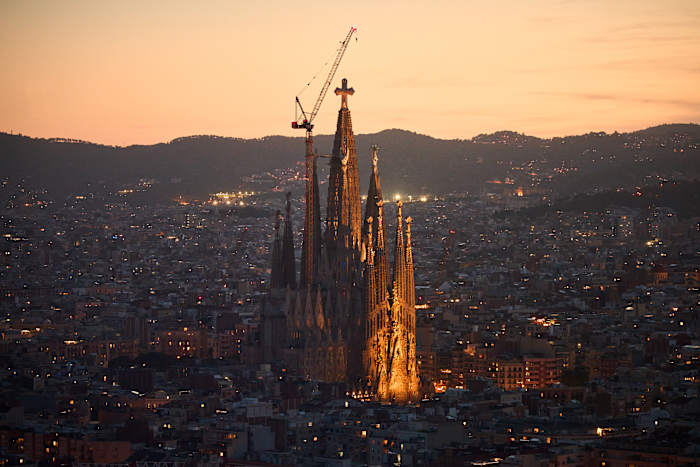
The Pontiff is in Barcelona to mark the centenary of the death of Antoni Gaudí, the legendary architect behind the Sagrada Família. On Wednesday and Thursday, the Pope will visit the newly completed Tower of Jesus Christ at the basilica, which now stands at a massive 172 meters, making it the tallest church tower in the world.
He's also scheduled to visit the Brians 1 prison and the mountain abbey of Montserrat, balancing high-profile architectural celebrations with the gritty social work that defines his public image.
If you want to understand the true spirit of the region during this papal visit, don't just look at the stone spires of the Sagrada Família. Look at the human skyline created in the Olympic Stadium. It proved that in Catalonia, the most impressive monuments aren't built with stone and mortar—they're built with people.
To see this unique cultural phenomenon yourself, keep an eye on local Catalan festival schedules, particularly the upcoming traditional town festivals (festa majors) across the region this summer, where rival groups will attempt even higher, more daring ten-tier towers.