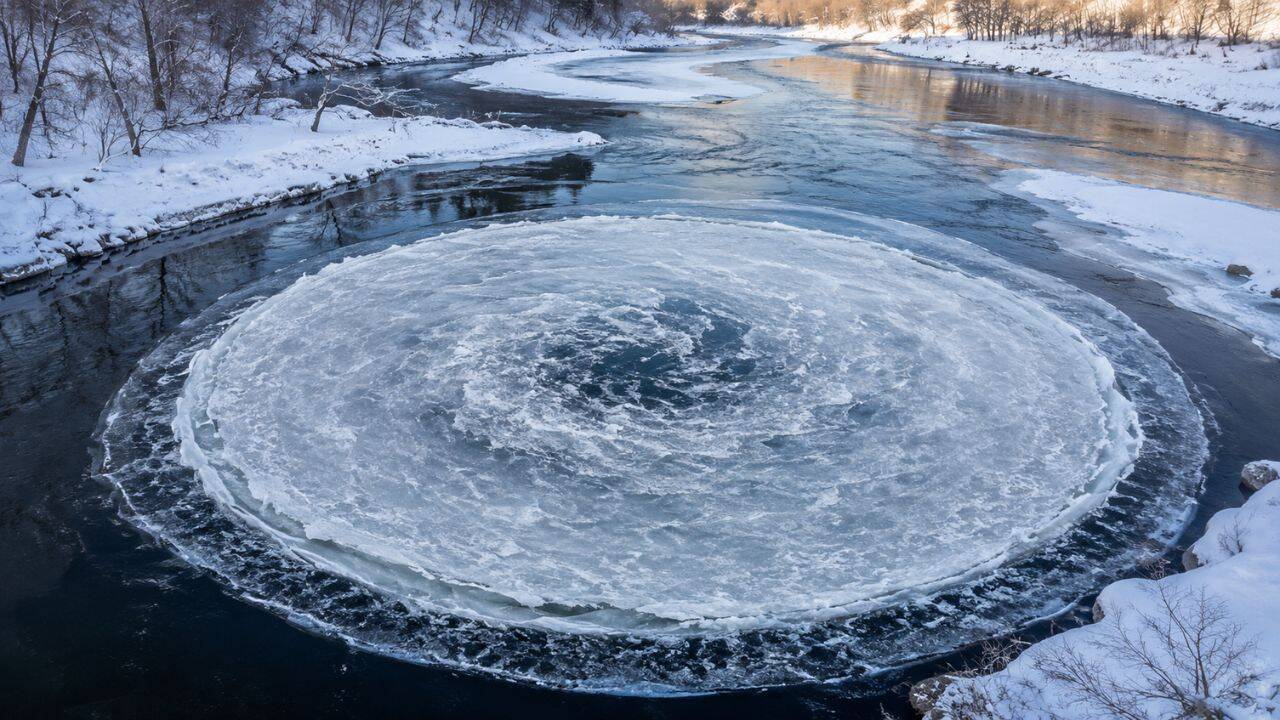
You are walking along a freezing river bank in British Columbia or Quebec in the dead of January, and you see something that looks completely artificial. A massive, perfectly geometric circle of ice is sitting in the water, rotating slowly like a giant vinyl record on a turntable. Some of these discs are the size of a car. Others stretch wider than a football field, turning with an eerie, mechanical precision that makes people instantly whisper about crop circles or alien landings.
For generations, onlookers assumed these spinning ice discs were just a freak accident of river currents. The common wisdom said that a chunk of ice broke off, got caught in a whirlpool, and ground itself round against the riverbank.
That explanation is incomplete.
While river currents definitely help shape these icy structures, they are not the true engine behind the spinning motion. A few years ago, a team of physicists from the University of Liège in Belgium cracked the real code behind this winter phenomenon. It turns out that these giant discs are actually thermal engines. They can spin even when the surrounding water is completely still, driven by a hidden vortex created by the melting ice itself.
If you want to understand how a block of frozen river water turns into a self-propelling turntable, you have to look beneath the surface at a strange quirk in the physics of water.
The Secret Thermodynamic Engine Under the Ice
To understand why ice circles spin, you first have to discard the idea that ice is completely dormant. It is constantly interacting with the water around it.
The breakthrough came when researchers led by physicist Stéphane Dorbolo decided to replicate ice discs in a controlled laboratory setting. They placed small discs of ice in a quiet water bath with zero active current. To keep the ice from drifting away, they embedded a tiny nickel bead into the center of the ice block and suspended a magnet above the water.
Even without a single ripple or current in the tank, the ice began to spin on its own.
When the researchers cranked up the temperature of the water bath, something even stranger happened. The ice did not just melt faster. It spun faster. This shattered the old theory that river currents were the sole driver of the rotation. The driving force was coming from a temperature differential.
The Magic of Four Degrees Celsius
The phenomenon relies entirely on a unique thermodynamic property of freshwater. Most liquids become steadily denser as they get colder until they freeze into a solid. Water does not do this.
Freshwater hits its maximum density at exactly 4°C (39.2°F).
When a sheet of ice floats on top of slightly warmer river water, it begins to melt from below. The melting process cools the immediate layer of water directly underneath the disc. As that subsurface water cools down and approaches that magic 4°C threshold, it becomes heavier and denser than the surrounding river water.
Because it is heavier, this cold water sinks straight down. This creates a vertical downward plume of dense water beneath the center of the ice disc.
How the Hidden Vortex Forms
A column of water sinking vertically through a fluid body cannot remain perfectly stable. As the downward plume develops, it starts to draw in surrounding water from the sides to replace what just sank.
This movement creates a tiny, spiraling underwater vortex. Think of it like the miniature whirlpool that forms when you pull the plug on a full bathtub.
The water beneath the disc begins to rotate horizontally as it sinks. Through the simple mechanism of fluid friction, this spinning underwater vortex grips the bottom surface of the floating ice disc. The water turns first, and the ice is forced to follow.
This means every single melting ice disc on a winter river is essentially generating its own propulsion. The warmer the surrounding water is relative to the ice, the faster that downward plume sinks, the faster the vortex spins, and the faster the disc rotates on the surface.
Why Deep Lakes and Icebergs Do Not Spin
This thermodynamic discovery also answers a question that puzzled geologists for decades. If melting ice creates a spinning vortex, why do we not see massive spinning icebergs in the Atlantic or rotating ice sheets on deep inland lakes?
The researchers tested these environments and found two distinct reasons why the phenomenon fails outside of specific river conditions.
- The Deep Lake Problem: Deep lakes generally maintain a steady temperature of 4°C at their lower depths during the winter months. Because the ambient water is already at its maximum density, the meltwater coming off a floating ice sheet cannot become any heavier than the water below it. Without that temperature gap, no downward plume forms, no vortex triggers, and the ice stays perfectly still.
- The Ocean Salinity Factor: In the ocean, the physics change completely because of salt. When an iceberg melts, the runoff is fresh water, which is naturally less dense than salty seawater. Even if that meltwater is freezing cold, its lack of salt makes it light enough to float right on the surface. Instead of sinking to create a vertical plume, the fresh meltwater just dilutes the top layer of sea water and spreads out horizontally.
How River Currents Shape the Perfect Circle
If thermodynamics explain why the ice spins, we still need to look at fluid mechanics to understand how it gets so perfectly round. Rivers provide a brutal, natural rock tumbler effect that refines these structures over days or weeks.
The birth of an ice circle usually begins with frazil ice. When a river temperature drops below freezing, turbulent water prevents a solid sheet from forming immediately. Instead, millions of tiny needle-like ice crystals called frazil ice develop in the current.
As these crystals bump into one another in slow-moving sections of the river, they begin to clump together into slushy, circular structures known as pancake ice.
The Role of River Eddies
When a large sheet of this young ice gets trapped in a slow-moving whirlpool, or an eddy, the mechanical shaping begins. Eddies typically form behind river bends, fallen trees, large boulders, or bridge pilings where the water flow is forced to loop back against the main current.
As the trapped ice slab is forced to rotate by both the river eddy and its internal thermal engine, its rough edges constantly grind against the surrounding shoreline ice or neighboring ice pans.
Imagine taking a jagged piece of styrofoam and spinning it inside a tight hole. The corners are the first things to get sheared off. Over hours of continuous rotation, this relentless grinding smooths down every single imperfection. What remains is a disc so perfectly circular that it looks like it was carved out by a laser.
Once the disc becomes circular, it operates with incredibly low resistance. It can continue to hover in the same river eddy for days, spinning cleanly without getting jammed against the shoreline.
Notable Sightings Across North America
While these circles can technically form anywhere that experiences harsh winters, Canadian and northern American rivers offer the absolute sweet spot of conditions. They have the right mix of steady flow, prolonged cold, and sudden, mild temperature shifts that trigger the thermal melting engine.
The South Thompson River Giant
In January 2020, residents near Kamloops, British Columbia, noticed a massive ice disc spinning slowly in the South Thompson River. Glaciologists estimated the disc measured roughly 40 meters (130 feet) in diameter.
The disc became a local sensation because the weather conditions were flawless. The air was cold enough to keep the river from completely thawing, but a slight afternoon warming trend provided the exact thermal gradient needed to drive the underwater vortex. The current in the South Thompson River eddy was just gentle enough to keep the disc spinning without tearing its fragile, slushy edges apart.
The Presumpscot River Megadisc
Perhaps the most famous modern example occurred just across the border in Westbrook, Maine, on the Presumpscot River in January 2019. That monster disc measured over 90 meters (approximately 300 feet) across.
It was so massive that it looked like a docked alien mothership. It served as a resting ground for hundreds of ducks and ducks looked like passengers on a slow-moving amusement park ride.
The Presumpscot disc highlighted a key rule of ice circle survival. You need incredibly stable weather. If a major storm hits or river currents surge too quickly, the extreme shear forces will snap the disc in half instantly. The Maine disc survived for days because a prolonged period of dead calm, clear weather allowed the giant structure to maintain its delicate balance.
The Recipe for the Perfect Ice Disc
If you want to hunt for these structures yourself during the winter months, you cannot just look at any frozen creek. You need a highly specific alignment of environmental factors.
- Moderate Below-Freezing Temperatures: The air temperature needs to stay low enough to sustain ice formation, usually between -5°C and -15°C. If it gets too cold, the entire river freezes solid from bank to bank, locking everything in place.
- Active But Gentle Currents: You need a river with enough velocity to create stable eddies behind natural obstructions, but not so fast that the water becomes a raging rapid that breaks up the ice.
- A Subtle Temperature Shift: The most dramatic spinning occurs when a cold snap is followed by a slight warming period. This introduces warmer water beneath the ice, kicking the 4°C density engine into high gear.
- Minimal Wind: High winds push floating ice sheets out of their stable eddies and force them into river banks, destroying the geometry before the circle can finish shaping itself.
How to Find and Photograph One Safely
Finding a spinning ice circle requires a mix of good timing and local scouting. They are rare, fleeting, and highly dependent on the whims of winter weather.
If you are planning to track one down, start by monitoring local winter hiking forums, regional news outlets, or community social media groups in places like Alberta, Quebec, Ontario, or the northern US states. When a large disc forms near a populated area, drone photographers usually spot it within 24 hours.
Look for slow-moving rivers with prominent bends or heavy bridge supports, as these structures naturally create the persistent eddies required to trap a rotating ice slab.
Never step onto an ice circle. Because these discs are constantly melting from underneath to fuel their own rotation, they are incredibly thin and structurally unstable. The edges are often nothing more than compressed slush.
The best way to document them is from a high vantage point, like a river bridge or a safe overlook on a steep bank. If you are photographing one, use a long exposure setting on your camera or shoot a time-lapse video. Because the rotation is often agonizingly slow to the naked eye, a time-lapse will reveal the true mechanical beauty of the underwater thermal engine at work.