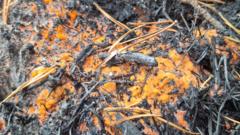
Charred tree trunks and miles of ash usually spell total ecological disaster. When a severe blaze sweeps through a beloved national park or forest, the immediate aftermath looks completely lifeless. Yet, nature has a weird way of surprising us. Weeks after the flames die down, a striking layer of bright orange fire fungus begins to coat the blackened soil and deadwood.
It looks apocalyptic. It feels alien. But it is actually the first concrete sign of biological rebirth.
Nature Has a Secret First Responder
Most people look for green shoots when judging whether a burned forest is healing. Ecologists know better. Long before saplings or wildflowers dare to poke through the ash, pyrophilous—or fire-loving—fungi arrive.
These organisms aren't casualties of the disaster. They are waiting for it. Their spores can remain dormant in the earth for decades, entirely unfazed by extreme heat. The moment a wildfire scorches the terrain, changing the chemical composition of the soil and leaving behind alkaline ash, these microscopic dynamos spring into action.
They bloom into vibrant cups of ochre, pink, and bright orange. Sometimes, they release so many spores at once that the forest floor appears to be smoking all over again.
What Fire Fungus Actually Does All Day
You might wonder how a bright splash of orange helps a ruined ecosystem bounce back. The answer lies in chemistry and soil mechanics.
High-intensity fires create a toxic, water-resistant waxy coating on the earth. Rainwater bounces right off it, leading to severe erosion and dangerous landslides. On top of that, the burned organic matter turns into complex carbon rings and polycyclic aromatic hydrocarbons that most living organisms cannot digest.
Fire fungi chew right through this toxic mess.
- They produce specialized enzymes to break down stubborn charcoal and soot.
- They transform locked-up carbon into bioavailable nutrients that plants can actually use.
- Their sprawling network of thread-like hyphae binds loose dirt particles together, stopping erosion dead in its tracks.
Without these fungi laying the groundwork, natural reforestation would take decades longer. They act as the ultimate ecological prep crew.
Learning From the Scorched Earth
Researchers studying post-wildfire zones are discovering that these fungi hold clues for environmental restoration on a wider scale. Because these organisms naturally process industrial pollutants and toxic hydrocarbons found in ash, scientists are looking closely at how their unique enzymes might be applied elsewhere.
Even more fascinating is the idea of ecological resilience. Some studies suggest that small, controlled burns can act almost like a vaccine for forest floors. They trigger a massive release of fire-fungal spores, preparing the landscape to handle and recover from future mega-fires much faster.
So, the next time you see footage of a blackened park suddenly sprouting vivid patches of orange crust, don't write it off as a weird disease or secondary damage. It is life fighting back from the bottom up.
Keep an eye out for these bright orange patches the next time you walk through a recovering woodland area. Understanding how our ecosystems heal gives us a much clearer picture of how to protect them.