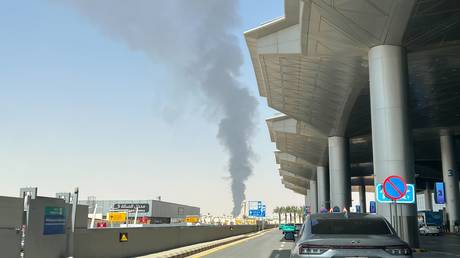
A massive black plume has hung over the Eastside of Los Angeles for six straight days. It isn’t from a typical brush fire or a normal structural blaze. Since Wednesday, June 17, 2026, a 500,000-square-foot commercial cold storage facility in Boyle Heights has been burning inside out. Neighbors are choking on a thick, toxic fog. Local schools have had to move hundreds of children to alternative campuses. Firefighters cannot even set foot inside the building.
The crisis at the Lineage Logistics facility at 1400 South Los Palos Street reveals a massive flaw in how our industrial hubs interface with working-class residential neighborhoods. This isn’t just an isolated accident. It is a structural nightmare. It shows exactly what happens when ultra-dense, insulated commercial mega-structures are built right across the street from family homes.
The Chemistry Behind a Six Day Fire That Cannot Be Extinguished
Most people think a fire gets knocked down in a few hours. That is true for normal wood-frame houses or open commercial shells. This building is a completely different beast.
LAFD Fire Chief Jaime Moore described the structure as a giant cooler. The warehouse is built with corrugated steel walls filled with dense foam insulation, reinforced by interior steel panels. When a fire gets trapped inside that kind of sandwich, the building behaves like a furnace. The thick insulation that keeps 85 million pounds of frozen pork, beef, poultry, and fish at sub-zero temperatures is now trapping the heat and feeding a slow, unstoppable burn.
The initial days of the fire were complicated by a major ammonia line rupture. Ammonia is the standard chemical used in massive commercial refrigeration systems, but it is highly toxic when inhaled. While those localized chemical threats have subsided enough for shelter-in-place orders to drop, the air remains thick with fine particulate matter.
Firefighters are dealing with extreme structural instability. The roof is heavily compromised. It is laden with commercial solar panels, and it has buckled onto 65-foot-tall heavy-duty steel storage racks inside. Sending people in would be a suicide mission. Instead, emergency crews are using heavy excavators to tear off sections of the exterior metal walls, trying to vent the smoke and spray water from a safe distance using massive water cannons.
Air Quality Realities on the Eastside
While the smoke plume is visible from Dodger Stadium and drifts into the Inland Empire, the immediate community of Boyle Heights is bearing the brunt of the pollution. Fine particulate matter, known as PM2.5, has spiked to levels deemed unhealthy and very unhealthy across central Los Angeles County. These microscopic particles bypass your body’s natural filters, getting deep into the lungs and entering the bloodstream.
The impacts are hitting families directly. On Monday, June 22, the Los Angeles Unified School District was forced to relocate several summer school programs to protect children.
- Dena Elementary and Dacotah Early Education Center moved to Sunrise Elementary.
- Eastman Early Education Center moved to Humphreys Elementary.
- Stevenson Middle School shifted its students to Belvedere Middle School.
Local clinics are working on overdrive. Direct Relief deployed 25,000 N95 respirator masks to Clínica Oscar Romero on Monday to get protection directly into the hands of residents. The American Red Cross has set up emergency assistance centers at Pecan Recreation Center and City Terrace Park to give families a place to breathe clean, air-conditioned air.
The Real Problem With Environmental Zoning in Los Angeles
This disaster highlights a massive issue that urban planners have ignored for decades. Boyle Heights is a predominantly working-class, Latino neighborhood that has historically been surrounded by heavy industry, railyards, and major freeway interchanges.
When corporate entities build mega-warehouses right next to residential zones, residents pay the price when things go wrong. Lineage Logistics is the largest temperature-controlled warehouse operator in the world. This specific facility was built recently, in 2018. It even had a smaller fire back in 2024 that was put out quickly. This time, a subcontractor working on the rooftop solar panels reportedly sparked the blaze, and the building's own high-efficiency design made it impossible to control.
Los Angeles Mayor Karen Bass and California Governor Gavin Newsom both declared states of emergency over the weekend to unlock state funding and resources. But declarations don't clear the air. They don't change the fact that an industrial biohazard threat sat feet from bedrooms. The food inside has begun to thaw because the refrigeration is dead, leaving millions of pounds of meat to rot in the summer heat while the shell of the building smolders.
How to Protect Your Family Right Now
If you live in the Los Angeles Basin, especially anywhere east of downtown or downwind in the San Gabriel Valley, you cannot treat this like typical smog. You need to adapt your daily routine until the LAFD can completely douse the core of the warehouse, a process that officials expect will take several more days.
- Keep every window, door, and external vent tightly closed. Run your air conditioner on recirculation mode so you are not pulling in polluted outdoor air.
- Stop exercising outdoors. High-intensity workouts cause you to breathe deeper, pulling fine particulate matter further into your respiratory system.
- Upgrade your indoor filtration. If you don't have a dedicated HEPA air purifier, you can make a temporary one by taping a high-rated furnace filter to the back of a standard box fan.
- Wear an N95 mask if you have to spend extended time outside. Standard cloth masks or blue surgical masks do absolutely nothing to filter out the microscopic PM2.5 particles slicing through this smoke.
You can track real-time local air quality updates through the South Coast Air Quality Management District to know exactly when it is safe to return to normal outdoor activities. Do not rely on visual clarity alone. The smallest, most dangerous particles are often the ones you cannot see.