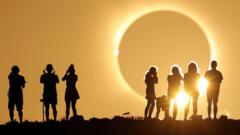
Millions of people dropped what they were doing, grabbed specialized cardboard glasses, and stared anxiously at the sky. A massive solar eclipse swept across the United Kingdom and parts of Europe, turning local parks and mountain ridges into crowded viewing platforms. Headlines screamed about a rare celestial alignment. They called it a once-in-a-generation event.
Let's be honest. Most people walked away slightly underwhelmed.
If you stood somewhere in southern England or parts of Scotland, you didn't get total darkness. You got a dim, slightly eerie afternoon light that felt more like a heavy storm rolling in than day turning into night. Yet, media outlets hyped the spectacle as a profound cosmic reset. Why do we fall for this every single time?
The Reality of Partial Coverage
The mathematics of an eclipse are straightforward, but the human expectation is completely distorted. Across the UK, the Moon covered roughly 84% to over 90% of the Sun. Sounds impressive, right? It isn't.
Astrophysicists will tell you that a 90% partial solar eclipse is visually worlds apart from a 100% total eclipse. The human eye adapts brilliantly to changing light levels. Unless the Sun is completely blocked—meaning totality—you won't see stars pop out in the afternoon or experience the sudden, freezing drop in temperature that defines the real deal. You just get a slightly muted sun that you still can't look at directly without burning your retina.
Special glasses sold out in hours across major cities. Parks filled with hopeful spectators clutching filters. But when the peak arrived around 19:06 BST in places like Edinburgh, the reaction was often a quiet murmur rather than roaring applause. People squinted, took mediocre smartphone photos through cheap filters, and wondered if that was it.
Where the Real Magic Happened
While casual observers in British parks dealt with stubborn cloud cover and muted lighting, a very different story played out further south and west.
Parts of Iceland and remote regions of Spain hit true totality. Tiny rural spots like Avellanosa de Muñó in northern Spain sat directly beneath the path where the Moon completely blotted out the solar disc. Because the event happened close to sunset, those lucky enough to be in the right geographic corridor watched day fade, vanish into totality low on the horizon, and then slide straight into normal evening twilight. That is an entirely different tier of experience.
Spain hadn't seen a total eclipse on its mainland since 1912. That is a genuine century-scale milestone. Lumping that historic event together with a 90% partial dimmer-switch effect in London or Manchester is a disservice to actual science communication. One is a life-changing encounter with orbital mechanics; the other is a reason to wear funny cardboard specs for ten minutes while hoping the clouds part.
Why We Crave Celestial Theater
We live hyper-digitized, hyper-scheduled lives. Any event that forces millions of people to look up at the exact same moment carries immense cultural value, regardless of whether the lighting changes dramatically.
Astronomical societies report massive spikes in engagement during these windows. Parents use them to teach kids basic orbital geometry. Communities gather in public squares. Even a mediocre partial eclipse achieves something vital: it snaps us out of our daily routine. It reminds us that we live on a spinning rock hurtling through a vast, indifferent void.
Even so, the media framing needs a reality check. Calling every partial alignment "once-in-a-generation" cheapens the terminology. True totality loops back around to Europe on August 2, 2027, crossing southern Spain. If you want the real spectacle, book a ticket for that instead of settling for an 85% cloud-filtered twilight over a city center.
Stop treating basic partial alignments like apocalyptic miracles. Next time a major shadow crosses the continent, check the exact percentage map first, manage your expectations, and travel to the path of totality if you actually want your mind blown.