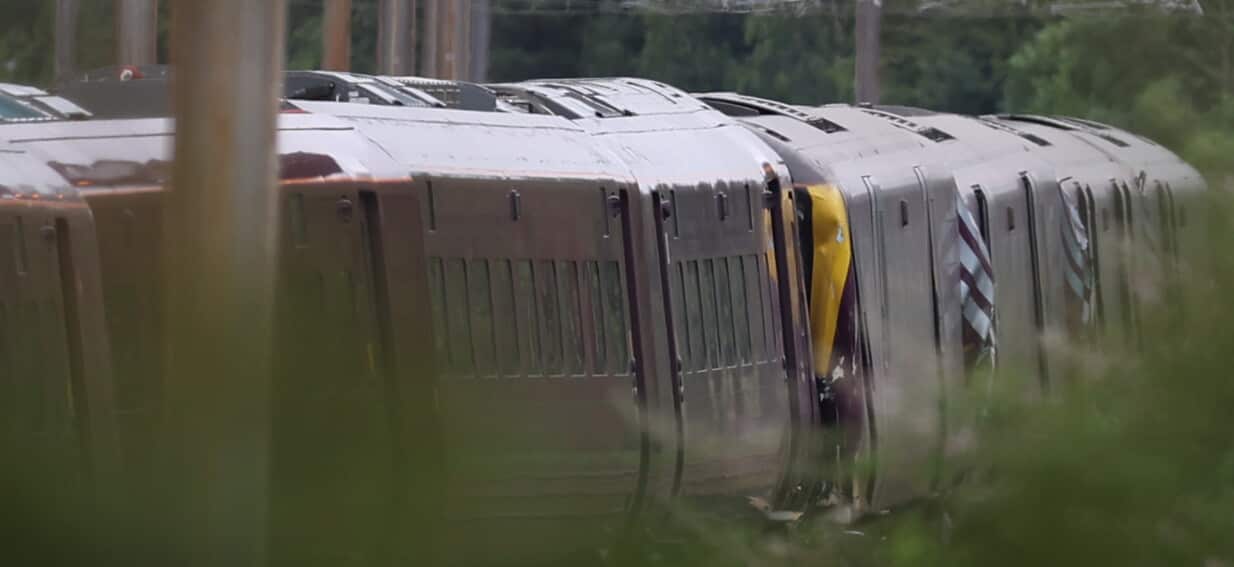
Friday afternoon on the UK rail network is always a hectic scramble. Thousands of commuters and weekend travellers pack into carriages, heading toward London with their minds already on the weekend. But on June 19, 2026, that routine journey turned into a absolute nightmare outside Bedford. Two London-bound passenger trains collided on the exact same track, leaving one driver dead and dozens of passengers with horrific injuries. It is the kind of disaster that simply should not happen in modern rail transit, and it points to systemic vulnerabilities that British transport authorities can no longer ignore.
The crash happened just outside the town of Bedford, about 100 kilometres north of London. Both trains were operating under East Midlands Railway (EMR), heading south toward London St Pancras station. One service had departed from Corby, while the other originated in Nottingham. When they impacted, the force was violent enough to trap passengers, crush driver cabs, and halt the entire Midland Main Line corridor. This was not a minor bump. It was a catastrophic failure of signaling or operational tracking that requires immediate accountability.
The immediate question everyone is asking is straightforward. How do two massive passenger trains end up on the exact same line at the exact same time? Britain has invested billions in train protection and warning systems over the past few decades. Yet, here we are looking at crumpled metal and treating almost a hundred casualties in a field in Bedfordshire.
The Grim Reality of the Bedford Crash Site
The collision occurred in the late afternoon, right as peak travel was getting underway. Emergency services flooded the area quickly, but the scene they discovered was chaotic. The East of England Ambulance Service soon confirmed the worst. The driver of one of the EMR services died from the impact. Beyond that single fatality, 11 people suffered very serious injuries, 22 were diagnosed with serious injuries, and another 56 individuals sustained minor cuts, bruises, and shock.
For the people inside those carriages, the experience was sheer terror. Passenger Pete Knapp described the moment of impact to journalists, noting that he was suddenly flung forward into the seat ahead of him before smoke began filling the carriage. He described scenes of screaming, immense fear, and confusion. He recalled seeing multiple fellow passengers who were completely unable to speak or had visibly broken legs.
Social media footage captured by survivors showed the front of one train tightly entangled with the rear of the other. Remarkably, the carriages managed to stay upright on the tracks rather than derailing into the surrounding fields. If those trains had derailed at speed, the death toll would have been significantly higher.
Breaking Down the Infrastructure Failures
We have to look at the track itself to understand how this happened. The Midland Main Line is a vital artery connecting the East Midlands and parts of Yorkshire to London. It handles a complex mix of fast intercity services, slower commuter trains, and heavy freight traffic. Managing that mix requires absolute precision from signal workers and automated track safety systems.
British trains rely heavily on the Train Protection and Warning System (TPWS). This setup automatically applies a train's brakes if it passes a signal at danger or if it approaches a signal or buffer stop too quickly. There is also the older Automatic Train Protection (ATP) system active on certain routes. If these systems were functioning correctly, a collision of this nature should have been mechanically prevented. The fact that one train slammed into the back of another indicates either a catastrophic equipment malfunction, a severe failure in the signaling control room, or a total bypass of safety protocols.
Investigating officers from the Rail Accident Investigation Branch (RAIB) are already on site collecting data recorders, often called the train's black boxes. They will look closely at the signaling data from the minutes leading up to the crash. Transport Minister Heidi Alexander confirmed an immediate, thorough probe is underway. Prime Minister Keir Starmer also issued a statement, offering his thoughts to the victims' families and thanking the first responders who managed the grim scene.
Immediate Action Steps for Rail Commuters
If you rely on East Midlands Railway or use the Midland Main Line, the fallout from this collision will disrupt your life for days, if not weeks. The rail operator cancelled all services to and from London St Pancras immediately following the crash on Friday. The disruption has spilled heavily into the weekend, with normal schedules completely shattered.
Here is what you need to do right now if you have travel plans through this area.
Check Alternative Routes Immediately
Do not turn up at St Pancras or any northern EMR station expecting a standard service. You must pivot to alternative lines. If you are traveling between London and the Midlands, look into London Northwestern Railway services out of Euston, or Avanti West Coast lines if you are further west. If you are coming from Yorkshire or the wider East Midlands, consider using LNER services out of London King's Cross, which run parallel to the affected region.
Claim Your Compensation
If your journey was delayed by more than 15 or 30 minutes, or cancelled entirely, you are legally entitled to compensation under the national Delay Repay scheme. Keep your physical tickets or your digital booking receipts. EMR is obligated to pay out, and given the scale of this shutdown, processing times might take longer than usual. Do not let them off the hook for ticket costs.
Monitor National Rail Inquiries Regularly
The physical recovery of the trains will take time. Heavy cranes must lift the entangled carriages off the tracks, and engineers will need to inspect the rails, ties, and overhead electric wires for structural damage before any commercial trains can run safely again. Check the National Rail website every few hours before leaving your house.
What This Means for the Future of UK Rail Safety
This disaster smashes the comforting belief that modern UK rail travel is entirely safe from multi-train collisions. While Britain boasts one of the safest rail networks in Europe statistically, incidents like the Bedford crash show that old vulnerabilities remain.
We cannot wait years for an RAIB report to implement basic changes. The government must accelerate the rollout of the European Train Control System (ETCS), a digital signaling standard that provides continuous speed monitoring and prevents trains from entering occupied blocks of track. The current piecemeal upgrade timeline is too slow.
If we keep running trains closer together to meet high capacity demands without updating the underlying safety tech, we are just waiting for the next disaster. The loss of a driver and the trauma inflicted on dozens of passengers outside Bedford must serve as a sharp wake-up call. Safety systems must be bulletproof. Right now, they clearly are not.