Everyone in media wants to talk about artificial intelligence changing the world, but behind closed doors, newsroom leaders are dealing with a much messier reality. Headcounts are shrinking, revenue models are fracturing, and traditional journalism is fighting for survival against algorithmic feeds.
The latest data from the WAN-IFRA State of Asian Newsrooms report, produced alongside Nanyang Technological University's IN-cube, lays out a clear picture of an industry caught between fast-moving tech and stubborn economic pressures. Surveying media professionals across twelve markets including India, Malaysia, Singapore, and the Philippines, the findings reveal deep tensions over AI adoption, creator partnerships, and how to keep journalism funded when pageviews stop paying the bills.
Doing More With Less
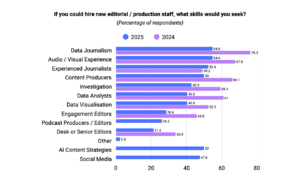
Staffing cuts are still the baseline for many organizations. When the numbers were tallied from responses across 42 media professionals, nearly half reported falling editorial headcounts. At the same time, the wishlist for new hires has shifted dramatically. Newsrooms don't just want general reporters anymore. They want people who can stitch together data, video, audio, and algorithmic tools.
More than half of respondents said they would prioritize data journalism and multimedia skills if given the budget. Yet, funding remains tight, forcing existing teams to shoulder multiple roles. This creates burnout and forces editors into a constant trade-off between daily output and investigative depth.
The Off-Platform Trap
Print readership continues to age out, while digital audiences cluster squarely in the younger demographics. But chasing those younger readers has created a trap.
Most publishers see their strongest audience growth happening off-platform—on social media feeds and aggregators controlled by massive tech companies. While this drives massive top-line numbers, it deepens a dangerous dependence on platforms that can change their distribution rules overnight. The core dilemma hasn't changed: how do you build a sustainable business when your audience lives on someone else's turf? Relying solely on advertising no longer cuts it, yet paywalls and membership models are an uphill battle in markets flooded with free content.
AI: Efficiency Tool, Not Writer
Talk of artificial intelligence replacing reporters is wildly overblown, at least for now. Two-thirds of newsrooms allow generative AI tools, but they are being used for mundane tasks rather than storytelling. Proofreading, transcription, background research, and translation take up the bulk of daily usage. Less than twelve percent use AI to write actual copy.
Trust remains the main barrier. Even though most media professionals agree that AI boosts operational efficiency, a significant majority simply don't trust the quality of the output.
Ethical guidelines are patchy at best. While some organizations have put clear rules in place, others are operating in a grey zone without formal oversight. Using a tool to transcribe an interview is a far cry from letting an algorithm draft a breaking news story, and newsrooms are drawing that line hard.
The Creator Dilemma
Traditional journalists used to look down on independent creators and influencers. Now, nearly half of news organizations are actively working with them or considering it.
Editors recognize that independent creators understand audience psychology and community engagement in ways legacy institutions often fail to grasp. But this relationship brings friction. Many newsrooms worry about creator credibility and standards. The tension highlights an identity crisis inside modern media houses: do you protect the traditional gatekeeper role, or do you adopt the personality-driven formats that audiences actually watch?
Moving Past the Survival Trap
The pressures highlighted in the regional data point to an uncomfortable truth. You can't out-tech a broken financial model. Newsrooms that want to survive the next few years need to stop treating technology as an add-on and start treating it as core infrastructure—while remembering that audiences pay for unique, trustworthy reporting they can't get from an AI chatbot.
Audit your current newsroom workflows today. Identify where your team spends hours on manual tasks that tools can handle safely, and redirect those saved hours into deep, original reporting that builds direct reader loyalty.