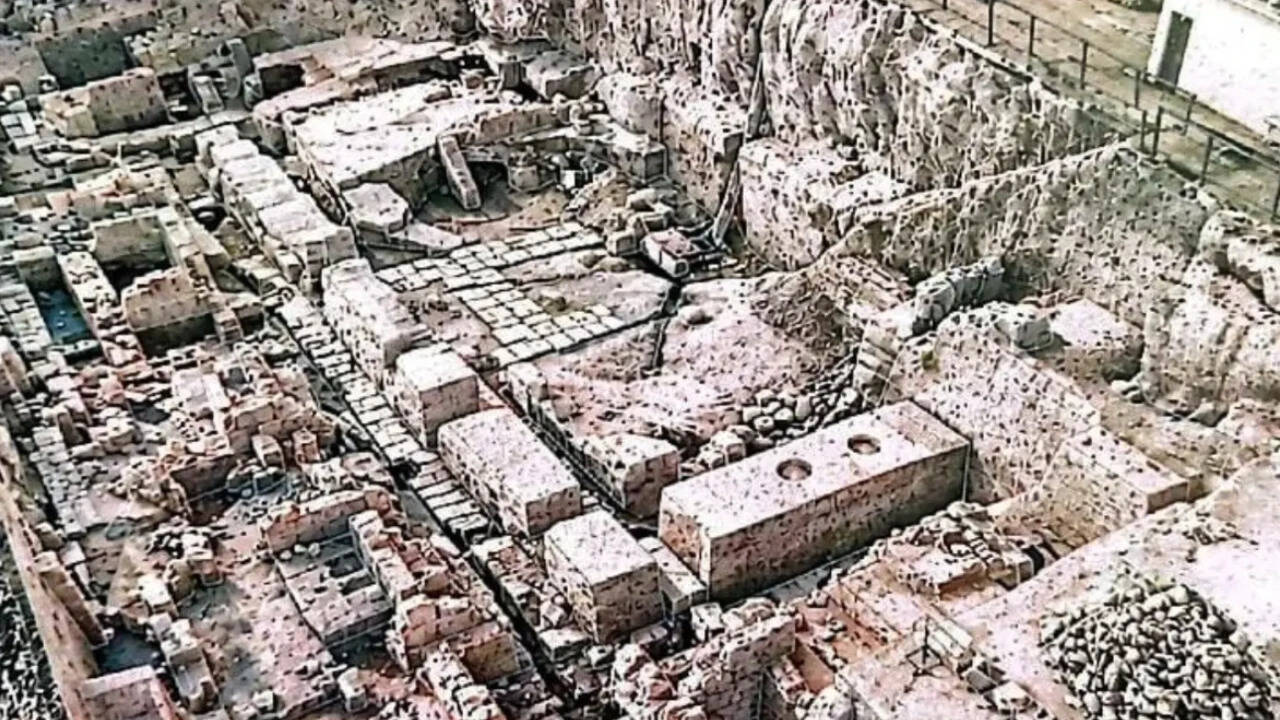
Digging beneath a quiet park in Alexandria, archaeologists hit heavy limestone blocks and a northward passage that immediately got royal-tomb rumors spinning. Slow down. A giant stone base and an underground tunnel in the city's former royal district could point to a Ptolemaic burial complex tied to Ptolemy IV Philopator, yet Egypt's own antiquity officials call that link a preliminary hypothesis, not a settled fact.
Anyone who has followed Mediterranean archaeology for more than five minutes knows how fast headlines jump from "promising stone foundation" to "lost royal tomb." Honestly, it happens almost every time someone turns over a substantial block of stone in Alexandria. In the Shallalat Gardens site, a Greek mission led by Calliope Limneos-Papakosta from the Hellenic Institute for the Research of the Alexandrian Civilization uncovered a square limestone foundation, surrounding walls, and a tunnel running north beneath the building. An Egyptian committee headed by Ayman Ashmawy of the Supreme Council of Antiquities inspected the site and noted its scale and possible funerary character, while stressing that further work is needed to prove what the structure actually was.
Why This Alexandria Royal Quarter Discovery Matters Right Now
Alexandria is a brutal place to do clean, textbook archaeology. Modern apartment blocks rise right over ancient streets, groundwater seeps into lower trenches, and earthquakes plus subsidence over two millennia have tilted or submerged entire districts. Finding intact architectural foundations and a subterranean tunnel in Shallalat Gardens gives researchers a rare anchor point in a city where the ancient map is mostly guesswork.
Think about what the Ptolemaic dynasty built here between 305 and 30 BC. After Alexander the Great died and the Ptolemies took control of Egypt, Alexandria became a powerhouse of Greek kingship, scholarship, and ceremonial display. The royal quarter held palaces, state buildings, and sacred spaces designed to project permanence. When a heavy square base shows up with enclosing walls and a hidden passage underneath, archaeologists pay attention because monumental tombs, shrines, and fortified complexes often share that kind of deliberate massing.
Yet scale alone doesn't name a king. A tall, thick-walled structure could support a funerary monument, a temple platform, or another major civic building. Without inscriptions, unmistakable burial assemblages, or clear stratigraphy tying the passage directly to a royal chamber, calling it a confirmed tomb before the digging finishes is just wishful thinking.
What Was Actually Found Beneath Shallalat Gardens
Let's stick strictly to what the excavation and committee review actually tell us so far. The team uncovered a square-shaped foundation constructed from limestone blocks, flanked by walls surrounding the structure, with a tunnel extending northward beneath it. That layout immediately raises practical questions for anyone reading field reports. Why build a heavy square base in this spot? Why run a tunnel north underneath it?
In ancient urban planning, subterranean tunnels served plenty of purposes. Some were ritual or ceremonial passages, some connected structures or moved water and access beneath crowded ground, and some belonged to tomb complexes. In Shallalat Gardens, the combination of a substantial limestone foundation, surrounding walls, and a northward tunnel gave specialists enough reason to consider a funerary function and explore a possible connection to the Ptolemaic royal burial tradition.
Still, there's a big gap between "worth investigating as a royal funerary structure" and "we found the tomb." Ayman Ashmawy and the committee—which included Greek and Roman history and archaeology specialists from Alexandria and Tanta universities—treated the connection as an early hypothesis to test, not a trophy to mount on the wall. That caution is smart science, even if it makes for less dramatic headlines.
The Ptolemy IV Philopator Connection and Strabo's Clues
Whenever a Ptolemaic funerary site comes up in Alexandria, historians and readers immediately look for names and texts. One name mentioned in connection with the site's possible funerary link is Ptolemy IV Philopator, a ruler of the Ptolemaic line that governed Egypt until Cleopatra VII's reign ended with the Roman conquest in 30 BC. Another essential reference is the ancient Greek geographer Strabo, who described the Sema in Book XVII of his Geography—an enclosure within the royal palace complex holding the burials of the kings and Alexander the Great.
Strabo's account is famous for a reason. He gives us a literary blueprint of how the royal quarter and its burial precinct were imagined in antiquity. The problem is that ancient literary descriptions rarely map cleanly onto modern street grids without hard physical proof on the ground. Centuries of rebuilding, reuse of stone, and urban expansion mean you can't just lay Strabo's words over a modern garden like tracing paper and expect every wall to line up.
Here is where hands-on archaeological judgment really shows its value. In cities with dense layers of occupation, teams often find architectural puzzle pieces across years or decades before they lock together. The Hellenic Institute for the Research of the Alexandrian Civilization has spent roughly twenty years excavating at Shallalat Gardens—a span highlighted in the Bibliotheca Alexandrina Antiquities Museum's exhibition announcement Twenty Years of Excavations at Shallalat Gardens (2006–2026)—turning up earlier clues like a Hellenistic statue possibly representing Alexander the Great, remains of a monumental public building, stretches of Roman and Hellenistic Royal roads, and a large subterranean tunnel.
Notice the pattern there. One discovery doesn't solve Alexandria overnight. Each trench adds another coordinate to a sprawling ancient city.
Common Myths About Lost Tombs in Alexandria
Whenever news breaks about a tunnel and big limestone blocks in Egypt, a few predictable misconceptions pop up right away. Clearing them out saves a lot of confusion.
- Myth 1: A hidden tunnel automatically leads to a sealed royal burial chamber. Tunnels under ancient buildings had varied functions, and even when a structure has funerary ties, passages can be disturbed, robbed in antiquity, flooded, or linked to adjacent complexes rather than a single intact royal vault.
- Myth 2: If a site sits in the royal quarter, it must hold Alexander the Great or Cleopatra. The royal quarter was a major political, palace, and ceremonial zone across roughly three centuries of Ptolemaic rule. Lots of monumental structures stood there, and most remain unlocated or only partially traced.
- Myth 3: An official committee reviewing a tomb hypothesis means the identity is settled. Scientific committees evaluate architecture and set research priorities. Ayman Ashmawy's point that the identification remains a preliminary hypothesis means the evidence hasn't crossed the finish line yet.
- Myth 4: Ancient Alexandria is frozen intact just waiting for a shovel. In reality, modern Alexandria sits on top of much of the ancient city, while other sections slipped below sea level. Archaeologists work around active urban life, high water tables, and fragmented remains.
Why Archaeologists Disagree on Early Identifications
You don't have to look hard to see why experts sometimes debate early interpretations in Alexandrian archaeology. Some researchers see strong architectural or topographical reasons to test links to royal monuments and Strabo's Sema precinct. Others urge strict restraint until stratigraphy, inscriptions, pottery, or structural joins leave zero doubt about date and function.
Neither side is acting out of bad faith. Conservatism protects the historical record from false certainty, while bold hypotheses help teams decide where to focus scarce time, funding, and technical surveys. In a place like Shallalat Gardens, where two decades of work have already shown layered streets, public architecture, and underground passages, careful hypothesis-testing is the only honest way forward. You can read more official context through Egypt's State Information Service and track broader archaeological reporting via Archaeology Magazine.
Practical Next Steps for Following the Dig
If you want to track this story without falling for clickbait or overblown claims, take a few practical steps.
- Watch for primary ministry and mission updates. Look for follow-up reports from Egypt's Ministry of Tourism and Antiquities, the Supreme Council of Antiquities, and the Hellenic Institute for the Research of the Alexandrian Civilization rather than second-hand social media summaries.
- Separate architecture from attribution. Pay close attention to what is physically verified—limestone foundations, enclosing walls, tunnel direction—versus who or what a structure might belong to.
- Check the broader Shallalat Gardens context. Read up on the multi-year excavation history at Shallalat Gardens, including Hellenistic and Roman road lines and earlier finds, so you see how this foundation fits into the wider urban layout.
- Expect slow, methodical verification. Real archaeological confirmation takes excavation seasons, documentation, and peer review—not overnight certainty.