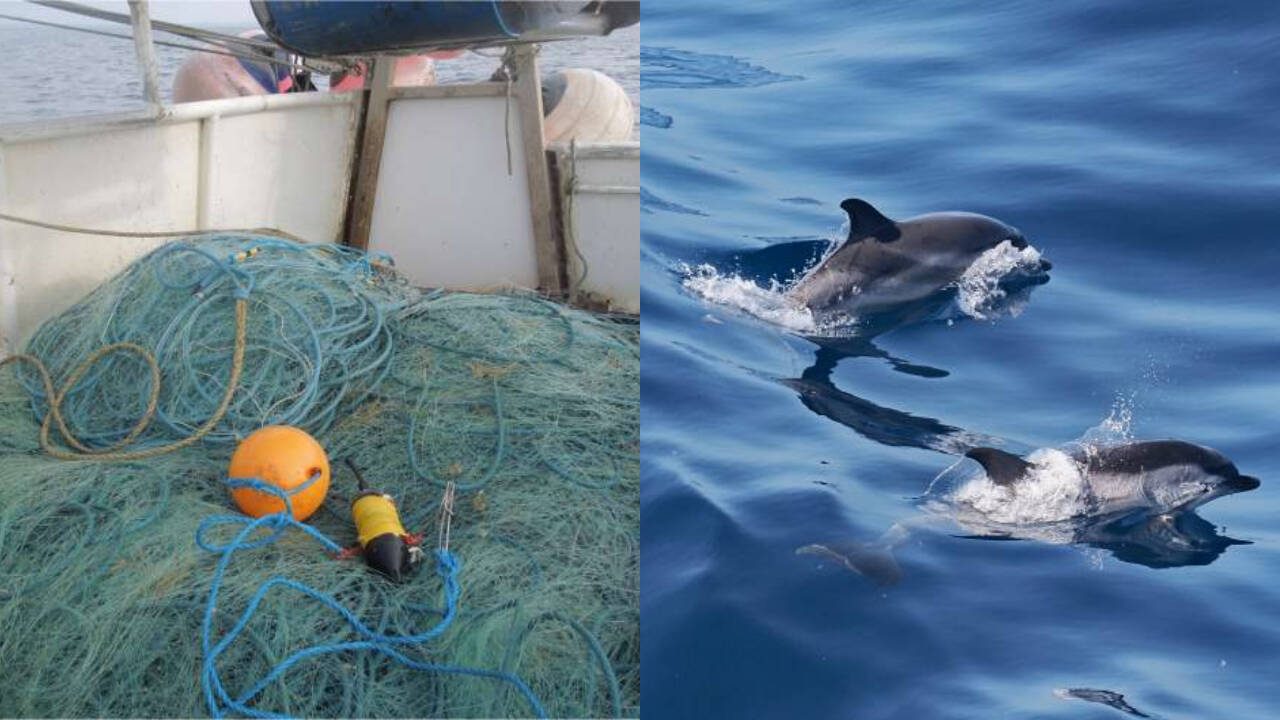
Capturing marine mammal behavior underwater is notoriously difficult, but a recent breakthrough off the coast of Cornwall has given scientists an unprecedented look at how harbor porpoises react to fatal fishing gear entanglements. Researchers from the University of St Andrews' Sea Mammal Research Unit and the Scottish Oceans Institute published a study on August 26 in Royal Society Open Science detailing a rare event: passive acoustic monitoring systems accidentally recorded two harbor porpoises interacting with a static gill net, culminating in an entanglement and an exchange of acoustic signals.
Bycatch remains the single greatest direct human-caused threat to cetaceans globally. In the UK alone, approximately 1,000 porpoises lose their lives annually after becoming trapped in static fishing nets. Because thousands of kilometers of commercial fishing gear are deployed across coastal waters at any given time, documenting these tragedies as they unfold has historically been almost impossible. Dr Jamie Macaulay, lead researcher on the project, noted that the statistical odds of stationary sensors capturing a bycatch event right as it happens are remarkably slim. Yet, this exact stroke of acoustic luck has opened a window into an otherwise hidden crisis.
What the Acoustic Data Actually Shows
The deployment involved sensors placed on a static gill net to monitor general marine animal activity. Audio and movement logs revealed two harbor porpoises foraging near the gear for several minutes. They clearly recognized the obstacle, swimming around it rather than colliding with it blindly. Marine biologists speculate that while chasing active prey, one animal momentarily lost spatial awareness, drifted too close, and became hopelessly snagged.
Once trapped, the porpoise generated enough physical force to strain and snap parts of the synthetic webbing, but failed to break free entirely. What makes this recording historically significant is the audio accompaniment. As the struggle unfolded, the sensors picked up distinct acoustic exchanges between the trapped animal and its companion swimming nearby. Experts suspect these vocalizations functioned as distress calls, though decoding the exact message encoded within these clicks and whistles requires deeper behavioral analysis.
The Brutal Reality of Static Net Bycatch
You might wonder why these agile animals get caught at all if they possess advanced echolocation. Echolocation works brilliantly for bouncing soundwaves off hard surfaces, but fine monofilament or multi-filament nylon netting can have a notoriously low acoustic profile. To a porpoise scanning a murky seabed for fish, a static net can look like open water until it's too late.
When a small cetacean enters a panic state inside a net, its swimming speed and physiological stress response accelerate the tragedy. Even if the animal isn't drowned immediately, the physical constriction stops respiration or causes fatal exhaustion. Around the UK, conservation groups and independent watchdogs estimate the annual mortality toll to be devastatingly high. Programs like the UK Bycatch Monitoring Program work tirelessly to quantify these numbers, but reactive counting isn't stopping the bleeding.
How to Fix Gear Conflicts Without Crushing Fisheries
Stopping coastal fishing isn't a realistic economic path forward for small coastal towns that rely on static-net fisheries for their livelihoods. Instead, engineers and marine biologists are collaborating on practical mitigation gear modifications that keep nets functional while protecting wildlife.
- Acoustic Reflector Integration: Modifying net materials to bounce back stronger echolocation signals gives porpoises an early warning system long before physical contact happens.
- Biomimetic Deterrents: Deploying specialized acoustic pingers that emit warning signals tailored to deter porpoises without driving away target fish species.
- Breakaway Panels: Redesigning structural net seams to rupture under the distinct weight threshold of a marine mammal while holding firm against standard commercial fish catches.
These technical solutions require active buy-in from commercial fishers. Conservationists emphasize that villainizing the fishing industry fails to achieve results; instead, partnerships through initiatives like CIBBRiNA are building equipment upgrades that make oceans safer without breaking local economies.
Listening to the ocean changes how we measure human impact. Capturing these brief, haunting audio logs from Cornwall proves that our marine ecosystems are constantly signaling distress. Turning those faint underwater echoes into actual policy changes is the real test ahead.