Museum basements are full of secrets. Most people assume every major discovery happens out in the field under a blazing sun or amidst freezing winds. That's a myth. Millions of specimens sit in storage archives around the globe, quietly waiting for someone with the right expertise to take a second look.
That just happened in Cambridge, and it completely alters our map of prehistoric life.
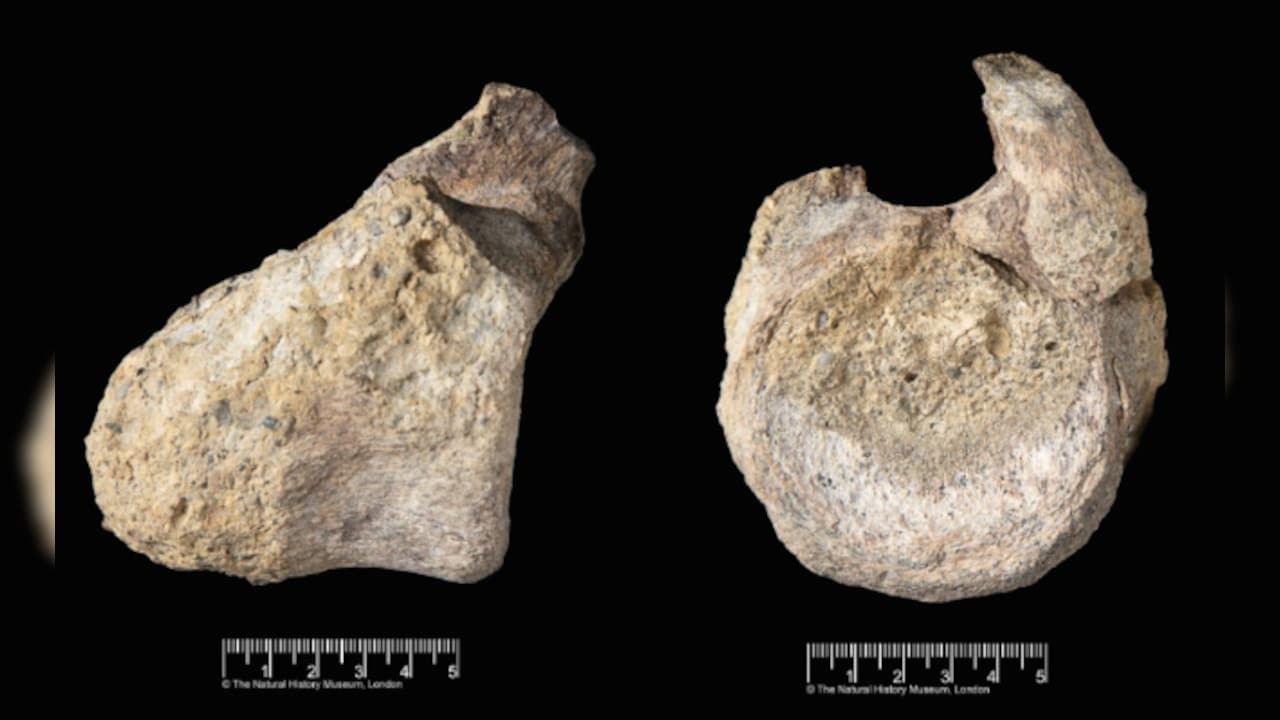
An unassuming, lumpy grey bone sat in a storage drawer at the British Antarctic Survey (BAS) for roughly 40 years. Collected in December 1985, it was recently pulled out, examined by specialists, and officially identified as a tail vertebra from a titanosaur. This means a routine archival sort revealed what is actually the first dinosaur fossil ever discovered on the Antarctic continent.
The Cold Case of the 1985 Discovery
The story starts on December 9, 1985. The late geologist Dr. Mike Thomson was mapping rock layers on James Ross Island, located on the Antarctic Peninsula. His primary mission wasn't hunting for dinosaurs. He was tracking marine rock formations to help future scientists date regional finds.
Thomson spotted a 10-centimeter-wide bone embedded in the Santa Marta Formation. He sketched it neatly in his field notebook, labeling it a "vertebra of large reptile."
Because the Santa Marta Formation is a marine rock layer—meaning it formed on an ancient seabed—Thomson and his team logically assumed the bone belonged to a prehistoric marine reptile, like a plesiosaur or mosasaur. They boxed it up, shipped it back to the United Kingdom, and filed it away in the massive BAS geology collections. Thomson passed away in 2020, never knowing the true identity of his find.
Spotting a Giant in a Cabinet Drawer
The breakthrough happened when Dr. Mark Evans, a paleontologist and the current collections manager at BAS, was working through the archives. He looked closely at the 10-centimeter bone and noticed structural details that didn't match a marine reptile. It looked distinctively like a terrestrial dinosaur.
Evans reached out to Professor Paul Barrett, a renowned dinosaur specialist at the Natural History Museum in London.
The bone possessed a highly specific architectural design: a deep hollow on one end and a distinct, rounded bump on the other. This structure allowed the tail bones to lock together in a sequence of ball-and-socket joints.
Barrett recognized it instantly. That specific combination of features is a anatomical signature unique to titanosaurs. The research, co-authored by Evans, Barrett, and Dr. Matt Lamanna of the Carnegie Museum of Natural History, was just published in the scientific journal Acta Palaeontologica Polonica.
Reconstructing a Tiny Titan
Titanosaurs belong to the sauropod family—the long-necked, plant-eating giants that include the largest land animals to ever walk the Earth. Some species grew to weigh over 15 tonnes.
This specific Antarctic resident was different. Based on the dimensions of the tail bone, scientists estimate this individual was only about 6 to 7 meters (23 feet) long.
Estimated Titanosaur Length: 6–7 meters (23 feet)
Fossil Width: 10 centimeters
Age of Rock Layer: ~82 million years old (Late Cretaceous)
There are two possibilities for its modest size. It could have been a young juvenile that died before reaching full growth. Or, it might represent a smaller, specialized species that bucked the trend of massive sauropod gigantism.
Why a Land Giant Sunk to the Bottom of the Sea
You might wonder how a land-dwelling, leaf-eating dinosaur ended up trapped in a marine rock formation filled with ancient sea life like ammonites.
It comes down to a well-known paleontological phenomenon called "bloat and float."
When a land animal died near an ancient coastline, its body could be swept out to sea during severe storms or flooding. As decomposition took hold, gases filled the torso, causing the carcass to float like a raft. Eventually, scavengers tore the remains apart, or the gas escaped, causing individual bones to sink to the muddy ocean floor where marine sediments quickly buried them.
When Antarctica Was a Lush Green Escape
Finding a titanosaur in Antarctica challenges our modern perception of the icy continent. Eighty-two million years ago, during the Late Cretaceous Period, Antarctica wasn't a frozen wasteland. It was covered in lush, temperate forests.
Heavy volcanic activity during this era pumped massive amounts of carbon dioxide into the atmosphere, creating an intense global greenhouse effect. The region was incredibly warm and hospitable compared to the miles of thick ice sheets covering it today.
Redrawing the Prehistoric Map
This rediscovery solves a massive geographical puzzle regarding how dinosaurs migrated across the southern hemisphere.
During the Cretaceous, the supercontinent Gondwana was breaking apart, but several landmasses remained connected. Paleontologists have found plenty of titanosaur fossils in South America, but the record drops off significantly elsewhere. Australia has no confirmed titanosaur fossils, and New Zealand has only yielded highly limited, ambiguous evidence.
The confirmation of a titanosaur in Antarctica proves these animals were present at the bottom of the world. It strongly indicates that the Antarctic Peninsula acted as an active prehistoric land bridge, allowing these large herbivores to march directly from South America into the regions that now make up New Zealand, bypassing the Australian landmass entirely.
The Next Steps for Paleontology
This find proves that major scientific breakthroughs don't just require expensive field expeditions into uncharted territories; they require investing time and resources into looking at what we've already collected.
If you want to track how this discovery changes our understanding of dinosaur evolution, monitor the upcoming geologic mapping projects scheduled for the Antarctic Peninsula. As modern ice cover retreats due to rising global temperatures, new rock layers are becoming exposed for the first time in millennia. Keep an eye on the open-access database updates from the British Antarctic Survey and the Natural History Museum, London, as research teams prepare to revisit James Ross Island to search for the remaining pieces of this ancient migration puzzle.