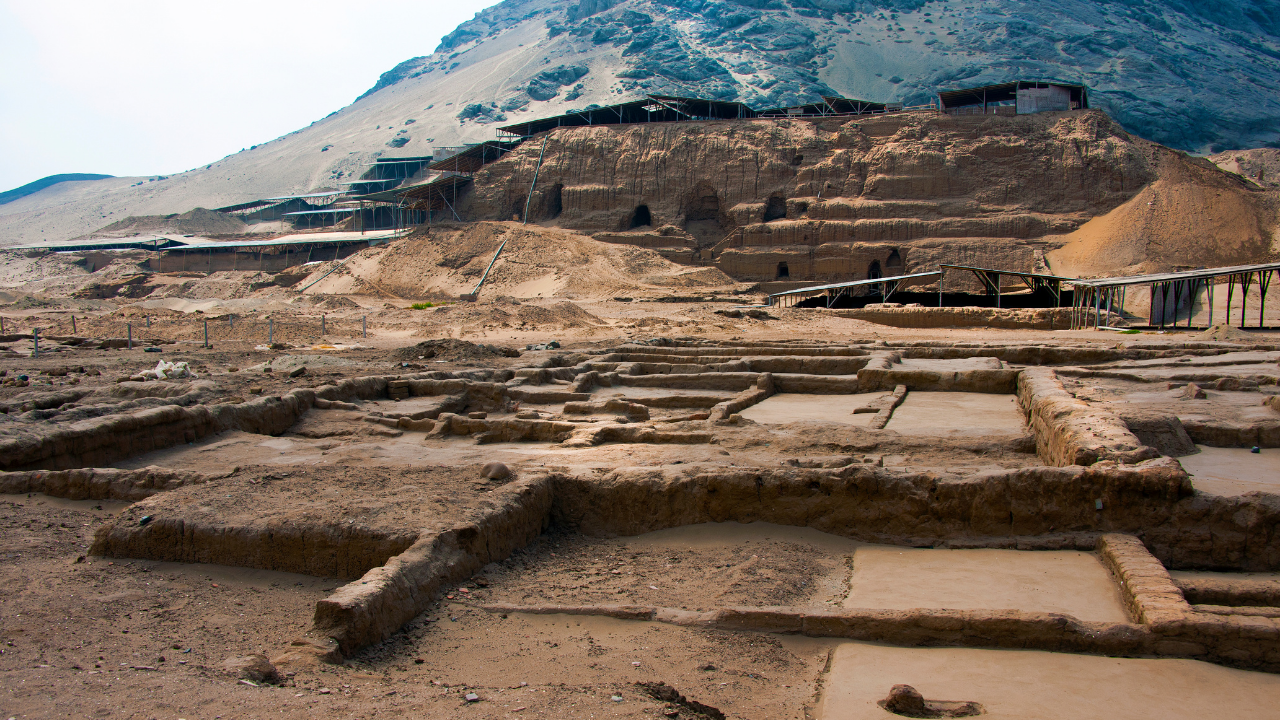
Most people think ancient archaeology is just about giant temples and royal gold. They forget about the ordinary lives left behind. Archaeologists working at the Huacas de Moche site in northern Peru recently uncovered a 1,500-year-old child burial that shatters simple assumptions about pre-Columbian death rituals.
The child was roughly 1.5 years old. Excavated within Architectural Complex 61 in the southern sector of the Moche urban core, this grave tells a gritty story of domestic life and ritual practices far away from the massive tourist pyramids.
Inside the Moche Residential Core
You won't find this grave tucked away inside a grand ceremonial monument. Instead, it surfaced right in the middle of a gritty residential zone.
Archaeologist Jermi Mejía López directed attention to the precise layout. The infant rested in a reclining position, head facing south and legs pointing north. That specific orientation matches traditional Moche burial patterns, even though finding a child this young buried in a domestic neighborhood rather than a temple is rare.
Project director Carlos Rengifo points out that studying these spaces reveals how everyday people lived and died. Domestic pottery fragments recovered alongside the grave show signs of daily meals, kitchen trash, and household chores. It's a raw look at an ancient neighborhood.
The Mystery of the Grave Goods
Four distinct items accompanied the toddler into the afterlife:
- Two ceramic whistles
- A clay rattle
- A striking sculptural vessel
People love to call these objects toys. Real archaeologists hate that assumption. We simply don't know if these sound-making objects belonged to the child as playthings or served a purely ritual function to guide the soul.
Calling every ancient small object a toy is lazy. Sound carried immense symbolic weight in Andean cultures. Whistles and rattles might have been meant to ward off malevolent spirits or provide comfort during a terrifying cosmic transition.
Protecting History from El Niño
Archaeology isn't just about digging holes. It's about keeping history safe from the weather.
The team plans to backfill the excavation pit with clean sand once documentation wraps up. Why? Because heavy rainfall driven by the El Niño phenomenon threatens to wash away fragile adobe walls and ruin the stratigraphy.
If you're ever visiting Trujillo, remember that the true heartbeat of the Moche civilization isn't just found in museums. It's buried under the floors where ordinary families cooked their dinners a millennium and a half ago.
Look closer at the dirt. That's where history actually happens.
An ancient child's grave with grave goods in Peru
This short video provides a quick visual look at the 1,500-year-old Moche child's grave discovered in Peru along with its accompanying artifacts.
http://googleusercontent.com/youtube_content/1