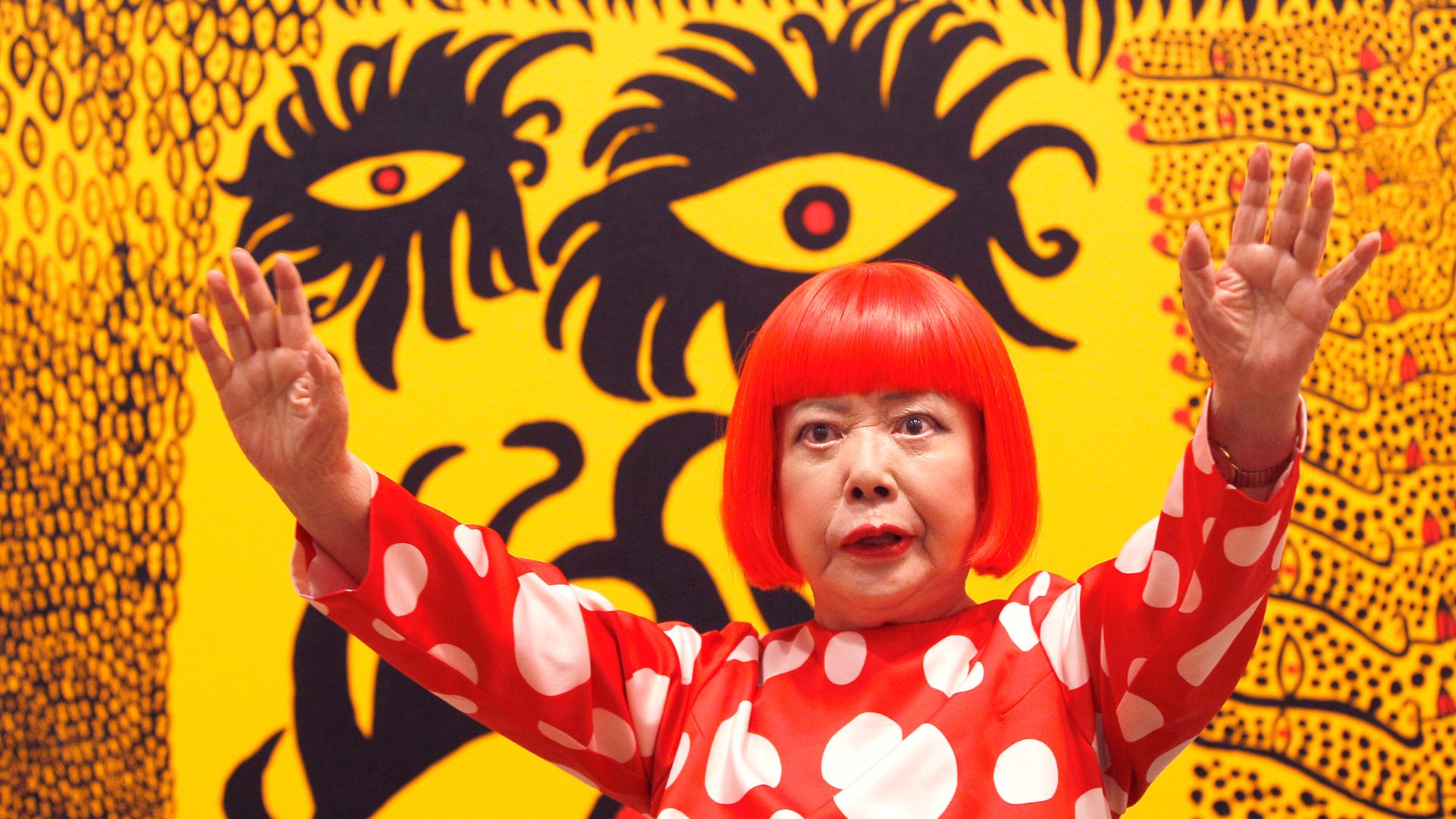
The art world lost its most vibrant icon when Yayoi Kusama passed away in a Tokyo hospital at the age of 97. Most mainstream obituaries reduce her to a quirky Instagram backdrop of polka dots and mirrored rooms. That is a massive mistake. Kusama wasn't just a purveyor of whimsical aesthetics. She was a fierce survivor, an avant-garde disruptor, and a relentless creator who spent eight decades weaponizing her own psychological pain to build universes that swallowed entire galleries whole.
Born in Matsumoto, Japan, in 1929, Kusama began drawing her signature nets and dots as a young girl to cope with terrifying visual and auditory hallucinations. Those dots weren't a stylistic choice. They were a shield. When she moved to New York in 1958, she entered a male-dominated art scene that routinely cannibalized her ideas. Artists like Andy Warhol and Claes Oldenburg drew heavy inspiration from her soft sculptures and immersive environments, yet she struggled for decades to gain the commercial recognition and financial stability she deserved. She didn't care about playing the polite gallery game. She staged unauthorized protests at the Venice Biennale in 1966, floating 1,500 plastic silver spheres on a lawn and offering them to buyers for two dollars each, mocking the naked commercialism of the elite art market.
Her resilience defines her true legacy. By the 1970s, exhausted and battling severe health struggles, she returned to Japan and voluntarily checked herself into a psychiatric hospital in Tokyo, where she lived for the rest of her life. Many thought her career was effectively over. They were dead wrong. From her studio across the street from the hospital, she kept painting, writing poetry, and crafting sprawling installations. She didn't let institutional walls or mental illness silence her. Instead, she treated her art as a daily survival ritual, painting until her final days without ever putting down her brush.
In the 21st century, public appetite for her kaleidoscopic visions exploded into a global phenomenon. Millions queued for hours just to catch a fleeting glimpse of her Infinity Mirror Rooms, eager to experience that dizzying sensation of absolute boundlessness. Her market value skyrocketed, with paintings fetching millions at auction, cementing her status as one of the highest-earning living female artists in history before her passing. Even in recent years, she unveiled massive permanent installations like her metallic sphere sculpture Infinite Accumulation outside London's Liverpool Street Station.
If you want to understand how an artist breaks through rejection, sexism, and personal torment, look closely at Kusama's trajectory. She didn't wait for permission to change culture. She just kept repeating her motifs until the entire world had no choice but to see through her eyes.
Don't remember her as a meme or a filter. Remember her as a titan who turned inner chaos into eternal light.