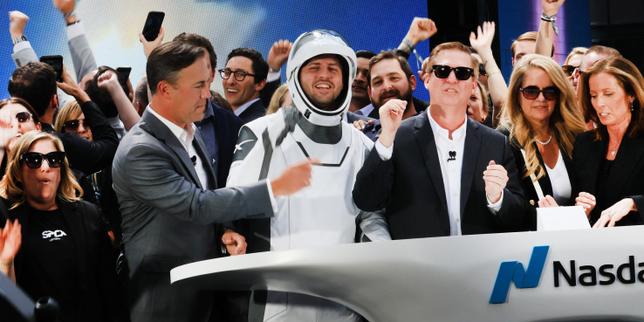
When SpaceX went public, retail investors saw a ticket to Mars. Wall Street saw a balance sheet overflowing with orbital promises, astronomical capital expenditure, and a massive bet on artificial intelligence.
The narrative selling the stock was pure science fiction made real. The financial results, however, are grounding everyone fast. You might also find this related story insightful: Why The Coming Wave Of Aging Homeowners Won't Save First-time Buyers.
If you look past the rocket landing livestreams, the raw numbers tell a wildly different story about where the cash actually goes, why the core launch business isn't the primary moneymaker, and why the company's valuation hangs on a thread.
Here's what is really happening behind the scenes at SpaceX and why the market reacted so violently to its quarterly filings. As reported in latest reports by Bloomberg, the implications are significant.
The Illusion of the Launch Empire
Everyone associates SpaceX with Falcon 9 rockets blasting off from Cape Canaveral. The visual of two booster stages landing in unison remains unmatched. Yet, as a standalone business, rocket launching is essentially a low-margin utility constrained by physical space and pad capacity.
Commercial space launch brings in roughly $5 billion a year. That sounds like a lot until you realize the sheer amount of steel, propellant, engineering hours, and regulatory friction required to haul hardware into orbit.
Worse, Falcon 9 can't even offer its full capacity to paying customers anymore.
Why? Because SpaceX consumes its own capacity. The vast majority of launch slots are reserved for internal payloads: Starlink internet satellites. The core launch engine effectively acts as an internal cost center serving a completely different business model.
If SpaceX were just a rocket company, its valuation would look like a traditional aerospace defense contractor—somewhere near Boeing or Lockheed Martin. It wouldn't command a trillion-dollar price tag.
Starlink Is the Real Engine
Starlink is where the actual money lives. Converting over 10 million satellite internet subscribers into monthly recurring revenue gives SpaceX the financial profile of a high-growth SaaS platform rather than a metal-bending manufacturer.
Business Segment     Revenue Profile           Cash Flow Impact
-------------------------------------------------------------------------
Starlink Internet    $15B - $20B Subscription   Highly Positive
Commercial Launch    ~$5B One-time Contracts    Moderately Positive
Government/Defence   ~$3.2B Fixed Contracts     Stable
Starlink accounts for the bulk of top-line growth. Consumer terminals, maritime connectivity, and aviation Wi-Fi produce steady, predictable subscriptions. Operating margins here look great on paper.
Without Starlink's cash generation, the rest of the company's futuristic bets would collapse under their own weight.
Yet, even Starlink's impressive subscription cash flow isn't staying in the bank.
The AI Cash Burn Machine
In early 2026, the corporate structure transformed dramatically when SpaceX formally absorbed xAI. The pitch sounded brilliant: build "orbital data centers" powered by unfiltered space solar energy, bypassing terrestrial power grids and environmental restrictions entirely.
Investors initially bought the hype, driving valuations into the stratosphere.
Then the earnings reports landed.
SpaceX dropped more than $15 billion in capital expenditure in a single quarter, with over 75% of those funds swallowed directly by AI infrastructure and compute hardware. The company posted a net loss over $500 million for the quarter despite recording nearly $8 billion in revenue.
Quarterly Capital Expenditure Allocation
=======================================
AI Infrastructure (xAI):  76%
Starlink Fleet Expansion: 14%
Rocket Infrastructure:    10%
Starlink's hard-earned profit is essentially being funnelled into the black hole of global AI training wars. Wall Street hates cash drains without near-term visibility. It doesn't matter how revolutionary orbital compute sounds if it burns through billions every three months before producing a dollar of actual server revenue.
Starship Is the Ultimate Bottleneck
The entire thesis for space-based data centers and massive broadband growth relies on one vehicle: Starship.
Starship is designed to lift massive payloads at a fraction of Falcon 9's cost per kilogram. Without Starship operating at high cadence, you cannot launch the massive Next-Gen Starlink satellites, nor can you place heavy GPU clusters in low Earth orbit.
The physical reality is stubbornly complex.
Starship is still stuck in test flight phases. Reusability at scale, rapid turnaround times, and orbital refueling are complex engineering problems that take years of trial and error to master.
Wall Street priced SpaceX as if thousands of Starships would be flying routinely by next year. The operational reality suggests a much slower ramp. Every month Starship remains in development, the return on investment for the company's grandest ambitions gets kicked further down the road.
What Happens Next for Investors
If you hold shares or are thinking about buying the dip, you need a realistic mental model for how this plays out. Stop looking at sci-fi presentations and watch three specific metrics instead:
- Starlink ARPU and Churn: Track whether Starlink can maintain high average revenue per user as it expands into lower-income global markets.
- CapEx Stabilization: Watch if AI infrastructure spending drops back to manageable levels or continues to swallow all operating cash flow.
- Starship Orbital Payload Milestones: Forget test flight spectacles. Look for the first commercial payload deployment and orbital refueling success.
SpaceX isn't going bankrupt. Starlink ensures the company has a massive, defensible cash engine that legacy competitors like Arianespace or Blue Origin can't match.
However, trading at tech-monopoly multiples while spending like an industrial utility is a recipe for volatility. Until Starship flies routinely and the AI spending produces real income, the stock will remain a battleground between futuristic hope and cold, hard accounting.