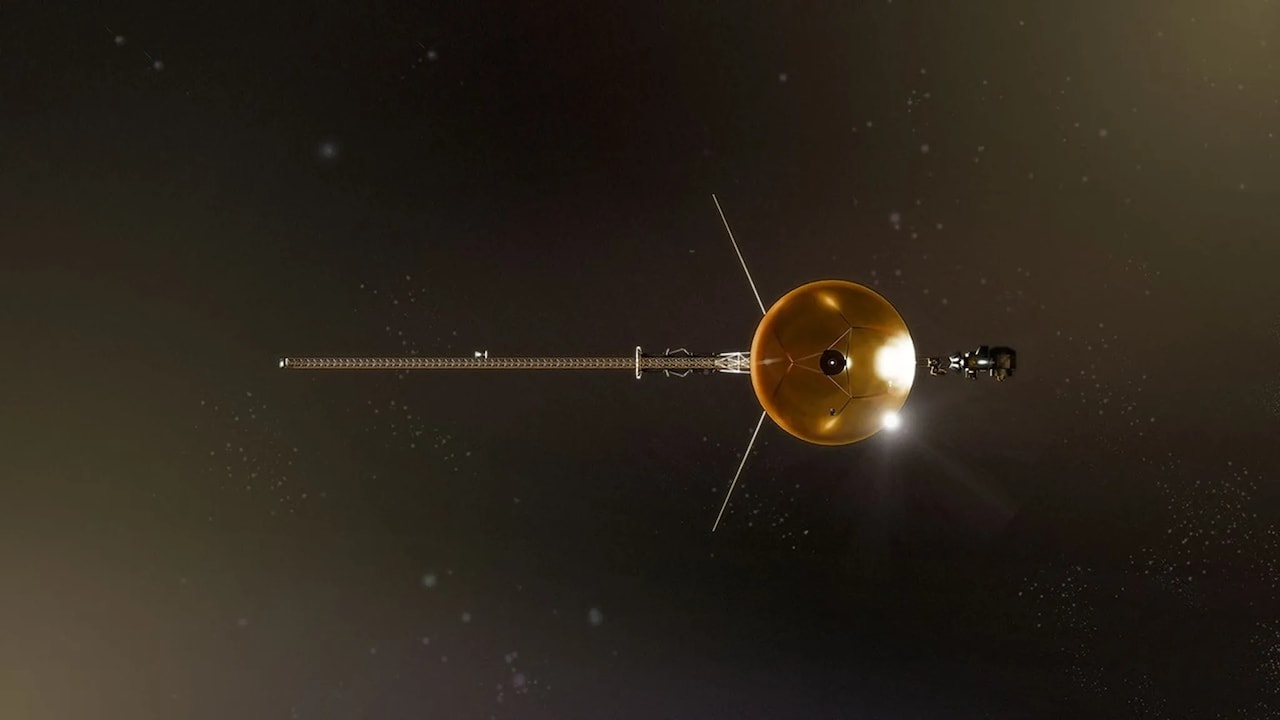
You can't really picture sixteen billion miles. It sounds like a random number pulled from a science fiction novel, but it's the actual, staggering distance NASA's Voyager 1 spacecraft has crossed after nearly fifty years of continuous flight. When mission controllers at the Jet Propulsion Laboratory sent a command and waited a full twenty-four hours for the signal to reach the probe, they weren't just testing electronics. They were acknowledging a milestone that no human-made object has ever touched before. Voyager 1 is officially one light-day away from Earth.
Most space stories focus on fiery rocket launches or expensive new telescopes that capture clean, Instagram-ready images of distant nebulae. Voyager 1 is the exact opposite of that. It's a battered, nuclear-powered relic from the seventies, built with computer memory that looks like a joke compared to the phone in your pocket, and it's outliving its creators out in the cold vacuum of interstellar space.
The Physics of a Twenty-Four-Hour Ping
Think about how we experience communication today. Everything is instant. You tap a screen, and data flies across the globe in milliseconds. If you want to talk to Voyager 1 right now, you have to hit send and wait a full day just to find out if the spacecraft heard you. Light travels at roughly 186,282 miles per second, which feels instantaneous until you measure it against the sheer scale of the cosmos. At sixteen billion miles, that single beam of radio frequency takes twenty-four hours to bridge the gap between our backyard and the edge of the unknown.
Managing a probe at that range requires a stubborn kind of patience that modern engineers rarely have to practice. When a glitch pops up—and they pop up more frequently now that the radioactive plutonium fuel is steadily decaying—the engineering team on Earth has to diagnose the problem, write a fix, beam it into the dark, and wait forty-eight hours just for a round-trip answer. It's deep-space debugging on extreme difficulty, performed on hardware that was designed before the internet existed.
How Voyager 1 Beat Its Twin to the Record
People often wonder why Voyager 1 reached this milestone nearly a decade before Voyager 2, given that they were launched just weeks apart in the late summer of 1977. The answer comes down to a deliberate trajectory choice made by mission planners decades ago.
Voyager 1 was specifically routed past Saturn's massive moon Titan to get a gravitational slingshot that hurled it upward and outward at a much faster clip. While Voyager 2 took a more leisurely path to study Uranus and Neptune, Voyager 1 put the pedal down. It's currently zooming away from the sun at a clip of about 3.5 astronomical units a year, outpacing its sibling and leaving the rest of the solar system behind in the dust.
Living on Borrowed Plutonium
You have to wonder how something built in an era of floppy disks and analog switches is still ticking. The secret lies in its three radioisotope thermoelectric generators, which convert the natural heat of decaying plutonium into electrical current.
That power source is fading fast. Every year, the generators lose about four watts of output. NASA engineers have had to perform digital miracles over the years, turning off heating instruments, shutting down non-essential scientific gear, and squeezing every last drop of efficiency out of failing circuits just to keep the primary communication link alive. Yet, despite power drops and communication scares, the veteran spacecraft refuses to die.
The Golden Record and Our Message to the Void
Tucked onto the side of Voyager 1 is a twelve-inch gold-plated copper phonograph record. It's a time capsule containing greetings spoken in dozens of human languages, the sound of a mother kissing her child, whale songs, crickets, and music ranging from Bach to Chuck Berry.
Long after our sun swells up and swallows the inner planets, and long after the last radio signal from Earth fades into static, Voyager 1 will keep coasting through the Milky Way. It carries no weapons, no cameras meant to spy, and no corporate logos. It's just a lonely piece of human craftsmanship sliding past the stars, whispering into the dark that we were here, we looked up, and we wanted to know what was on the other side.