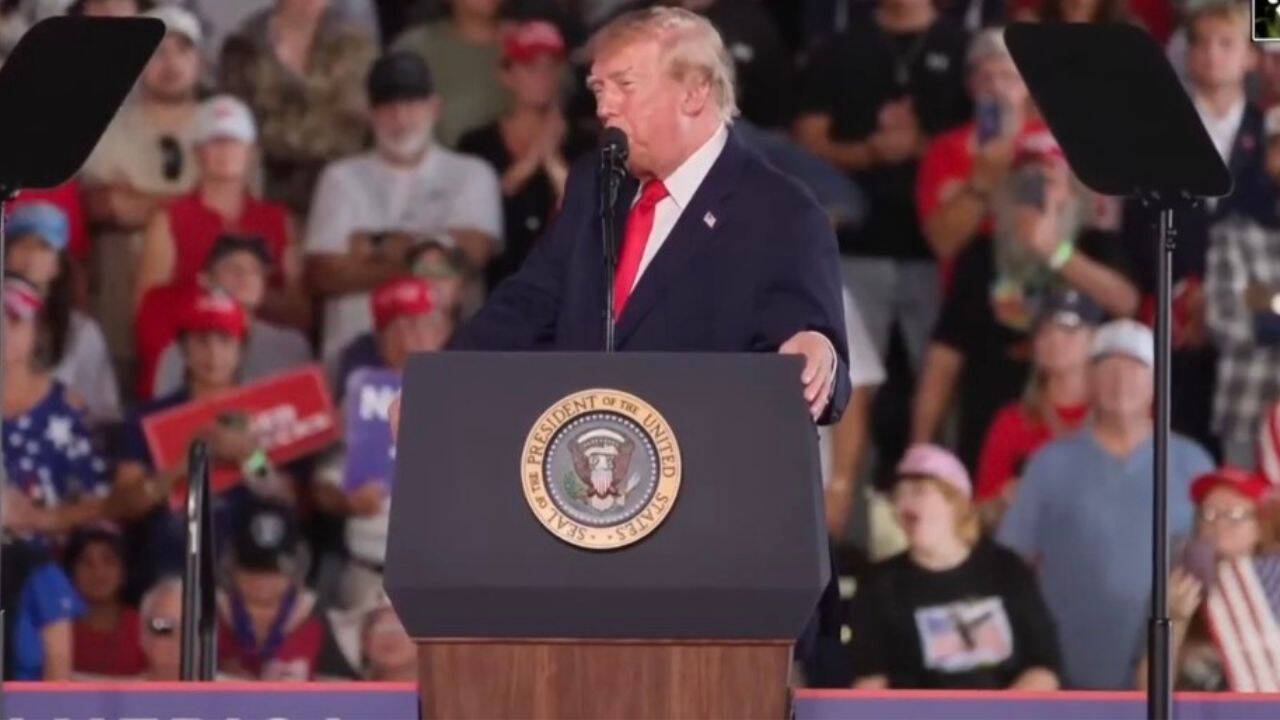
Political rallies in Michigan rarely lack tension, but Donald Trump took rhetoric to a whole new level in Port Huron. Standing before a roaring crowd while campaigning for Republican Senate nominee Mike Rogers, Trump launched a barrage of intense personal and security-focused allegations against Democratic candidate Abdul El-Sayed.
Trump called the former Detroit health director a "threat to national security," repeatedly misnamed him using variations of "Mohammed," and suggested El-Sayed should undergo daily metal detector screenings if elected to the United States Senate.
Political observers didn't miss the underlying strategy. Michigan isn't just another swing state. It's home to the highest concentration of Arab American voters in the country, many of whom reside in Wayne and Macomb counties. By framing El-Sayed through radical security rhetoric, Trump is attempting to consolidate his rural and suburban voter base while driving a sharp wedge through the state's electorate.
If you're trying to figure out what this means for Michigan and national politics, you aren't alone. Here is what is actually going on beneath the headline noise, why these attacks are surfacing now, and what the fallout looks like for both campaigns.
The Specific Accusations Trump Unveiled in Port Huron
Trump didn't pull any punches at the Port Huron rally. He claimed El-Sayed harbored loyalties to the Muslim Brotherhood and advocated for implementing Sharia law in the United States.
"So Abdul... also wants our country to go to Sharia law, and if he ever pulls that off, he should be the first one that's tried," Trump told the crowd, adding that he would personally serve as a witness in such a trial. He went on to describe El-Sayed as a "jihadist Muslim Brotherhood member" and insisted the candidate shouldn't even be allowed access to classified information, let alone a seat in Congress.
Crowd reactions were immediate. Attendees chanted "traitor" as Trump proposed singular security protocols for El-Sayed, suggesting he should be the only member of the Senate required to pass through a metal detector before entering the chamber.
These assertions lack factual documentation. Independent fact-checkers and congressional oversight reporting have repeatedly found no evidence connecting El-Sayed to the Muslim Brotherhood or radical groups. El-Sayed has repeatedly denied any such ties, emphasizing his public record as a physician, public health professor, and local government official.
Who Is Abdul El-Sayed Beyond the Headlines
To understand why these attacks carry so much weight, you have to look at El-Sayed's background. He isn't a political newcomer popping up out of nowhere.
El-Sayed grew up in Michigan, earned his medical degree from Columbia University, and earned a doctorate as a Rhodes Scholar at Oxford. In 2015, at just 30 years old, he was appointed health director for the city of Detroit, making him the youngest city health commissioner in a major American city.
During his tenure in Detroit, he focused heavily on public health accountability:
- Inspecting public schools for lead contamination in drinking water.
- Rebuilding city immunization programs that had collapsed after Detroit's municipal bankruptcy.
- Fighting corporate industrial polluters along the Detroit River corridor.
He gained statewide political prominence during his 2018 gubernatorial primary run. While he lost that nomination to Gretchen Whitmer, he built a dedicated progressive following that powered his later work as a public health commentator, author, and Wayne County Health Department executive. When he announced his run for the U.S. Senate, his campaign focused heavily on healthcare access, environmental protection, and economic investments in working-class communities.
Why Trump Is Using Religion in Michigan
Political strategists aren't surprised by the timing or nature of Trump's remarks. Campaign dynamics in Michigan during high-stakes election cycles hinge on razor-thin margins.
In recent election cycles, Michigan's Arab American and Muslim voters—numbering over 300,000 across the state—became a pivotal voting block. Dissatisfaction with mainstream foreign policy positions created complex polling dynamics across Dearborn, Hamtramck, and Sterling Heights.
Trump's rhetoric operates on two distinct political fronts:
- Rallying the Base: By using high-visibility warnings about national security and religious influence, Trump galvanizes turnout among conservative voters in outer-suburban and rural counties like St. Clair and Macomb.
- Forcing Democratic Candidates onto the Defensive: Forcing a candidate to respond to dramatic security claims shifts the news cycle away from policy issues like healthcare costs, union wages, and manufacturing jobs—areas where Democrats typically prefer to debate.
Civil rights groups and political opponents were quick to call out the tactic. Critics decried the language as blatant religious profiling designed to play on fear rather than policy differences.
Civil rights advocacy groups pointed out that tying a Muslim-American public official to international extremist groups without factual backing relies on well-worn islamophobic tropes. It forces the candidate into a defensive position of constantly proving their patriotism.
What Fact-Checkers and Security Experts Say
When political candidates make claims about national security risks, government vetting procedures provide helpful context.
U.S. Senators do not undergo standard background checks like executive branch appointees, but they gain access to classified material via their constitutional status as elected legislators. However, candidates running for federal office undergo routine background scrutiny through public records, financial disclosures, and campaign finance reporting monitored by the Federal Election Commission (FEC).
Security analysts note that suggesting a sitting or prospective member of Congress undergo individual metal detector screenings or religious loyalty tests violates long-standing congressional protocols. The Capitol Police board governs chamber security uniformly for all 100 senators and 435 representatives.
Regarding claims about Sharia law and foreign organization ties:
- No official records from federal law enforcement or intelligence agencies link El-Sayed to international political groups.
- Constitutional protections under the Article VI Religious Test Clause explicitly state that "no religious Test shall ever be required as a Qualification to any Office or public Trust under the United States."
How the Candidates Are Handling the Conflict
The contrast between the two campaigns couldn't be sharper.
Mike Rogers' campaign has sought to keep the focus on traditional Republican messaging points—economic inflation, border security, and industrial regulations affecting Michigan's auto sector—while welcoming high-profile endorsements from Trump to drive voter turnout.
El-Sayed's team responded by dismissing the allegations as desperate distraction tactics meant to sidestep real economic issues affecting Michiganders. His campaign reiterated his core platform:
- Expanding Medicare coverage to lower prescription drug costs.
- Protecting manufacturing jobs against offshore competition.
- Securing federal infrastructure dollars for local roads and clean water systems.
By keeping his primary focus on pocketbook issues, El-Sayed attempts to prevent the media coverage from getting totally consumed by personal attacks.
Practical Takeaways for Voters Tracking the Race
Campaign noise gets loud fast, especially when national figures jump into state-level races. If you're following this election or trying to analyze political news accurately, keep these practical evaluation steps in mind:
- Check primary sources for security claims: Whenever a politician accuses an opponent of ties to foreign entities, look for official government reports, court filings, or vetted investigative journalism rather than rally statements.
- Distinguish policy debates from character attacks: Pay attention to whether a speech addresses legislative proposals (taxes, infrastructure, healthcare) or focuses on personal identity markers.
- Track local media coverage: Local Michigan outlets like the Detroit Free Press and The Detroit News often provide crucial local context that national political reporters miss.
- Verify federal candidate requirements: Understand how constitutional rules work regarding eligibility, security clearances, and congressional authority so you can spot hyperbole when it happens.
Expect rhetoric around Michigan's Senate seat to intensify as election day approaches. Staying focused on verified records and clear policy proposals remains the best way to cut through the political noise.