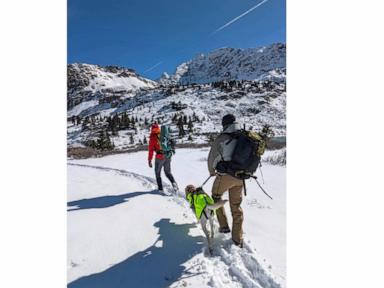
When two young climbers head into the high country, everyone naturally watches the weather. That was the initial fear when 19-year-old Kaden Matsuda and 20-year-old Jackson Donlon went missing in the Colorado Rockies. A brutal early-season storm rolled in, dumping up to two feet of snow across Chaffee County and sparking an urgent search before the weather locked down the peaks.
Yet the official autopsy results brought a sobering reality check. Weather didn't take their lives. Equipment failure did.
The Chaffee County Sheriff and Coroner's Office confirmed that Matsuda and Donlon—both students at Colorado Mountain College in Leadville—died from multiple blunt force injuries sustained in a long fall after a climbing anchor broke. They were found at the base of West Apostle Mountain, their deaths instant and occurring during their pursuit of the outdoor education they loved.
If you spend time in vertical terrain, stories like this hit hard. They force an uncomfortable look at the gear we trust with our lives every single time we tie in.
The Illusion of Absolute Security on the Rock
We place gear, clip our ropes, weight the system, and hope for the best. Most of the time, physics rewards our efforts. But mountaineering is an unforgiving sport where a single point of failure cascades into catastrophe.
When climbing anchors fail, it's rarely because of a single miraculous freak occurrence. High-alpine environments test materials in brutal ways. Freeze-thaw cycles, weathered rock, marginal placements, and high-stress loads create razor-thin margins for error.
Matsuda was studying to become a wildland firefighter, and Donlon was immersed in outdoor recreation leadership. They weren't tourists stumbling blindly into the backcountry. They were students at an institution famous for training professionals in the state's rugged outdoor economy. They knew the risks. They understood the technical nature of alpine travel.
And yet, tragedy still struck. That realization dismantles the comforting myth that experience or education completely shields you from bad luck or misjudged physics.
Understanding Why Anchors Fail in Alpine Terrain
Alpine anchors are notoriously complex. Unlike bolted sport climbing crags where steel expansion anchors provide reliable stationary points, alpine mountaineering often forces climbers to build anchors out of natural protection—ice screws, snow flukes, traditional gear in shifting rock, or horns of stone.
When an anchor breaks under load, investigators look at several critical variables:
- Rock quality: High-alpine rock is frequently fractured, loose, or weathered by millennia of expansion and contraction.
- Directional pull: A multi-point anchor must distribute forces evenly. If a load shifts unexpectedly, leverage can concentrate entire forces onto a single flawed placement.
- Environmental wear: Ice, moisture, and rapid temperature swings degrade gear integrity faster than standard gym or crag environments.
When you're out on a remote peak like West Apostle Mountain, you don't get a warning beep when a cam starts to walk or a rock horn weakens. You rely entirely on your field assessment and redundancy in your rigging.
The Mental Toll on Mountain Communities
Communities like Leadville—sitting proudly at over 10,000 feet as America's highest incorporated city—share a unique bond with the mountains. The peaks aren't just scenic backdrops for postcards. They are classrooms, workplaces, and sanctuaries.
When a campus loses young members who shared a passion for exploration, the grief ripples through the entire guiding and outdoor community. Dean Ben Cairns noted that their lives were full of promise and felt deeply by everyone who knew them. Friends and faculty remember them not by the grim mechanics of their final hours, but by the energy they brought to the high country.
We owe it to climbers like Kaden and Jackson to talk openly about these hazards. Sugarcoating the risks of alpine climbing doesn't protect anyone. It only breeds false confidence.
Inspect your gear. Double-check your equalized systems. Build redundancy where failure is fatal. Respect the mountain, because it doesn't care how much potential you have or how much you love the climb.