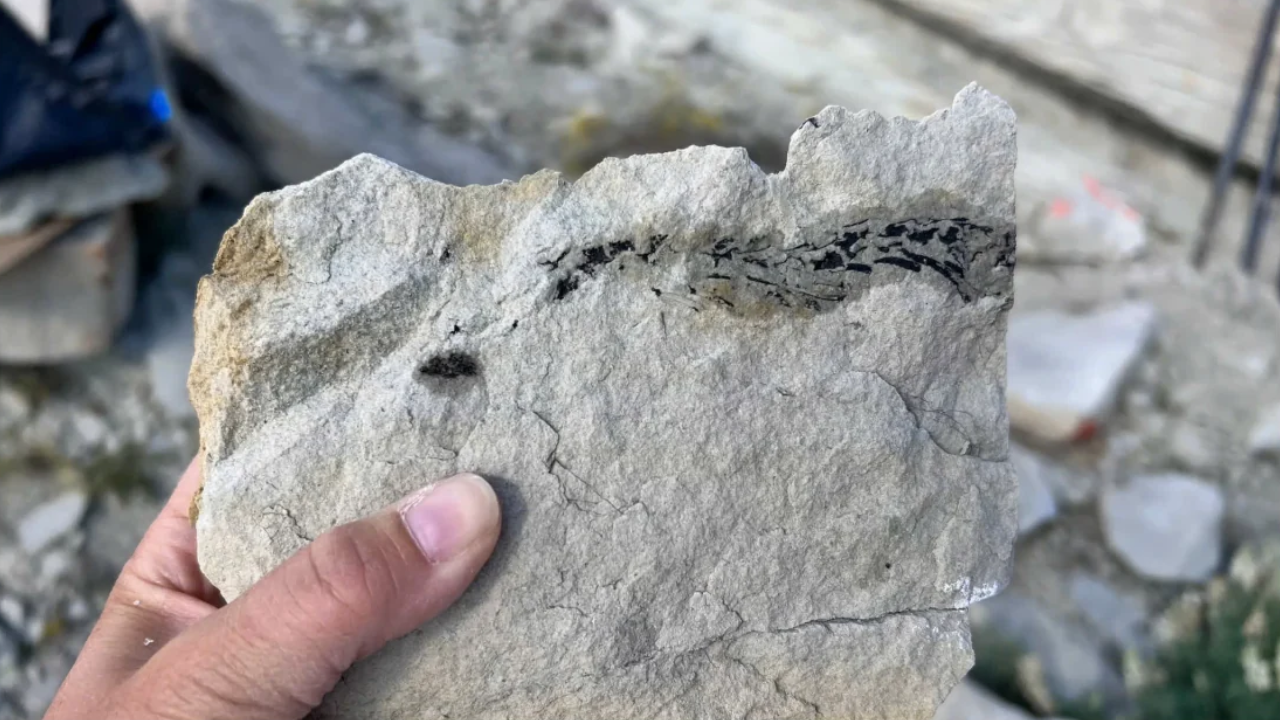
Most people picture the Jurassic American West through giant bones, massive Diplodocus necks, Stegosaurus plates, or Allosaurus teeth. Yet a 156-million-year-old horned reptile fossil trapped in Wyoming sandstone has just turned that big-bone obsession upside down.
Measuring only about 45 centimeters long, this newly named species—Meilynodraco amonamarthi—sported two dragon-like projections at the back of its skull and spent time in or near freshwater. Scientists didn't chisel it free with hammers. They used neutron and X-ray scans to peer straight through solid rock without destroying a bone smaller than your thumb. Meanwhile, you can explore other events here: Why Vladimir Putin Can't Stop Talking About Indian Diversity.
Published on November 18, 2026, in Royal Society Open Science, the study shows how a seemingly minor rock slab from Wyoming's Morrison Formation holds big clues about an ancient reptile group called choristoderes. If you care about how paleontologists solve high-stakes rock puzzles—or why tiny, overlooked bones often beat flashy skeletons—this find is worth your time.
How a Tiny Horned Reptile Fossil Survived in Wyoming Sandstone
Back in August 2022, an excavation team from Switzerland's Aathal Dinosaur Museum was working at Meilyn Quarry in Wyoming. The Morrison Formation is famous for pulling heavyweights out of the dirt, so finding a small, delicate skeleton sticking out of sandstone felt almost backward. To explore the full picture, we recommend the excellent report by The New York Times.
Only a few vertebrae showed on the surface. Most of the skeleton stayed locked inside the stone.
Honestly, when a fossil is mostly buried and tiny, guessing what you have is a trap. Could it be a young dinosaur? An early snake? A primitive relative of crocodiles? Chipping away at hard sandstone with dental picks or air scribes is risky when the bones are fragile and small. A single slip can turn key anatomical features into dust.
That's why bringing the block back to Switzerland and waiting for the right imaging setup was the smart move. In fossil prep, patience saves specimens. Rushing ruins them.
A Business Card Starts a Neutron Investigation
Sometimes science moves forward because a dad takes his kids to a museum. In January 2023, Pavel Trtik, a materials scientist at the Paul Scherrer Institute (PSI) in Switzerland, visited the Aathal Dinosaur Museum with his three sons. While his boys checked out teeth and armor, Trtik looked at the rock and left his business card with a note offering help if the team ever needed imaging work.
Ten days later, the museum called about the mystery Wyoming fossil.
That detail matters more than people realize. Real paleontology runs on cross-disciplinary collisions like that—materials physicists talking to vertebrate paleontologists who otherwise might never cross paths.
Why Neutron Scans and X-Rays Beat Cutting Rock Open
You can't just throw every fossil into a standard X-ray machine and expect magic. Sandstone and fossilized bone can look stubbornly similar in density, especially when bones are thin, scattered, or buried deep inside dense rock.
Trtik and University of Zurich paleontologist Torsten Scheyer teamed up with colleagues at the Paul Scherrer Institute, the Swiss Federal Laboratories for Materials Science and Technology (Empa) in Dübendorf, and the University of Zurich to combine neutron and X-ray computed tomography.
Here's why pairing the two works so well:
- Neutrons spot hydrogen: Neutrons interact differently with matter than X-rays do, and they are particularly sensitive to hydrogen. Bone contains hydroxyapatite, a mineral component that holds hydrogen, helping researchers separate fossilized bone from surrounding sandstone.
- X-rays add complementary contrast: X-rays probe density and structure in their own way, filling gaps where neutron contrast alone isn't enough.
- Tens of thousands of slices: Sorting through tens of thousands of cross-sectional images lets researchers trace tiny bones in 3D before touching the rock physically.
From those scans, the team identified an articulated vertebral column, pelvic bones, parts of a hind leg, and scattered skull elements—including a nearly complete braincase measuring less than two centimeters across. Even better, they spotted two horn-like projections at the back of the head.
Still, let's be honest about limits. Imaging isn't a free pass that magically restores every missing piece. Much of the front of the skull and jaws, the shoulder girdle, and large parts of the limbs were missing or incomplete. Digital reconstruction still requires hours of careful anatomical detective work, not push-button automation.
What Meilynodraco amonamarthi Means for Choristodere Evolution
Once the scans revealed the skull and braincase, the story shifted from "weird little backbone" to a major data point for choristoderes. Choristoderes are an extinct group of diapsid reptiles—often lizard-like or gharial-like in general lifestyle—whose exact spot on the reptile family tree has long given paleontologists headaches because their skulls are so specialized.
What makes Meilynodraco amonamarthi stand out?
- Oldest North American record of the group: It pushes the known North American history of choristoderes back to roughly 156 million years ago in the Late Jurassic.
- Most complete early-branching specimen: Earlier members of the lineage have been patchy, making this specimen a crucial reference point.
- Inner ear clues: The tiny bones in the inner ear region closely resemble those of crown-group reptiles (the group that includes living reptiles), pointing toward a closer evolutionary tie to modern reptiles than some earlier fossil evidence suggested.
The name itself is a nod to both place and personality. Meilynodraco nods to Meilyn Quarry and its dragon-like cranial projections, while amonamarthi honors Amon Amarth, the Swedish melodic death metal band favorite of co-lead Torsten Scheyer (whose name comes from the Elvish name for Mount Doom in The Lord of the Rings).
Detached Head and River Sediment Mysteries
One detail in the fossil grabs attention right away: the reptile's head and torso were found separated in the sandstone.
People love dramatic stories about a predator snapping a creature's head off in a bloody river ambush. Scheyer has rightly stayed cautious here. You can't prove a predator attack just from a detached skull, even if a larger predator can't be ruled out. Currents, scavenging, decomposition, and shifting river sand can all separate bones before burial.
Either way, it was a stroke of luck for science that the tiny braincase wasn't pulverized or swept away. Fine river sand buried the remains and hardened into sandstone over millions of years, locking away clues that waited 156 million years to be read.
Common Misconceptions About This Fossil Discovery
Whenever a story mentions "horns" and "dragon" in a Jurassic fossil, misconceptions spread fast. Keep a few realities straight:
- It wasn't a horned dinosaur or a fire-breathing dragon: A 45-centimeter reptile from a river deposit is worlds apart from a Triceratops or a mythical monster. "Dragon" in the genus name is an anatomical nod to those two projections at the back of the skull.
- Scientists didn't guess from a single bone: The initial surface view only showed part of the backbone. The breakthrough came from combining tens of thousands of neutron and X-ray scan slices to map the braincase, inner ear region, pelvis, hindlimb parts, and vertebrae.
- A detached skull isn't automatic proof of murder: Predation is possible, not proven. Honest science separates plausible scenarios from confirmed facts.
Practical Next Steps If You Want to Follow This Research
If you want to go beyond headlines and dig into the primary evidence yourself, a few concrete steps will get you there fast:
- Read the primary paper: Look up Neutron and X-ray computed tomography reveals new early-branching choristoderes from the lower Morrison Formation of Wyoming, USA in Royal Society Open Science to inspect the anatomical descriptions and scan figures directly.
- Check institutional releases: Follow updates from the Paul Scherrer Institute and the University of Zurich to see how non-destructive neutron and X-ray imaging is being applied to other fragile fossils.
- Plan a museum visit: If you're following exhibition news, watch for the Aathal Dinosaur Museum Rock Fossils on Tour showcase planned for early 2027, where the specimen is slated to appear.