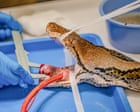
When you hear about a 15-foot python undergoing advanced cancer treatment, it sounds like a weird headline from a tabloid. It’s not. It’s actually a major moment for veterinary medicine that proves we’ve stopped treating exotic animals as afterthoughts.
Jodie Foster, a 50kg reticulated python living at Chester Zoo, recently became the first snake in history to receive electrochemotherapy. This isn't just about a famous snake getting lucky. It’s about how we’re finally applying human-grade medical technology to species that were historically left behind. Meanwhile, you can read similar stories here: Why The New Ebola Spread Is Terrifying Health Experts Right Now.
Why This Matters More Than You Think
Most people don't think about snakes having cancer. It happens, though. In Jodie’s case, it was a fibrosarcoma—a nasty, malignant tumor—that started invading her jawbone. For a python, your jaw is your entire life. If you can’t strike, grip, and swallow prey, you’re in serious trouble.
The standard move would’ve been traditional surgery. They tried that. It failed. The tumor came back, and it was eating away at her bone. Veterinary officers at the zoo had to decide if they were going to give up or try something that hadn't been tested on a snake before. To understand the bigger picture, check out the excellent report by National Institutes of Health.
They chose to innovate.
They teamed up with specialists from the University of Liverpool to adapt a human treatment: electrochemotherapy. If you haven't heard of it, it’s pretty wild. It combines a chemotherapy drug called bleomycin with controlled electrical pulses delivered straight to the tumor site. The pulses make the cancer cells "open up" temporarily, so the drug actually gets inside and kills the bad stuff.
The Practical Challenges Of Operating On A Giant
I’ve spent enough time around large reptiles to know that simple logistics are often the biggest hurdle. You can’t just put a 15-foot python on a standard metal exam table. It doesn't work.
The team at Chester Zoo had to push two operating tables together just to make a platform the size of a double bed. Imagine the precision required to keep an animal that size sedated, stable, and monitored during a 90-minute procedure. They had to anaesthetize her in her own habitat before even transporting her to the vet center.
This wasn't just a "let's see what happens" scenario. It was a calculated risk that required insane attention to detail.
Translating Human Tech To Reptiles
This story highlights a massive shift in how we handle complex diseases in exotic animals. We’re moving away from "just do the bare minimum" toward "let's figure out how to make this work."
The researchers involved are already planning to publish their findings. That’s the most important part of this whole ordeal. By sharing the technical details of the anesthesia, the dosage of the bleomycin, and the electrical pulse frequency used on a reptile, they’re creating a roadmap for other veterinarians.
Now, if another zoo or wildlife rescue center faces a similar diagnosis, they don't have to start from scratch. They have a blueprint.
What This Means For Veterinary Science
It’s easy to dismiss this as just a cool animal story. That misses the point. The tech used here—electrochemotherapy—is helping vets treat tumors in dogs, cats, and now snakes that would’ve been considered "inoperable" only a decade ago.
We’re seeing a convergence of human oncology and wildlife medicine. It’s the kind of progress that’s quiet, slow, and genuinely life-saving.
Jodie Foster is doing great. She’s back to eating, she’s active, and her jaw is holding up. If you’re ever dealing with a tough diagnosis for a pet or animal in your care, the biggest lesson here is that standard procedures aren't the end of the road. Sometimes, you have to ask what else is possible.
Collaboration between specialists is how we fix the "unfixable." Don't be afraid to look for experts outside your immediate circle.