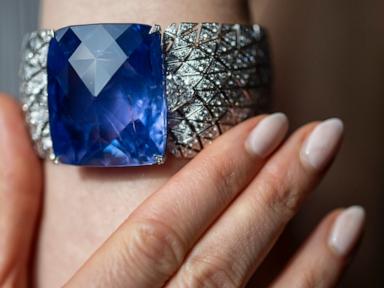
History has a funny way of wearing a price tag. When a 197.80-carat cushion-shaped sapphire once tied to the Russian imperial court hit the block at Sotheby's Royal & Noble Jewels sale in Geneva, auction houses played it safe with a pre-sale estimate of 850,000 to 1.7 million Swiss francs. They figured the market was cautious. They were wrong. Driven by fierce bidding from an anonymous private collector, the piece sold for more than 4.1 million Swiss francs—roughly $4.9 million.
The jaw-dropping final tally proves that royal provenance combined with an unheated, museum-grade gemstone will almost always rewrite market expectations.
The Journey from the Winter Palace to a Cartier Mount
If you want to understand why this specific piece commanded nearly five million dollars, you have to look past the modern gold and diamonds. The stone itself carries a century of political chaos.
Dowager Empress Maria Feodorovna, mother of the ill-fated Czar Nicholas II, famously wore the sapphire pinned to the front of her skirt at the legendary 1903 Winter Palace Ball. That event remains etched in history as the final glittering gasp of Imperial Russia before revolution tore the country apart.
When the monarchy collapsed, the new Soviet government needed cash. They catalogued the imperial treasures in the landmark Fersman inventory and systematically sold off the crown jewels to foreign buyers. This massive sapphire slipped out of Russia, passing through the hands of eccentric opera singer and collector Ganna Walska before eventually landing with Cartier.
It wasn't until 2015 that Cartier built the current transformable bracelet around the historic gem, featuring a geometric arrangement of diamonds and a detachable clasp that lets the massive sapphire be worn independently as a pendant.
What Buyers Actually Pay For at the High End
Most casual observers look at a multi-million-dollar auction and assume people are just paying for shiny rocks. That misses the mechanics of ultra-high-end fine jewelry.
Three specific factors drove this sale past the four-million-dollar mark:
- The unheated status: The gemstone originates from Ceylon (now Sri Lanka) and has never undergone heat treatment to artificially enhance its color or clarity. In the upper echelons of colored gemstones, natural, untreated stones of this scale command an immense premium.
- Traceable lineage: A sapphire can be tested in a lab, but its story cannot be manufactured. Because this piece appears directly in old imperial records and Soviet sale catalogues, buyers aren't guessing about its past.
- Transformable design: High jewelry collectors increasingly demand versatility. A piece that functions as both a heavy statement bracelet and a standalone pendant offers practical wearability alongside investment value.
What This Sale Signals for the Luxury Market
The auction results send a clear signal about where wealthy collectors are putting their money. Volatile global markets haven't dampened the appetite for rare, tangible assets with bulletproof provenance. When items carrying genuine historical weight surface, competition spikes instantly.
As long as royal artifacts with clear paper trails keep emerging from private vaults, the top tier of the auction market will continue to defy conservative estimates.