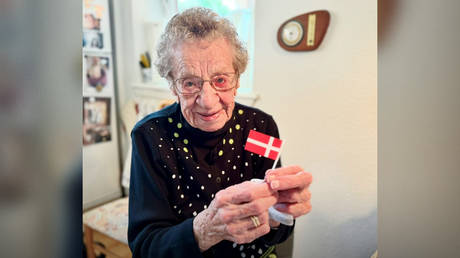
One month after celebrating 112-year-old Kirsten Schwalbe as the longest-lived person in Danish history, a major national biography got pulled from shelves and a hit TV series went dark. That whiplash says a lot about how Denmark still wrestles with its wartime past.
Let's be blunt from the start. Schwalbe didn't just sign her name in a dusty ledger in 1941 and forget about it. Archival records reviewed by the Danish investigative outlet Frihedsbrevet show that she held two local leadership roles in the National Socialist Workers' Party of Denmark, known as DNSAP, in the western town of Holstebro from August 1943 to July 1944.
When Kristeligt Dagblad first reported her 1941 party enrollment in October 2026, right after she broke Denmark's longevity record on October 14, 2026 at 112 years and 218 days, she told TV Midtvest she had "barely" known what the party was and had "never been interested in politics," claiming she joined because her husband asked her to. A month later, the Frihedsbrevet findings from the Danish National Archives complicated that story considerably.
Why Denmark's Oldest Citizen Became a National Flashpoint
Before the revelations, Kirsten Schwalbe was basically comfort television. Born on March 10, 1914 in Vester Lem on Salling, she went to work young—as a child nursemaid in the countryside and as a housekeeper in Holstebro by age 15, marrying her husband in 1938. Starting around age 109, she appeared in TV Midtvest programs including Længe leve de 100-årige, Skål Kirsten!, and Kirstens vilde år. Even her Instagram account, managed by the broadcaster, had a final post on October 28 wishing her younger brother Bertel a happy 105th birthday before going quiet.
Gyldendal published her biography, We Have Something to Laugh About (translated from its Danish title), on October 8, 2026, written by two TV Midtvest staffers. Neither the authors nor the publisher flagged her DNSAP membership at release. Once the archival documents surfaced, nonfiction director Mette Korsgaard said the new facts put the book in a very different light, and Gyldendal halted sales while TV Midtvest paused coverage and dropped the planned final episode of Kirstens vilde år after her family said the media storm was taking a heavy toll on her health.
Honestly, watching a country pivot from folksy longevity celebrations to historical reckoning in a matter of weeks isn't surprising if you pay attention to how European memory works. What's striking here isn't a sensationalist caricature of a cartoon villain. It's the collision between an upbeat modern media narrative and messy, uncomfortable mid-20th-century choices.
What Local Nazi Leadership Actually Meant in Holstebro
If you only read quick headlines, "prominent Nazi leader" can sound like someone giving orders in Berlin or running a national ministry. That's not what happened here, and overstating it does nobody any favors.
Historian Claus Bundgaard Christensen of Roskilde University examined the records for Frihedsbrevet and made the distinction clear. Schwalbe wasn't at the top of DNSAP nationally. Yet she was no passive bystander either. Serving as acting group leader for the local branch and leading its women's group in Holstebro from August 1943 to July 1944—while her husband served as acting local branch head from November 1942 to July 1944—put her in a middle-management role on the ground.
In practical terms, historians note that local branch leaders helped organize meetings, line up speakers, and open gatherings, while DNSAP women's groups backed Danish volunteers fighting for German forces on the Eastern Front by sending parcels, letters, and Christmas gifts. Gry Scavenius Bertelsen, a museum curator associated with the Museum of Danish Resistance and the Frøslev camp, likewise noted that she held a leadership function at the local level.
Timing matters too. August 1943 wasn't a sleepy, ambiguous early month of the occupation that began on April 9, 1940. By August 1943, tensions in Denmark had reached a boiling point, culminating on August 29, 1943, when the Danish government resigned rather than meet German demands, the navy scuttled its ships, and occupation rule hardened dramatically, followed in October 1943 by the roundup of Danish Jews—most of whom were rescued across the water to Sweden. Claiming total political obliviousness in late 1943 runs right into a wall of historical context.
Everyday Choices Under German Occupation
People love clean moral boxes when looking back at World War II. Denmark rarely fits neatly into one.
For five years, Danes lived under a German occupation where ordinary life, official cooperation, quiet resistance, and outright collaboration existed side by side. Having a husband in a local Nazi leadership post undoubtedly shaped household pressures in a small town like Holstebro. Still, taking on formal organizational duties isn't the same thing as being forced at gunpoint to sign a membership card.
In my own experience reading wartime biographies and family histories, people very rarely wake up thinking, "I'm going to become the bad guy today." Most drift or lean into social circles, marriages, status, or ideological currents right in front of them, and decades later they tell themselves a softer version of how they got there. Memory is forgiving. Paper trails in archives are much less so.
How Old Archives Suddenly Surface Decades Later
A lot of readers wonder how something like this stays hidden during years of television appearances and a book deal, only to blow up in late 2026. Part of it comes down to how archival access rules work and how journalists dig.
DNSAP, founded in 1930 along the lines of Adolf Hitler's party and dissolved in May 1945 after the war ended, left behind membership registers and administrative records preserved in the Danish National Archives. Privacy and data-protection rules around sensitive personal records often carry multi-decade waiting periods—commonly around 75 years depending on the record type and statutory rules—which means records from the early 1940s can cross thresholds where researchers and reporters examine them more closely.
Here is a mistake I see media teams and publishers make all the time when profiling centenarians or historical figures. They treat old age itself as a clean bill of character and skip basic archival checks on political organizations from the 1930s and 1940s. When someone hits 112, you're dealing with a life lived across an entire century, not a cute quote about eating porridge and staying cheerful. If you're going to publish a life story, checking party rolls and municipal history isn't cynical—it's basic homework.
Weighing Accountability Without Losing Sight of the Facts
Whenever a story like this breaks, opinions split fast. Some people argue that a 112-year-old whose health is fragile shouldn't be dragged through public condemnation eight decades after the war. Others push back just as hard, saying that celebrating someone's life story while airbrushing active Nazi party roles distorts history and insults those who suffered under occupation.
Both reactions tap into real values, even if they pull in opposite directions. Treating a frail supercentenarian with basic human restraint isn't the same thing as excusing Nazism. Equally, refusing to whitewash historical records doesn't require turning a local 1943 branch organizer into a caricature of every war crime of the Third Reich.
What actually serves the public best is accuracy, proportion, and honesty. Acknowledge what the documents show, explain what those local titles actually involved, note what remains unanswered, and resist the urge to turn complex history into either a fairy tale or a tabloid circus.
If you're researching family history, reviewing wartime records, or evaluating coverage of historical figures, start with a few practical steps:
- Check primary repositories like the Danish National Archives (Rigsarkivet) and consult established museums such as the Museum of Danish Resistance rather than relying on secondhand social media summaries.
- Separate rank-and-file enrollment, local party administration, and documented wartime crimes instead of lumping every wartime label together.
- Cross-check dates against major occupation milestones—such as April 9, 1940, August 29, 1943, and October 1943—to understand the real political climate at the time.
- Look closely at when biographies and media profiles were written, who funded or produced them, and whether inconvenient chapters were quietly left out.


