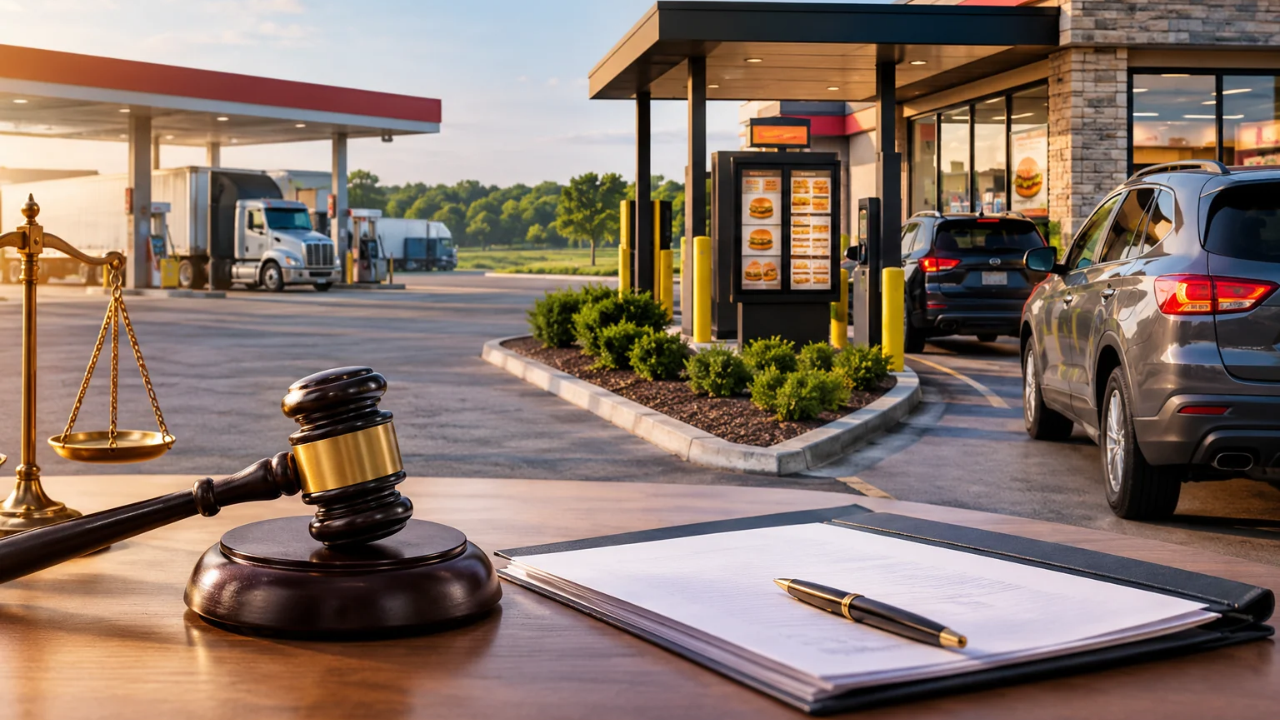
Bureaucracy loves to drag its feet. When small business owners try to adapt to changing consumer habits, local zoning boards often treat simple property updates like an existential threat. That is exactly what happened to Jyotsna and Anil Jivani, who spent nearly six years fighting local authorities just for the right to install a drive-through window at their truck stop.
Their legal marathon finally hit a major turning point on October 27, 2026, when the Pennsylvania Commonwealth Court overturned a lower court's denial. The ruling handed the couple a vital victory in Jyotsna Jivani and Anil Jivani v. East Lampeter Township Zoning Hearing Board.
If you own commercial property or deal with municipal zoning boards, this case offers a masterclass in why you should never take a local board's initial "no" at face value.
The Reality of Running a Modern Truck Stop
The property in question sits on a 5.7-acre tract at 2622 Lincoln Highway East in East Lampeter Township, Lancaster County. It is a bustling operation featuring a convenience store, fuel pumps, and established food counters like Subway and Champ's Fried Chicken. It runs twenty-four hours a day, serving tired truckers and local motorists alike.
Operating as a lawful nonconforming use in an agricultural district, the site has decades of history. Back in 1988, a zoning decision already recognized a fast-food restaurant component on the premises.
When the pandemic hit, consumer habits changed overnight. Drivers, especially older patrons, grew hesitant to step inside enclosed spaces. Franchise partners pushed for curbside delivery or pickup windows to keep business moving. In response, the Jivanis submitted an application in October 2020 to replace an underutilized bus passenger drop-off lane with a clean, efficient drive-through setup.
The design was practical. It featured a nine-foot-wide lane splitting into two paths so vehicles could bypass queues. It accommodated four cars before the kiosk and four cars after it, strictly for passenger vehicles only. Furthermore, the construction involved a tiny 38-square-foot rear addition offset by removing an identical area near the front entrance. There was zero net increase in usable floor area.
How Local Officials Blocked the Plan
Logic and minor adjustments rarely impress rigid zoning boards. East Lampeter Township officials dug their heels in. They argued that the township zoning ordinance banned drive-through facilities at convenience stores.
The zoning board bought that argument and denied the application in January 2021. The Lancaster County Court of Common Pleas backed them up in August 2025.
Local officials basically claimed that even though the truck stop had successfully operated food counters for years, adding a window to hand food to someone in a car crossed some imaginary legal line. The Jivanis refused to back down. They kept fighting through the appellate system, turning what started as a simple storefront modification into a multi-year legal battle.
The Commonwealth Court Breaks the Gridlock
Pennsylvania's Commonwealth Court took a close look at the actual text of the township ordinance, and things quickly unraveled for the local board.
The judges discovered a glaring contradiction in the rulebook. Section 2020 defined a convenience store as selling ready-to-eat food but excluded drive-throughs. However, Section 23200 explicitly laid out rules and vehicle queuing requirements for drive-through service lanes at convenience stores.
The township zoning officer even admitted under testimony that the permissive language was left in the ordinance by mistake during a 2016 rewrite.
That admission proved fatal to the township's case. Under Section 603.1 of Pennsylvania's Municipalities Planning Code, whenever zoning restrictions conflict or remain ambiguous, the law favors the property owner. Courts cannot punish property owners for sloppy municipal drafting.
Natural Expansion and Property Rights
Beyond the drafting errors, the court recognized a fundamental legal principle regarding nonconforming uses. A small drive-through window did not magically transform the truck stop into a brand-new enterprise. It simply offered an alternative way for customers to purchase products they were already buying inside.
The physical alterations were minimal. There was no spike in paved lot coverage or overall floor space. The project repurposed dead space where buses used to drop off passengers.
The October 27 ruling reversed the lower court and sent the case back to the zoning board for further proceedings. While it is not a final construction green light, it strips away the legal barrier that the township used for six years to block progress.
Lessons for Business Owners Facing Municipal Pushback
Municipal red tape kills countless small business expansions every single year. Most owners surrender when faced with hostile zoning boards and expensive legal fees.
If you find yourself locked in a similar battle, look closely at how the Jivanis handled it. Do not accept a denial simply because a local official says an ordinance forbids your plan. Read the text yourself. Look for conflicting sections, oversight errors, and statutory ambiguities.
State planning codes exist to protect property owners from arbitrary municipal overreach. When ordinances contradict themselves, the law typically leans toward your right to use your land. Persistence pays off, even if it takes six years to prove your point.