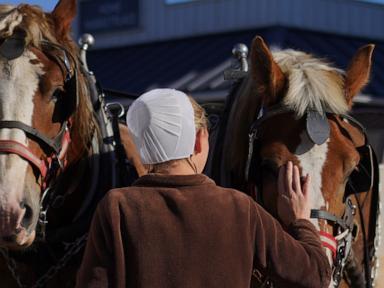
A quiet shift is happening across the rolling green hills of Lancaster County. For generations, many traditional Amish families chose to skip standard immunizations, relying instead on tight-knit community structures, herbal remedies, and a lifestyle isolated from modern medical routines. But a historic measles outbreak has shattered that bubble. When preventable diseases begin taking lives in your own backyard, rigid ideologies collide hard with harsh biological realities.
You might wonder how a community known for self-reliance handles a crisis moving this fast. The truth is messy, nuanced, and entirely different from the simplistic narratives pushed on social media. Let's look at what's actually happening on the ground in Pennsylvania, why minds are changing, and what this means for public health moving forward.
The Breaking Point Behind the Outbreak
Measles isn't just a bad rash. It's an aggressive, highly contagious virus that exploits gaps in herd immunity faster than almost any other pathogen. When kindergarten MMR vaccination rates across Lancaster County slipped to historic lows—dropping to roughly 88% overall, with much lower estimates inside private and religious schools—the community sat wide open to an infection wave.
The numbers tell a grim story. State health records show hundreds of cases sweeping through the region, leading to dozens of hospitalizations and heartbreaking fatalities among unvaccinated individuals. When parents watch infants or young children struggle to breathe, abstract vaccine debates suddenly turn into urgent bedside decisions. Local midwives, clinic operators, and community leaders have noted a sharp uptick in families asking for catch-up shots and measles-mumps-rubella protection.
This isn't the first time a crisis has forced a reassessment. History shows that during past health threats—such as polio scares decades ago or localized rubella surges—Plain communities temporarily lowered their guard against outside medical interventions to protect their children. Outbreaks act as brutal wake-up calls.
Overcoming Misinformation and Distrust
You can't talk about vaccine hesitancy in rural Pennsylvania without addressing external pressures. Over the past few years, high-profile political figures and anti-vaccine activists heavily targeted the Amish population with messaging claiming that government authorities intended to force mandatory medical treatments. That outside noise bred deep suspicion.
However, theory crumbles when reality strikes. Local healthcare workers note that once the virus started circulating through large family gatherings and communal workspaces, political talking points mattered a lot less than finding a pediatrician with a syringe.
Trust within these communities relies heavily on peer-to-peer communication. Amish families rarely scroll through cable news or public health websites to make healthcare choices. Instead, they talk to trusted local midwives, shopkeepers, and neighbors who have lived through the outbreak firsthand. When respected community members step forward to say they got vaccinated without issue, it carries infinitely more weight than any government brochure ever could.
What Public Health Gets Wrong About Isolated Communities
Outsiders often assume that traditional communities reject modern medicine out of pure ignorance or stubbornness. That assumption is flat-out wrong.
Amish families often weigh health choices through a practical lens. They evaluate whether an intervention aligns with their religious beliefs, whether it preserves their independence, and whether the threat is immediate enough to warrant breaking a long-standing tradition. Framing the issue as a battle of science versus superstition completely misses the mark.
Public health officials who succeed in these environments don't lecture. They listen, respect cultural boundaries, and set up accessible, confidential local clinics that respect the community's privacy. Building that bridge takes years of patient listening, not rushed mandates during an emergency.
Where Public Health Goes From Here
The surge in Lancaster County serves as a warning flare for the rest of the country. Herd immunity is fragile. When vaccination coverage drops below critical thresholds in any pocket of society, ancient viruses make a comeback.
If you're tracking immunization trends, don't just look at state averages. Look at the hyper-local numbers, because outbreaks always start in the cracks where community immunity fails. Protecting vulnerable populations requires meeting people where they are, respecting their concerns, and providing clear, honest information without judgment.
The shift happening in Pennsylvania proves that even the most insular traditions can adapt when the cost of standing still becomes too high to bear.
Historic measles outbreak hits Pennsylvania Amish country
This video provides additional context on the measles outbreak and public health responses in Pennsylvania.