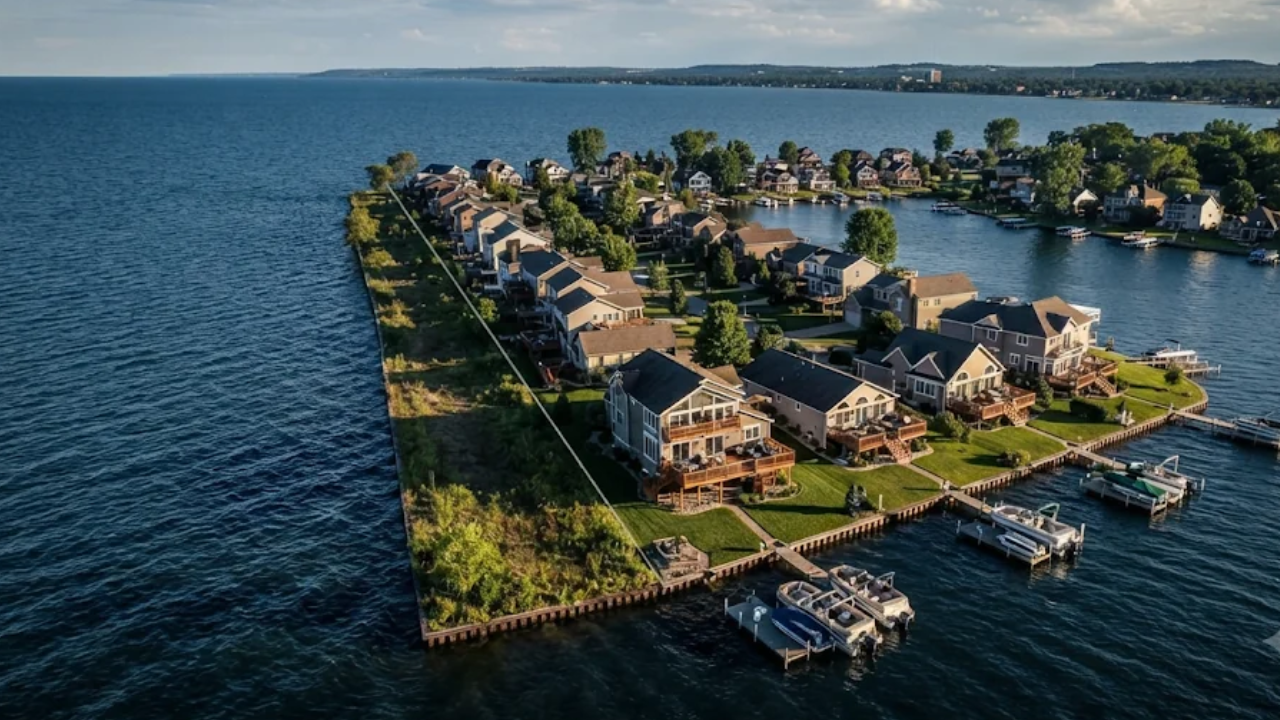
A fresh property survey can look like a routine paperwork chore until it suddenly redraws a neighbor's shoreline. That's what happened along Sandusky Bay in Ohio, where an appeals court just blocked a commercial landowner from claiming a man-made peninsula while still letting the company keep a neighboring beach.
On November 13, 2026, the Ohio Sixth District Court of Appeals issued a split decision in 1643 Limited, L.L.C. v. Shades of Nantucket Unit Owners Assn. (2026-Ohio-4515). If you own waterfront property, share common shoreline amenities, or assume decades of casual beach days lock in permanent rights, this ruling has real teeth. The court protected the Nantucket Drive peninsula from 1643 Limited's ownership claim because the company's own summary judgment filings stopped short of claiming that peninsula land. At the same time, the judges upheld 1643 Limited's title to an adjacent beach area formed by natural shoreline buildup and tossed out the homeowners' attempts to claim it through years of recreation and yard care.
How a 2019 Survey Sparked a Waterfront Fight
Property lines on shifting water are rarely as tidy as a suburban fence. Back in 1947, the U.S. War Department issued a permit allowing construction of a yacht basin in Sandusky Bay, which became Snug Harbor with three man-made peninsulas platted in 1948 and western lots along Nantucket Drive replatted in 1956. That federal permit authorized building bulkheads, dredging, and boathouses around public navigation rights. It didn't hand out fee-simple land titles.
Fast forward to 2017. 1643 Limited bought vacant industrial land at 1643 First Street in Sandusky across two parcels of roughly ten and five acres. Its original deed description didn't include the disputed beach. Two years later, in 2019, the company commissioned a new survey tied to an Ohio Environmental Protection Agency application. That survey produced an expanded legal description covering both the beach and a strip along the western edge of the Nantucket Drive peninsula, where condominium owners and residents along Nantucket Drive had long used the waterfront and built decks, docks, or concrete pads atop protective stone riprap.
In March 2020, after sending letters flagging alleged encroachments and failing to reach a deal, 1643 Limited sued. The Erie County Court of Common Pleas initially sided with the company on key ownership and removal issues, prompting the appeal.
Why the Peninsula Stayed Out of the Company's Hands
Here's the catch that tripped up the lower court's broad land award. Judges aren't supposed to hand a party property rights they didn't actually ask for in their summary judgment papers.
Reviewing the record, the Sixth District found that 1643 Limited had explicitly stated in its summary judgment motion that it was not seeking ownership of any part of the peninsula itself, focusing instead on land lying west of the western peninsula and stating in its reply that it sought no action regarding the western peninsula or removal of residents' riprap. Because the trial court went past those self-imposed boundaries, the appeals court reversed the peninsula ownership award, vacated the ejectment order and permanent injunction tied to the peninsula, and ordered 1643 Limited to obtain a revised property description within 90 days covering only the beach parcel.
Honestly, that procedural discipline is huge for property litigators. A survey can draw a bold new line on paper, yet litigation strategy and court filings still define the battlefield.
Why Decades of Beach Days Didn't Beat Accretion
If you're thinking, "Wait, they swam, hosted gatherings, put in fire pits and picnic spots, and tended trees for over 27 years—doesn't that count?" In Ohio property law, warm memories and weekend upkeep don't automatically equal legal title or an easement.
Accretion and Ohio's 21-Year Bar
Under Ohio law, accretion occurs when water gradually deposits sand, mud, or sediment along a shoreline, adding dry land that an abutting owner can acquire. Ohio also holds Lake Erie waters and submerged lands in public trust under Revised Code 1506.10, while natural shoreline shifts mean today's water edge isn't frozen in time. 1643 Limited presented testimony from registered surveyor John Hancock supporting accretion along the beach, and the appeals court backed the company's legal ownership of that beach area.
To overcome that title through adverse possession in Ohio, a claimant must prove open, notorious, exclusive, adverse, and continuous possession for at least 21 years by clear and convincing evidence. Same goes for a prescriptive easement, which requires proving continuous, adverse use rather than mere permissive or scattered neighborhood enjoyment.
Where the Homeowners' Proof Fell Short
The court pointed out that the homeowners hadn't shown clear and convincing proof of exclusive possession or continuous adverse use by the Shades of Nantucket Unit Owners Association or by specific, identified individual owners. A sworn statement from resident Joyce Byington described activities by individual residents rather than the association itself, without tying specific acts to named property owners in a way that met the legal standard.
Nor did the homeowners lock in acquiescence (mutual treatment of a boundary line by adjoining owners for 21 years) or easement by estoppel (relying to your detriment on misleading conduct or representations about a right to use someone else's land). The appeals court noted it isn't a court's job to cobble together arguments a party didn't properly develop, and there wasn't enough evidence of misleading conduct to support estoppel.
What Waterfront Owners Should Do Next
Litigation over waterlines is expensive, slow, and stressful. Even when you feel like everyone on the block has treated a patch of sand or stone wall the same way for thirty years, paper records and strict proof rules can hit hard.
- Pull your full chain of title and plat history before building decks, docks, concrete pads, or retaining walls—especially near filled channels, bayous, or old industrial parcels.
- Check historical surveys against recent ones whenever a neighbor, developer, or company commissions a new survey for permits or financing.
- Document actual boundaries and written permissions early, and talk to a local Ohio real estate attorney before letting informal habits harden into an expensive court fight.