The days of treating Honiara as a geopolitical wildcard are officially over. At least, that's what Solomon Islands Prime Minister Matthew Wale wants the rest of the Pacific to hear.
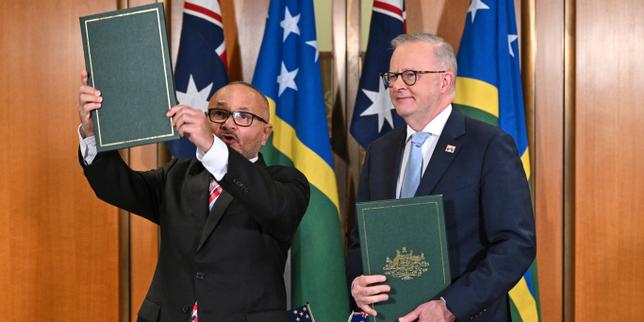
On November 25, 2026, Wale and Australian Prime Minister Anthony Albanese signed a sweeping bilateral treaty in Canberra. The pact names Australia as the Solomon Islands' primary security partner, rules out foreign military bases on Solomon Islands soil, protects critical infrastructure from militarization or foreign interference, and backs the deal with AU$740 million (about US$490 million) over a decade for education, infrastructure, renewable energy, sport, and expanded labor mobility. Taken together with Honiara's move to let its controversial 2022 security pact with Beijing expire rather than renew it in April 2027, the agreement marks the sharpest pushback against China's security ambitions in the South Pacific since the 2022 deal first rattled Canberra and Washington. Learn more on a connected topic: this related article.
If you've watched Pacific diplomacy over the past seven years, you know how fast the ground shifted. In 2019, Honiara abruptly cut ties with Taiwan after 36 years and aligned with Beijing. Three years later, under former Prime Minister Manasseh Sogavare, the country signed a secretive security cooperation agreement with China that raised alarms about Chinese policing deployments and a potential naval foothold roughly 1,600 kilometers from Australia's coast.
Now Wale—who took office after the May 2026 election—is trying to close that chapter. Standing in Canberra, he declared that his country would no longer be a source of regional uncertainty and doubt. That's a bold line, and honestly, it tells you plenty about how much domestic and regional pressure Honiara felt after years of diplomatic whiplash. Further journalism by USA.gov highlights comparable perspectives on this issue.
Why This Australia and Solomon Islands Treaty Matters Right Now
Security treaties in the Pacific rarely succeed on security promises alone. Small island states have heard big promises from outside powers before, often wrapped in jargon about stability while their local schools, clinics, and roads still struggle for basic funding.
What makes this agreement different is the tradeoff between hard security guardrails and everyday domestic priorities. Canberra isn't just asking Honiara to say no to foreign military bases or consult Australia before striking critical infrastructure or security deals outside the Pacific Islands Forum. It's putting AU$740 million over ten years behind education—including a push toward universal access from kindergarten through Year 12—alongside infrastructure, renewable energy, sports, and wider access to the Pacific Australia Labour Mobility (PALM) scheme in sectors like early childhood education and aged care.
That matters on the ground. Roughly a third of Solomon Islands children do not attend school, and fewer than 20 percent finish Year 12. When a leader can point to classroom funding, aged-care visas, and local jobs instead of abstract strategic competition, the treaty has a much stronger chance of surviving future political shifts.
Oliver Nobetau, Pacific Islands program director at the Lowy Institute in Sydney, pointed out to the Australian Broadcasting Corporation that the agreement looks carefully tailored to what Solomon Islands leaders actually prioritize rather than a generic Canberra checklist. That's a fair assessment. For years, critics argued that Western responses to China in the Pacific leaned too heavily on reactive checkbook diplomacy or security warnings. Tying non-militarization commitments to education and labor pathways is a smarter play—though money alone won't erase deep-seated political divisions inside Honiara.
How China Reacted and Where the Fine Print Gets Messy
Beijing didn't blow up publicly, at least not in its talking points. Chinese Foreign Ministry spokesperson Guo Jiakun avoided giving a direct answer on whether Honiara had moved to end the bilateral security pact, sticking instead to familiar phrasing that China's ties with Pacific island nations follow mutual respect and equality and aren't aimed at third parties or bloc confrontation.
Still, behind closed doors, the shift stings. Since 2019, Chinese loans and contractors have been visible across Solomon Islands infrastructure, including ports, airports, energy, and telecommunications. The new treaty's language protecting sensitive infrastructure—explicitly spanning airports, ports, energy, and telecommunications—from militarization, foreign interference, and unauthorized access is aimed squarely at those vulnerabilities.
Yet there's a catch right in the text. The non-militarization and anti-interference provisions are not retroactive. Existing Chinese-built assets or past commercial arrangements don't magically vanish overnight just because a new treaty gets signed in Canberra.
Secrecy clauses add another layer of friction. When pressed by reporters in Canberra about ending the security agreement with China, Wale said non-disclosure provisions restricted what he could say publicly, even as reports from the ABC indicated Honiara had quietly told Beijing it won't renew the five-year deal when it comes up in April 2027. Meanwhile, opposition leader Manasseh Sogavare criticized the pace of the Australian treaty while the status of the Chinese security arrangement remained murky.
Let's be real: that ambiguity isn't going away tomorrow. Geopolitics in the Pacific rarely moves in neat, clean lines, and domestic rivalries in Honiara remain sharp.
Common Misconceptions About the Pacific Security Shift
Plenty of commentators treat any new pact between Canberra and a Pacific capital as a knockout blow that ends Beijing's regional play. That's wishful thinking.
- Misconception 1: A security treaty with Australia erases China's economic footprint. It doesn't. China remains a major trade partner and infrastructure lender across the Pacific, and commercial projects don't stop because a security pact lapses.
- Misconception 2: Pacific island nations are passive pawns. Leaders like Matthew Wale and Manasseh Sogavare have repeatedly used competing suitor dynamics—between Australia, the United States, and China—to extract aid, diplomatic attention, and bargaining leverage. Calling Honiara a "pawn" misses how island governments actually play the board.
- Misconception 3: Every Pacific state is locking arms identically. Canberra has actively built a web of agreements across the region—including a defense pact with Fiji in July 2026 and security treaties with five other Pacific nations—but each country negotiates around its own domestic politics, debt burdens, and regional ties. Treating the Pacific as a single bloc is one of the fastest ways to misread it.
What Comes Next for Watchers, Analysts, and Policymakers
If you're tracking South Pacific security, aid policy, or Indo-Pacific supply chains over the next year, don't stop at the handshake photos from Canberra. Watch what happens on the ground between now and April 2027.
- Track the April 2027 expiration window. Watch whether Honiara formally lets the 2022 policing and security arrangement with China lapse without a quiet replacement or side letter.
- Read the implementation details, not just the joint statement. Pay close attention to how consultation rules work on port, airport, telecom, and energy projects, and how Canberra delivers the AU$740 million education and infrastructure commitments without bureaucratic bottlenecks.
- Watch domestic politics in Honiara. A treaty signed by one government still has to survive parliamentary scrutiny, local grievances, and shifting coalitions in the Solomon Islands.
- Look across the wider Pacific Islands Forum. Check how neighboring states respond to the emphasis on Pacific Islands Forum security responsibility—and whether other capitals push for similar economic-plus-security packages from Canberra or look elsewhere.
Check the Australian Department of Foreign Affairs and Trade treaty announcement for official summary details, and pair that with independent Pacific reporting and think-tank analysis from institutions like the Lowy Institute to judge whether this pact holds up once the ceremony fades.