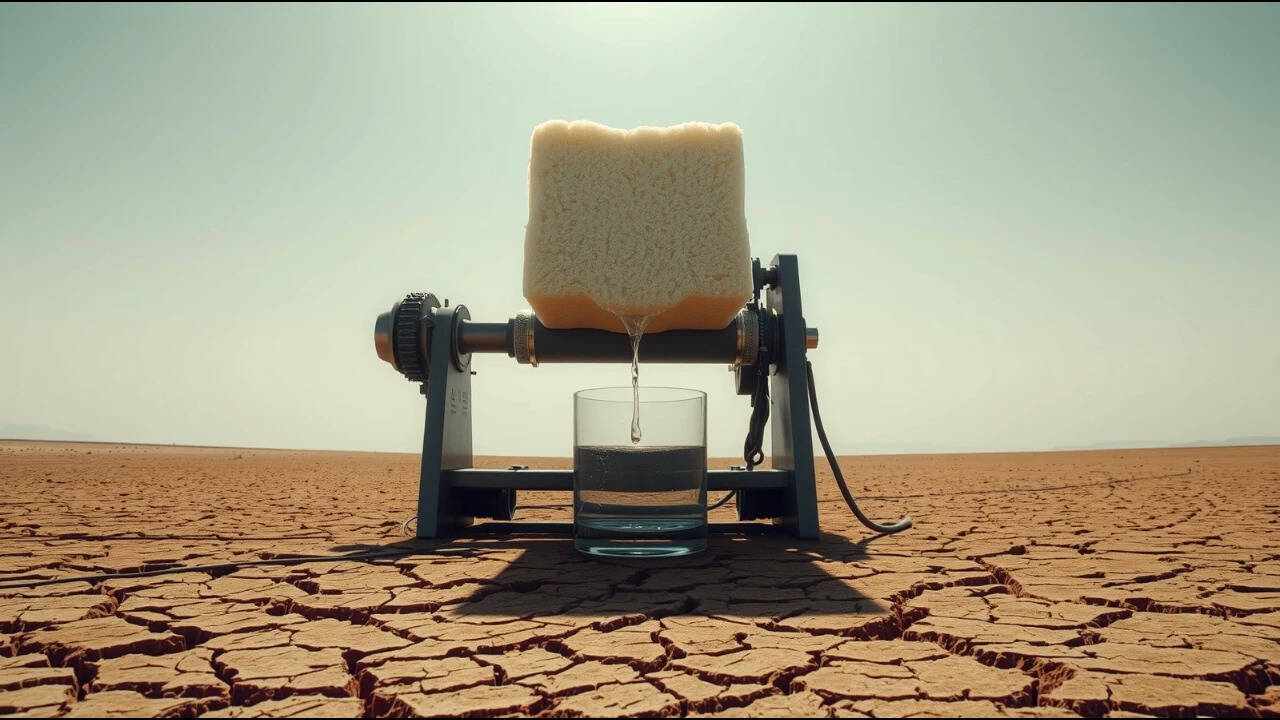
Freshwater scarcity isn't a distant threat anymore; it's a daily reality for millions. Traditional wells run dry, and rainfall grows less predictable by the season. Enter a clever chemical engineering breakthrough coming out of Kiel University in Germany. Researchers there have perfected a sponge-like material that yanks drinkable water straight out of thin air, even when the humidity drops to a bone-dry 18 percent.
Let's look at the numbers. Under those harsh, dry conditions, just one single kilogram of this composite material can churn out up to 1.8 liters of clean drinking water every single day. It sounds like science fiction, but it's grounded in hard chemistry.
Understanding the Metal Organic Framework Behind the Magic
The material itself is known as CAU-10-H. It belongs to a class of compounds called metal organic frameworks, or MOFs. If you haven't heard of MOFs yet, you will soon. The foundational chemistry driving these materials even captured the Nobel Prize in Chemistry.
Think of a MOF as an atomic-scale loofah. It features an intensely porous internal structure packed with countless microscopic, interconnected cavities. At room temperature, these cavities act like a magnet for water vapor floating around in the atmosphere.
Most older atmospheric water harvesting systems demand high humidity to function. They fail completely in arid environments. CAU-10-H flips the script. It starts pulling in moisture the moment relative humidity hits 18 percent.
Solving the Speed Trap of Water Harvesting
Capturing moisture is only half the battle. Older experimental materials usually hit a wall when it comes to releasing the trapped water. They hold onto it too tightly, requiring massive amounts of heat and a full 24-hour cycle to reset.
Professor Norbert Stock and his team at Kiel University's Institute of Inorganic Chemistry solved this bottleneck. They combined CAU-10-H with electrically conductive carbon structures.
This integration allows internal Joule heating or direct sunlight to warm the composite efficiently. Instead of waiting a full day, the material completes a full capture-and-release cycle in just a few hours. Faster cycles mean higher daily output volumes without needing a larger physical footprint.
Laboratory evaluations revealed that the composite absorbs up to 0.17 grams of water for every single gram of material under dry testing parameters. That exact uptake rate drives the 1.8-liter daily yield per kilogram.
Beyond Drinking Water: Reinventing Cooling Systems
Water production is only part of the story. Lead researchers like Kalle Mertin and study author Lasse Wegner point out that this material has a second, massive application: cooling.
Traditional air conditioning relies heavily on energy-sucking compressors. Adsorption-based cooling systems use water vapor cycles instead. When tested inside these systems, CAU-10-H delivered up to three times the cooling performance of silica gel, which has been the industry standard for decades.
By tapping into waste heat from industrial facilities or data centers, these systems could cool buildings while generating fresh water on the side.
Scaling Up From Lab Bench to Pilot Production
Lab breakthroughs often die in academic papers because they're impossible to manufacture cheaply. The Kiel team avoided that trap. They successfully scaled production up to pilot levels, pushing manufacturing costs to roughly $12 to $14 per kilogram.
Real-world trials across hot, dry zones like the Mediterranean will determine how fast this technology moves into commercial deployment. If field tests match laboratory data, remote and arid communities will finally have a reliable, off-grid way to turn dry air into clean drinking water.
Watch how pilot projects integrate these conductive carbon composites into local infrastructure over the next few years.