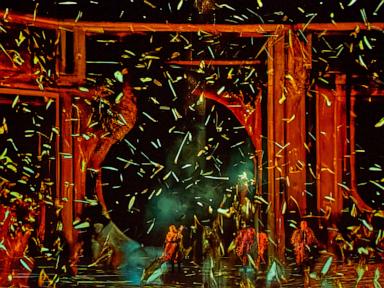
Opera lovers didn't travel to Germany to watch a glorified screensaver. When the legendary Bayreuth Festival kicked off its 150th-anniversary production of Richard Wagner's massive four-part Ring cycle, audiences expected boundary-pushing theater. Instead, they got an automated projection machine that traded human drama for real-time digital noise.
Curated by stage director Marcus Lobbes and his team at the Academy for Theater and Digitality, the production—subtitled From Myth to Code—used artificial intelligence to generate live visuals by scanning 150 years of archival material from past Bayreuth stagings. The software tracked the orchestra and the performers, churning out a continuous stream of associative imagery across a massive proscenium screen.
When the curtain fell on Götterdämmerung, the response was loud, split, and entirely unforgiving. Conductor Christian Thielemann and the cast secured a lengthy ovation, but the creative team walked out to a sharp wave of boos, whistles, and frustration.
What Actually Happened on Stage
If you expected robots or computers acting as characters, you misunderstood the experiment. Festival organizers made it clear beforehand that the technology wouldn't perform. It acted purely as an image-generating engine.
Singers like bass-baritone Michael Volle and tenor Klaus Florian Vogt spent hours stranded behind a massive gauze projection screen. They wore uniform, minimalist costumes while a hyperactive visual cosmos swirled around them.
The system fed on roughly 1,000 historical images, mining a century and a half of cultural memory. Because the algorithm generated associations in real time, no two performances were identical. Sounds promising on paper, right? In practice, it turned into a chaotic collage.
Spectators watched a dizzying loop of shifting textures. Mutant hands sprouted extra fingers. The blurry faces of historical figures—including former German Chancellor Helmut Kohl—flashed by alongside stock photos of scrap metal, water droplets, and greenery. A random historical photo of emaciated African youths flickered across the screen during Die Walküre, leaving viewers bewildered by the jarring and unexplained colonial imagery.
Why the Audience Booed
Audiences didn't reject the production simply because it featured computers. They rejected it because the software failed to build any actual drama.
Wagner spent his life obsessing over the Gesamtkunstwerk—the total work of art where music, poetry, staging, and visual design fuse into a single emotional punch. This production did the exact opposite. It treated sound and vision as two completely separate tracks.
While Thielemann coaxed soaring, magnificent moments from the orchestra pit, the screen displayed a relentless flood of digital bric-a-brac. When Wotan delivered a devastating monologue filled with heavy emotional silence, the screen refused to breathe. It kept hyperactively morphing, destroying the tension that the singers and musicians worked so hard to build.
People grew tired of looking at a screen that felt disconnected from the stagecraft. Technology in opera should serve the story, not hijack it.
The Bigger Picture for Classical Arts
Bayreuth has always courted controversy. Wagner himself built the Festspielhaus to break away from 19th-century staging conventions. Innovation is baked into the festival's DNA.
Yet relying on an algorithm to free-associate through history highlights a fundamental misunderstanding of creative limits. Generative systems remix patterns. They do not possess dramatic judgment, empathy, or historical understanding. Feeding a database a century of archival files cannot replace a director who understands why a character makes a heartbreaking choice.
When you let software call the shots without human emotional editorializing, you get a performance that looks busy yet feels entirely empty.
Opera houses looking toward the future should take note. Audiences will tolerate bold risks, strange concepts, and jarring modern updates. What they won't forgive is art that forgets how to make people care.
Check the lineup before buying tickets to experimental classical performances, and always look past the tech gimmick to see who is actually driving the artistic vision.