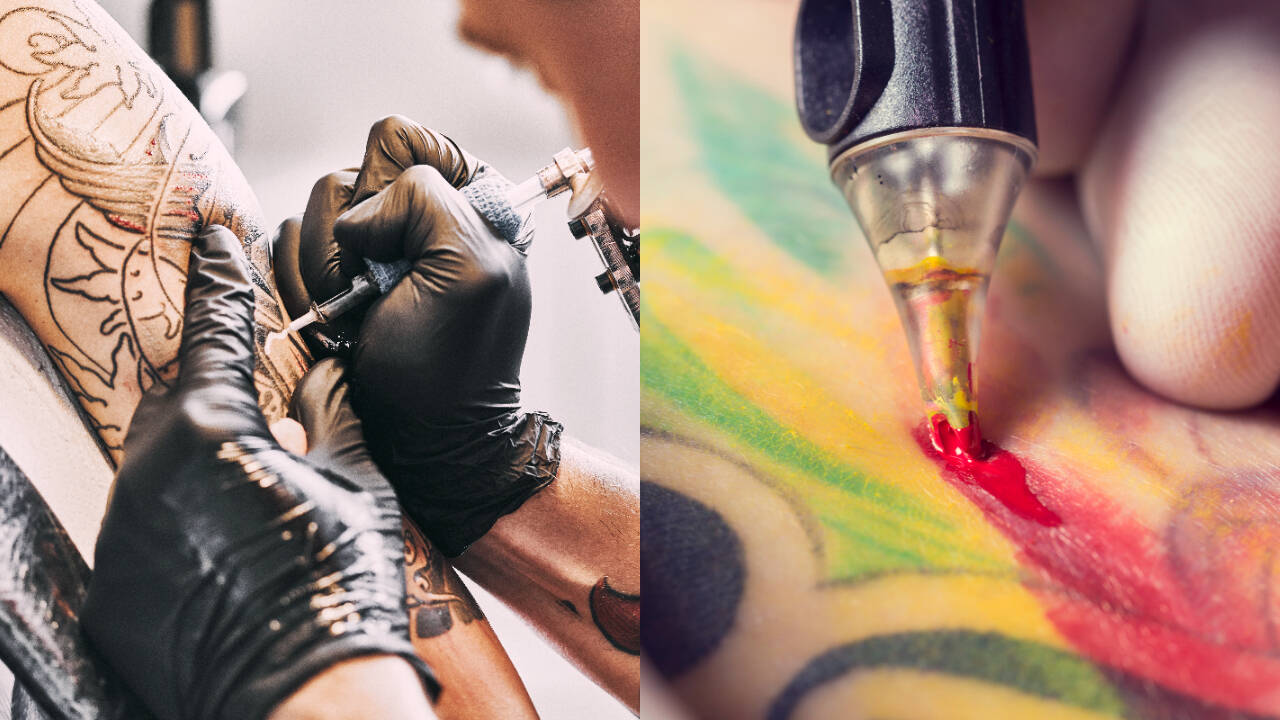
Tattoos have always demanded permanent commitment. You sit in a chair for hours, bleed a little, pay a small fortune, and live with the ink forever unless you want to endure painful, expensive laser removal sessions. But researchers are changing the rules of body art by building tattoo inks that can be switched on with ultraviolet light and made to disappear entirely when exposed to ordinary sunlight.
Developed by teams including biomedical engineering researchers like Carson Bruns at the University of Colorado Boulder, this technology goes by the name PhotoTat. Instead of traditional heavy metal or carbon-based pigments that remain trapped forever in the dermis, PhotoTat utilizes specially engineered photochromic dyes enclosed inside tiny nanoparticles made of polymethyl methacrylate—a glass-like plastic commonly used in medical implants and dermal fillers.
How does it actually perform in practice? The system relies on three primary color channels: blue, magenta, and yellow. When exposed to a 365-nanometre ultraviolet LED for about two to three seconds, these pigments alter their molecular structure and switch on. Under indoor lighting, they stay visible for hours or even days. Step outside into bright outdoor sunlight, however, and ultraviolet exposure makes them fade away within seconds.
Crucially, the ink doesn't instantly vanish from your body when you walk outside. The physical pigment particles stay right where they are in the skin, but their visible appearance toggles based on light exposure. In laboratory and live tests, researchers found that these color channels remained switchable in living skin for periods ranging from 1.4 to 2.2 years before degrading or losing their responsiveness.
The Mechanics Behind Light Reactive Body Art
If you look closely at how these dyes function, the chemistry gets fascinating. Different wavelengths trigger different sections of a custom design. For instance, you can activate magenta elements using green light, or bring out yellow pigments with blue light.
You aren't restricted to purely temporary pieces, either. Artists can layer these light-sensitive compounds alongside conventional permanent black tattoo ink. Imagine a permanent black outline that conceals hidden details inside it. Those details remain completely invisible until you hit them with the correct wavelength of light, giving your skin a dynamic, multi-layered visual dimension.
Carson Bruns has tested successive iterations of this ink on his own skin, arranging various formulations into scale-shaped tattoos. By tracking how individual pigments respond over months and years, the team has managed to map out durability issues, light fatigue, and immune system reactions.
Moving Beyond Aesthetics Into Medicine
While changing your ink for a weekend party sounds fun, the real value of PhotoTat lies in clinical settings.
Patients undergoing radiation therapy for cancer frequently receive small permanent tattoo dots. These tiny marks help oncology teams align linear accelerators and radiation beams with extreme precision. Once the treatment finishes, those permanent dots serve as an unwanted reminder of a difficult period in the patient's life. PhotoTat offers a clean solution. The alignment markings can be switched on precisely when needed during treatment sessions and made to disappear once therapy concludes.
Surgeons face similar challenges when mapping incisions or procedural coordinates on a patient's body. Temporary visual markers that respond to specific light sources could guide clinicians through complex operations without leaving permanent marks behind once the sutures heal.
Beyond standard surgery and oncology, researchers have experimented with smart tattoos designed to track individual ultraviolet exposure or warn workers about hazardous gamma radiation levels in nuclear or industrial environments. These functional applications turn body art into a bio-sensor.
Hurdles and Real-World Limitations
Let's be realistic about where this technology stands right now. It is far from replacing your local tattoo parlor's traditional ink supply.
First, commercial availability is minimal. So far, only a basic purple ink version has made it to market following third-party medical testing, retailing for roughly one hundred dollars for a small bottle. Scaling production down to affordable consumer pricing remains a massive hurdle.
Second, long-term safety data is still developing. Introducing PMMA nanoparticles and photochromic chemical compounds into human skin requires extensive biocompatibility trials. While animal and early human trials up to 2.2 years show promising stability, scientists must prove that prolonged UV-switching cycles don't break down into toxic byproducts or trigger chronic inflammatory responses over decades.
Finally, application technique requires specialized tools. Tattoo artists cannot simply load these nanoparticles into an old coil machine without understanding how UV-curing and light exposure affect the healing process.
What Comes Next for Switchable Ink
If you are thinking about getting a light-switchable tattoo tomorrow, hold off. You will need to wait as researchers work on expanding the color palette beyond basic purple and blue, lowering manufacturing costs, and completing rigorous safety evaluations.
Yet the shift is undeniable. Body art is moving away from permanent permanence toward adaptive flexibility. Whether you want a design that fades for a corporate job interview or a medical team needs a surgical marker that vanishes after healing, light-reactive pigment technology is rewriting what ink can do beneath the surface.