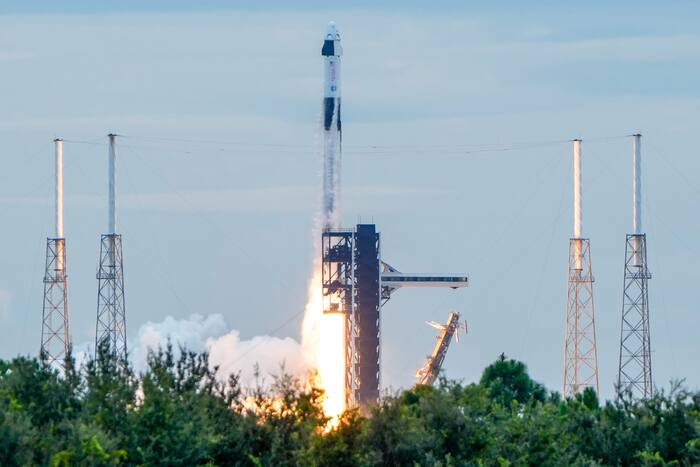
Four astronauts just blasted off toward the International Space Station on a blistering eight-hour transit. If you think routine rocket launches have become boring, think again. This flight, designated Crew-13, just shattered glass ceilings and brought a whole new meaning to long-distance parenting.
NASA commander Jessica Watkins led the charge from Cape Canaveral, making history as the first Black woman to command a crewed orbital flight. Joined by NASA pilot Luke Delaney, Canadian Space Agency colonel Joshua Kutryk, and Russian cosmonaut Sergey Teteryatnikov, the quartet boarded a SpaceX Falcon 9 after weathering a tense three-week delay caused by a stubborn capsule fuel system leak.
When you look past the standard mission briefings, the human elements of this flight reveal why space exploration still captures our collective imagination.
Breaking Records and Overcoming Delays
Getting this crew off the pad wasn't easy. Weather threatened to scrub the countdown right up until ignition. Thick clouds hovered over Cape Canaveral Space Force Station, and engineers spent weeks scrutinizing propulsion components.
The three-week hold tested everyone's nerves. Yet, once the clearance came, the Falcon 9 rocket delivered a textbook ascent from pad 40.
For Watkins, this marks her second trip to the orbiting laboratory following her 2022 stint. Her path from studying Martian geology with NASA's Curiosity rover to commanding a spaceflight showcases an extraordinary career trajectory.
The Logistics of a Space Station Fatherhood
Space is lonely. It is also remarkably busy. For Joshua Kutryk, the mission comes with a uniquely high-stakes personal timeline. His wife, Heather, is expecting their third child in late November.
Kutryk is set to become only the fourth man in history to welcome a child while orbiting Earth. Previous spacefaring fathers managed the distance via scheduled radio links and telephone patches from orbit.
NASA and the Canadian Space Agency have established robust communication protocols to keep Kutryk looped in when the big day arrives. It highlights a fascinating shift in astronaut demographics. Modern spacefarers are active parents balancing grueling career demands with family milestones happening hundreds of miles below them.
Embracing the Spirit of Apollo 13
The crew named their mission patch after Apollo 13, riding to the launchpad in black Teslas fitted with license plates reading "Lucky 13."
That nod to history isn't just about superstition. It acknowledges the calculated risks inherent in human spaceflight. Even with reusable boosters and advanced Falcon 9 telemetry, launching humans on top of controlled explosions remains hazardous work.
The crew's camaraderie reflects an international coalition that continues to function despite terrestrial geopolitical friction. While diplomatic tensions flare on Earth, American, Canadian, and Russian astronauts train together, fly together, and rely on each other for survival aboard the station.
What Happens Next for Crew 13
Over the next six months, the newly arrived quartet will conduct hundreds of scientific experiments, maintain station hardware, and eventually welcome subsequent commercial cargo and crew vehicles.
They are replacing the long-duration residents who arrived back in February. As Crew-13 settles into orbit, their fast-track arrival proves that commercial space transit has evolved from experimental gamble into reliable routine.
Keep an eye on upcoming orbital updates as humanity's presence in low-Earth orbit continues to expand.