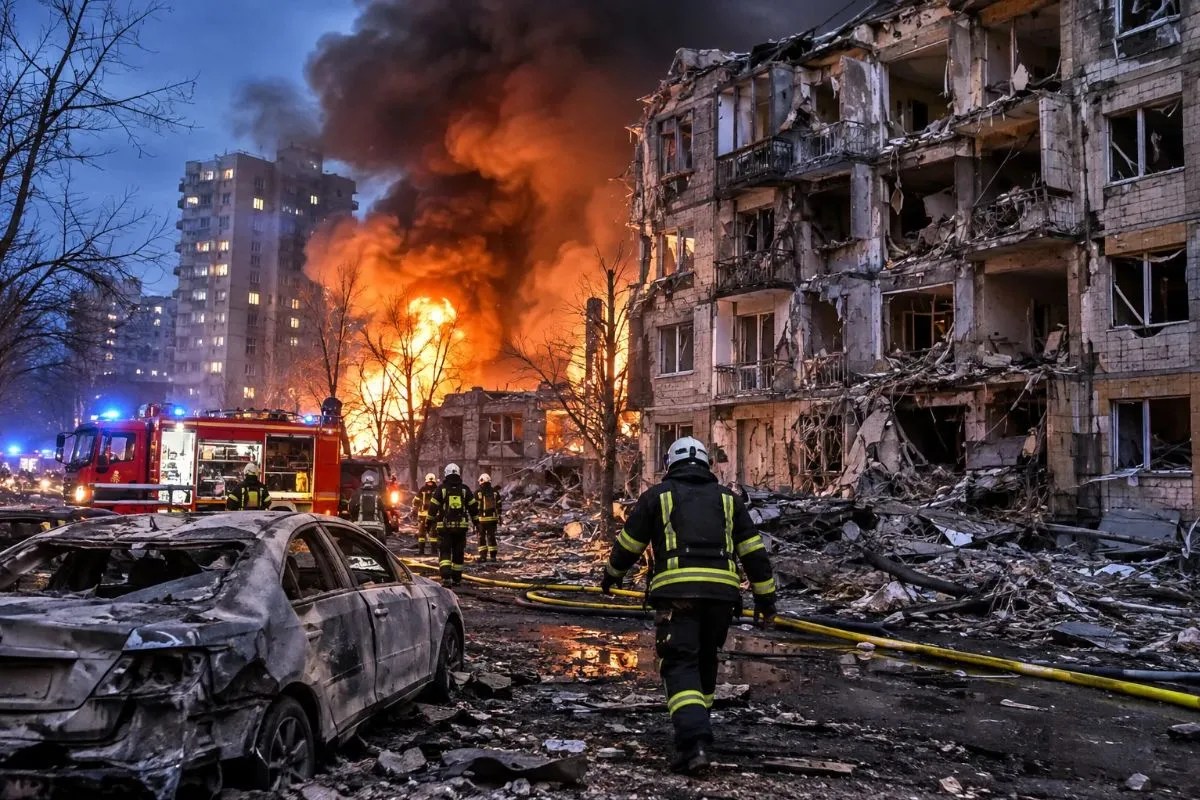
Explosions echoed over Kyiv all night, and by morning parts of the capital were dark, cold, and struggling for basic utilities. Short news briefs often reduce a night like that to a tidy casualty tally and a list of districts without power. Honestly, that misses the real story.
When Russian missiles and drones slam into Kyiv's energy infrastructure, the damage doesn't stay neatly contained inside a single transformer or substation. Power goes out, sure. Then water pressure drops, district heating falters, cross-river bridges take hits, and emergency outages ripple across multiple regions as grid operators scramble to keep the whole system from cascading. Don't miss our recent post on this related article.
Let's be clear about what the numbers look like right away because the fog of war makes early tallies messy. Reporting around the November 20, 2026 barrage noted three deaths and nine injured in initial Kyiv dispatches—the exact figures highlighted in early coverage—while broader updates from Ukrainian officials and outlets later reported higher tolls across the capital and wider country as emergency crews worked through debris. Private energy provider DTEK pointed to power disruptions across major parts of five Kyiv districts—Pecherskyi, Solomyanskyi, Holosiivskyi, Dniprovskyi, and Darnytskyi—as strikes hammered critical infrastructure.
That gap between early reports and updated counts happens in almost every major aerial assault. First responders are still digging through rubble at dawn while air raid alerts are only just lifting. If you want more about the background of this, NBC News provides an in-depth breakdown.
Why Kyiv Power Outages Threaten More Than Lights
People who haven't lived through a winter grid strike usually picture a cozy annoyance—flashlights, a dead phone, maybe eating cold food for dinner. In Kyiv, a major blackout is a domino chain.
High-rise apartment blocks depend on electric pumps to push water up upper floors and circulate heat through municipal district networks. Cut the electricity or hit a critical utility facility, and residents quickly lose lights, running water, and warmth at the same time. Mayor Vitali Klitschko reported damage to critical infrastructure, and strikes hitting bridges and transport arteries complicate how ambulances, repair crews, and commuters move across the Dnipro River.
Look at why timing matters so much in late November. Winter isn't a vague future threat in Ukraine—temperatures are sliding toward freezing right as demand climbs. Knocking out substations and high-voltage links at this exact moment puts maximum pressure on every remaining megawatt.
According to reporting on the November 20 assault from outlets including The Kyiv Independent and NV, strikes also hit energy lines tied to nuclear power generation and cross-border links, forcing Ukraine's operational nuclear plants to cut output and triggering emergency outages across multiple regions. That's the part quick summaries skip: you don't even have to score a direct hit on a reactor hall to force a nuclear plant to dial back generation. Knocking out key transmission lines and substations forces grid operators to throttle output for safety and stability.
The Hidden Strain On Nuclear And Cross-Border Power
A lot of folks assume nuclear power makes a grid immune to blackouts. It doesn't work that way in real life.
Nuclear plants are baseload workhorses, not instant light switches. When high-voltage transmission lines or switchyards take damage, operators have to reduce generation capacity rapidly so the grid doesn't trip into wider instability. Deputy Energy Minister Artem Nekrasov has noted how strikes on power plants, substations, and transmission lines force generation cuts and emergency outages across regions.
Cross-border interconnections with neighboring European grids help balance supply when domestic generation is strained, yet they can't magically bypass damaged domestic transformers or local distribution lines. A city still needs intact step-down equipment and local lines to get electricity into apartments.
What Makes Grid Repair So Brutal In Practice
I've followed grid resilience and infrastructure recovery closely enough to know one hard truth: fixing a wire is easy; replacing heavy high-voltage gear under fire is a nightmare.
A standard distribution line can sometimes be spliced in hours. A damaged high-voltage autotransformer or specialized switchgear? That can take weeks or months, depending on spares, logistics, and whether the site gets hit again while crews are working.
Analysts at the Armed Conflict Location & Event Data project (ACLED) have pointed out that repair crews themselves face rising danger, including drone threats near substations, alongside shortages of interceptor missiles and constraints on satellite communications. Try doing precision electrical work with a spotter watching the sky and a spare part sitting hundreds of miles away.
Here is a practical mistake people make when judging recovery speed: they assume "lights back on" means "problem solved." Often, engineers reroute power through temporary paths that are fragile. One more strike on a nearby substation can knock the same neighborhood dark all over again.
Drone Swarms, Low-Flying Missiles, And Air Defense Math
Why do waves of dozens or hundreds of drones and missiles still get through despite layered air defenses? Pure math and physics.
Air defense interceptors—especially high-end systems like Patriot PAC-3 missiles—are expensive and produced in limited numbers. Firing a multi-million-dollar interceptor at every cheap decoy or long-range strike drone isn't sustainable over months of war.
Analysis from the Atlantic Council highlights how incoming drones and missiles have adapted to fly lower, hug terrain or cloud cover, and complicate detection and interception. Even when air defenses shoot down a high percentage of incoming targets, falling debris or the few projectiles that slip through can still hit a transformer yard, a water main, or a residential block.
It's a war of attrition where defense has to be right almost every time, while offense only needs a few hits to cause serious disruption.
Sorting Signal From Noise When Breaking News Hits
When a major strike hits Kyiv, social media fills up fast with unverified claims, recycled photos from earlier months, and conflicting casualty numbers. You don't need to panic-scroll every feed to stay informed.
First, treat initial casualty counts as provisional. Early figures—like three dead and nine injured in initial dispatches from Kyiv—often rise or shift as emergency services clear debris and confirm identities.
Second, separate local outages from system-wide shortages. A district might lose power because a local cable or substation took damage, even if total generating capacity isn't zero. Conversely, emergency rolling blackouts across multiple oblasts usually point to transmission bottlenecks or forced generation cuts.
Third, watch official utility operators and established newsrooms rather than anonymous rumor accounts. Updates from DTEK, Ukraine's Energy Ministry, municipal leaders, and verified reporting give you a much clearer picture of whether heat, water, and power are stabilizing or deteriorating.
Practical Steps For Readers Following Or Supporting Relief
If you're tracking the crisis from abroad and want to do something concrete rather than just doomscrolling, start small and verify where your money goes.
- Check organizational track records before donating. Look for established humanitarian groups, medical relief organizations, or vetted aid initiatives with transparent reporting on how funds reach civilians and utility workers.
- Avoid unverified fundraiser links. Scammers routinely spin up fake appeals within hours of major attacks using dramatic photos from past incidents.
- Read cross-checked reporting. Compare updates across multiple reputable outlets and watch how figures evolve over 24 to 48 hours instead of locking onto the very first post.
- Focus on winter essentials. When power and heat fail in freezing weather, backup power, warm clothing, medical supplies, and clean water support matter most on the ground.
Every night like this reminds us that modern cities run on delicate, interconnected systems—and when those systems are targeted on purpose, the toll reaches far beyond a single dark street.
Russian strikes devastate Ukraine's power grid as winter approaches
This video adds visual context on how sustained strikes damage power generation and transmission equipment in Ukraine ahead of winter.