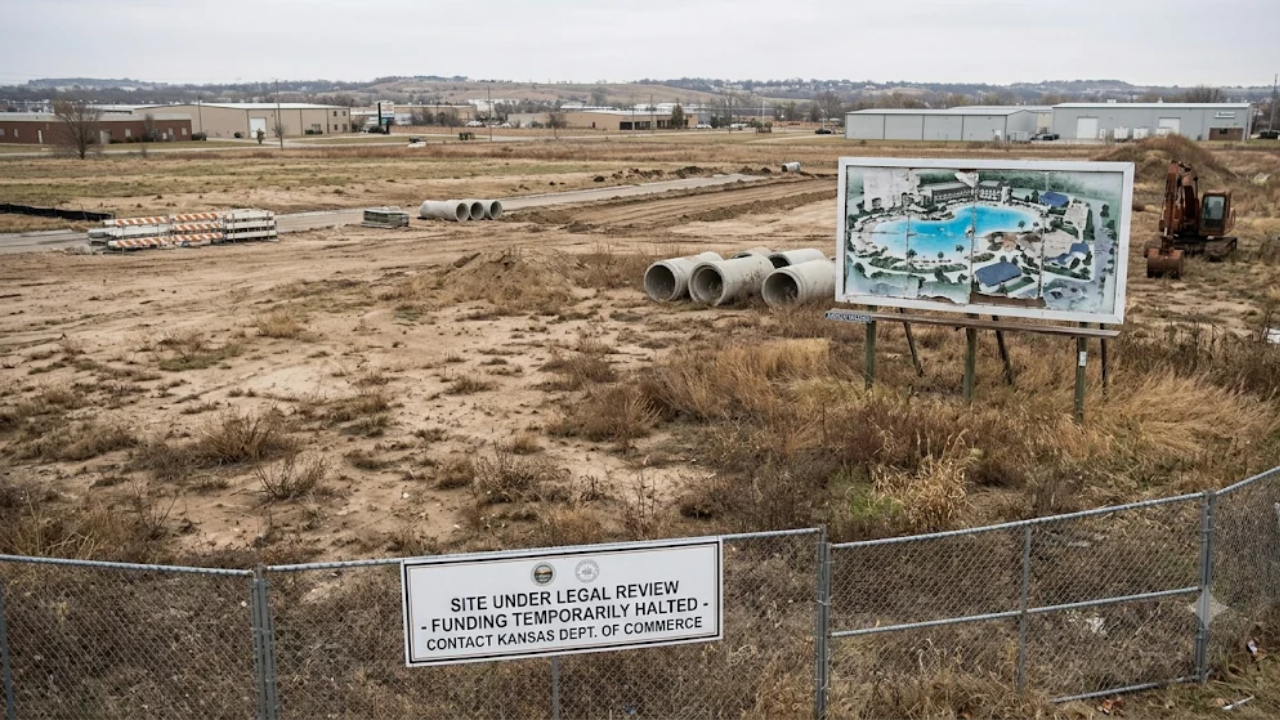
Four years ago, Kansas officials made a massive bet on a sparkling oasis. Today, that bet looks like an empty field of weeds. The state Department of Commerce just took legal action in Sedgwick County District Court to freeze public bond funding for Derby Shores, a planned 160 million dollar mega-resort that still has zero above-ground buildings on its property.
When millions in public-backed debt get spent on a project and years pass without vertical construction, taxpayers have every right to ask what went wrong. If you look closely at how these public financing deals get structured, the Derby Shores mess highlights the exact dangers of relying on sales tax revenue to fund private tourist fantasies. For another perspective, read: this related article.
The Grand Vision Versus the Empty Lot
Back in 2022, the pitch for Derby Shores sounded incredible. Developers planned a 40-acre destination centered around a massive 4.5-acre lagoon featuring water sports, a hotel, apartments, senior housing, waterfront dining, ziplines, and an outdoor event space. The original budget hovered around 130 million dollars before local developers Dave Murfin and Rick Worner brought in Rodney Steven II, the founder of Genesis Health Clubs. Steven took charge of expanding the lagoon concept, determined to build a major regional draw.
The project tied into a larger 100 million dollar sales tax and revenue, or STAR, bond district established by the city of Derby back in 2018. STAR bonds are unique because future sales tax dollars collected inside the special district pay off the project bonds instead of flowing directly into the State General Fund. Similar insight regarding this has been shared by Al Jazeera.
That sounds harmless on paper until you realize who actually carries the financial risk. Kansas lawmakers know taxpayers absorb the hit if a project stalls, which is why state law explicitly requires construction to kick off within two years of project approval.
The Deadline Debate and Broken Timelines
Announced opening dates have come and gone with nothing to show for it. The state approved the project plan on May 10, 2022, and sold over 35.2 million dollars in bonds that July.
When state regulators checked on the site years later, they found nothing standing. Lawyers for the developers tried arguing that construction technically started in January 2023 when workers knocked down an old barn and a farmhouse on the land. State officials weren't buying that loose definition of construction, pointing out that the city's own 2026 report to the state admitted actual construction didn't begin until 2026.
City manager Kiel Mangus noted that underlying infrastructure work like roads, drainage, land grading, and sewers is nearly complete. But basic grading and underground pipes don't pay off bonds or entertain tourists looking for a weekend getaway. The state lawsuit notes bluntly that whatever ground was cleared in the past has simply gone back to weeds.
What the State Wants Now
The Kansas Department of Commerce isn't trying to blow up the entire STAR bond district or cancel Derby's underlying agreements. They also aren't demanding the return of money that was legitimately spent on approved project costs up to this point.
Instead, the state is asking a judge to block any further bond payments, account for the 35.3 million dollars already sold, and apply any unexpended proceeds directly toward retiring the existing bonds. If the developers want to keep chasing their resort dream, the state maintains they can reapply under the STAR Bond Act once they actually meet the legal requirements.
City officials in Derby are still figuring out their next move while hoping for an amicable resolution with private partners who haven't returned calls for comment. Local leaders are caught between private developers demanding funds be released and state regulators enforcing statutory deadlines meant to protect the public treasury.
STAR bonds and public-private partnerships are supposed to supercharge local economies by bringing tourists and jobs to smaller markets. But when oversight fails and projects sit as vacant dirt lots years after millions in bonds change hands, the public loses patience fast. Kansas is drawing a hard line in the courtroom, and other states watching municipal financing deals will likely take notes.