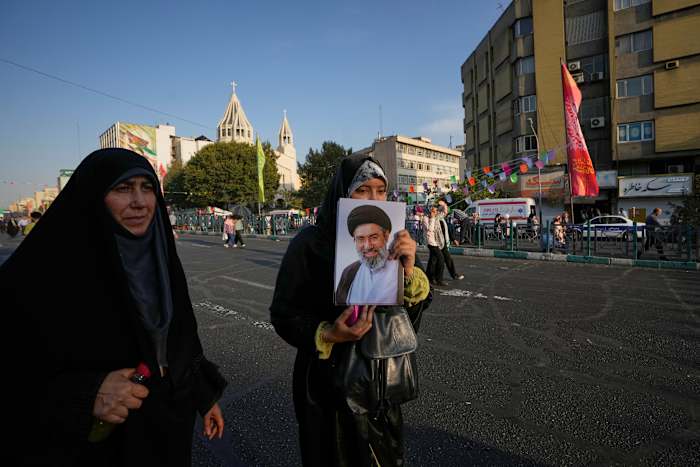
Geopolitical shifts never happen in a vacuum. When Iran's supreme leader, Ayatollah Mojtaba Khamenei, issued a public letter urging Muslim nations to band together against the United States and Israel, he wasn't just tossing standard rhetoric into the wind. He was capitalizing on a region already boiling over from months of direct warfare, shifting defense pacts, and escalating violence across the West Bank and Gaza.
If you look past the standard political theater, this latest call for solidarity exposes deep fractures within the Islamic world. Tehran wants a united front. Yet, its own military actions against neighboring Gulf Arab countries and ongoing shipping restrictions in the Strait of Hormuz have pushed many regional neighbors away rather than drawing them closer.
The Strait of Hormuz Flashpoint
The military math in the Gulf remains volatile. U.S. forces recently executed what military officials described as a limited, precise strike against Iranian rocket launchers and minelaying forces in the Strait of Hormuz. This marked the first direct U.S. military action against Iran in a month, breaking a brief lull in a conflict that has dragged on for over half a year.
Iran didn't stay quiet. State television broadcast footage showing ballistic missiles fired toward U.S. bases in Jordan. Jordan's armed forces confirmed intercepting eight missiles that breached their airspace.
Meanwhile, commercial shipping continues to pay the price. A monitoring agency run by the British military reported that an unknown projectile struck a tanker ship north of Khasab, Oman. No environmental disaster or casualties resulted, but the underlying risk to global energy transit remains high. Tehran's strategy relies heavily on choking economic lifelines to pressure Western powers, but it also alienates local trade partners who depend on open sea lanes.
Shifting Alliances in Istanbul and Beyond
While Tehran rallies for ideological alignment, other regional powers are drawing their own hard lines. Turkey is hosting senior officials from Saudi Arabia and Pakistan for high-stakes strategic talks. This follows a major defense agreement signed earlier in the month, which stipulates that an armed attack on any of the three nations will be treated as an act of aggression against all of them.
The inclusion of Pakistan's army chief, Field Marshal Asim Munir, alongside top diplomats highlights a growing cross-regional security network. This axis operates independently of both Western oversight and Iranian command. It shows that major Muslim-majority countries are choosing alternative bilateral security arrangements over Tehran's vision of resistance.
West Bank Pressures and Media Hazards
Violence on the ground in the West Bank continues to spiral, creating massive headaches for political leaders. Masked settlers recently attacked an NBC news crew—including correspondent Matt Bradley—while the journalists were interviewing a Palestinian woman displaced from her home. Footage showed attackers wielding sticks and smashing vehicles.
Prime Minister Benjamin Netanyahu issued rare public condemnations of violent settler factions, calling them a small group of young people whose actions harm the broader settlement project and damage international perception. Yet, human rights critics argue that harsh rhetoric fails to curb ongoing abuses.
In a separate incident, settlers detained a British activist named Finn Joughin in a Palestinian village, locking him in a shed before handing him over to police. His defense lawyer argued the arrest was purely political, noting that authorities quickly moved toward deportation without a proper hearing. British embassy officials have since raised the case with Israeli authorities.
The Cost of Protracted Conflict
In Gaza, the human toll mounts daily despite fragile past ceasefire attempts. An Israeli strike in western Deir al-Balah killed a three-year-old child and a man the military designated as a Hamas operative. Local hospital records underline a grim reality: thousands have died since hostilities flared years ago, with the Gaza Health Ministry maintaining casualty tracking that independent experts and United Nations agencies view as fundamentally reliable.
At the same time, high-level security measures dictate daily life elsewhere. Israel's Shin Bet security agency urgently evacuated Prime Minister Netanyahu's oldest son, Yair Netanyahu, from the United States following a significant, unelaborated security threat. Netanyahu previously mentioned that Iranian operatives had targeted members of his family, underscoring how personal the wider shadow war has become.
Geopolitical alignments won't rewrite themselves overnight. Iran's push for a united anti-Western front collides directly with the reality of regional self-preservation. Neighboring states prefer concrete security pacts over ideological slogans. Watch the borders, monitor the shipping lanes, and keep an eye on how these new defense alliances respond to the next escalation.