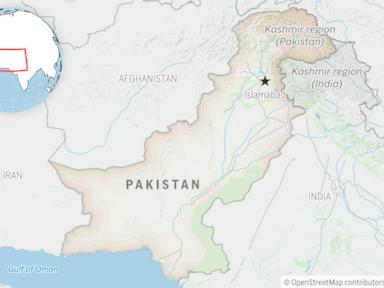
Security forces across Pakistan have stepped up operations significantly, announcing a staggering death toll of 74 suspected insurgents over a concentrated 10-day span. If you follow regional security trends, these figures aren't just isolated numbers. They represent a brutal, grinding escalation along the rugged borderlands with Afghanistan.
The military's public relations wing detailed operations spanning multiple hotspots, including intense raids in the northwest districts of Mir Ali and Orakzai within Khyber Pakhtunkhwa province, alongside separate sweeps in the volatile southwestern province of Balochistan. Troops recovered caches of explosive devices, automatic weapons, and ammunition from subterranean hideouts. Expanding on this idea, you can find more in: When Winter Rain Hits Gaza Survival Becomes An Impossible Calculation.
Why
Why Pakistan Army Operations Against Militants Keep Reshaping Regional Security
news Analysts at USA Today have also weighed in on this trend.
The headlines out of Islamabad rarely tell the whole story. When the military announces a major security sweep, the numbers roll in fast: dozens of fighters killed, hideouts destroyed, weapons seized. Recently, the Pakistani military reported taking down 74 militants across targeted raids. It sounds like a clean victory on paper. Reality on the ground is messier, more violent, and deeply tied to years of shifting geopolitical fault lines.
If you want to understand why these large-scale counter-terrorism operations keep happening, you have to look beyond the press releases. You have to look at the porous borders, the ideological splintering of extremist groups, and a state caught between internal security collapse and external pressure.
The Reality Behind the Numbers
Numbers like 74 dead militants grab attention. They serve a vital purpose for military public relations, signalling strength to a domestic population exhausted by violence. But numbers don't capture the attrition rate of a protracted insurgency.
Insurgent networks in regions bordering Afghanistan aren't traditional armies. They don't wear standard uniforms or hold fixed territory for long. They operate in rugged terrain, blending into local populations or retreating across mountainous boundaries when pressure mounts. When security forces strike a network, the leadership often fractures rather than disappears entirely.
Think of it like clearing weeds from an overgrown field without pulling the roots. You get an immediate clean look, but growth returns with the next rain.
Why the Border Dynamics Matter
You cannot talk about security operations in Pakistan without talking about the western frontier. The political landscape shifted dramatically when the Afghan Taliban regained power in Kabul. Security planners in Islamabad hoped a friendly regime next door would clamp down on groups targeting the Pakistani state, specifically the Tehreek-e-Taliban Pakistan, known as the TTP.
That hope didn't pan out the way strategists planned.
Instead, cross-border infiltration remains a persistent headache. Militant factions find ideological sympathy and logistical breathing room across the border. When Pakistani forces launch raids, the pressure forces these fighters to move, adapt, and strike back through asymmetric warfare—suicide bombings, targeted assassinations of police officers, and attacks on remote outposts.
The Cost Felt by Civilians
Military campaigns carry an immediate human cost that rarely makes it into top-tier statistical summaries. Communities living in the former tribal areas and border provinces bear the brunt of the instability. They are caught between the kinetic force of state operations and the intimidation tactics of insurgent groups.
Displacement is a constant threat. Local economies struggle to find footing when security conditions remain volatile. Trust between local populations and the central government frays when people feel over-policed or under-protected. Winning a tactical skirmish means little if the strategic victory—winning local allegiance—slips away.
Looking Ahead at Regional Stability
The cycle of raids, high death tolls, and retaliatory threats will likely define the security calendar for the foreseeable future. A lasting solution requires more than kinetic force. It demands economic development in marginalized regions, genuine intelligence sharing across international borders, and a political consensus on how to handle violent extremism without plunging civilian populations into endless crisis.
Pay attention to how these operations shift from high-profile raids to long-term holding actions. That transition dictates whether a military campaign is a temporary fix or a turning point.