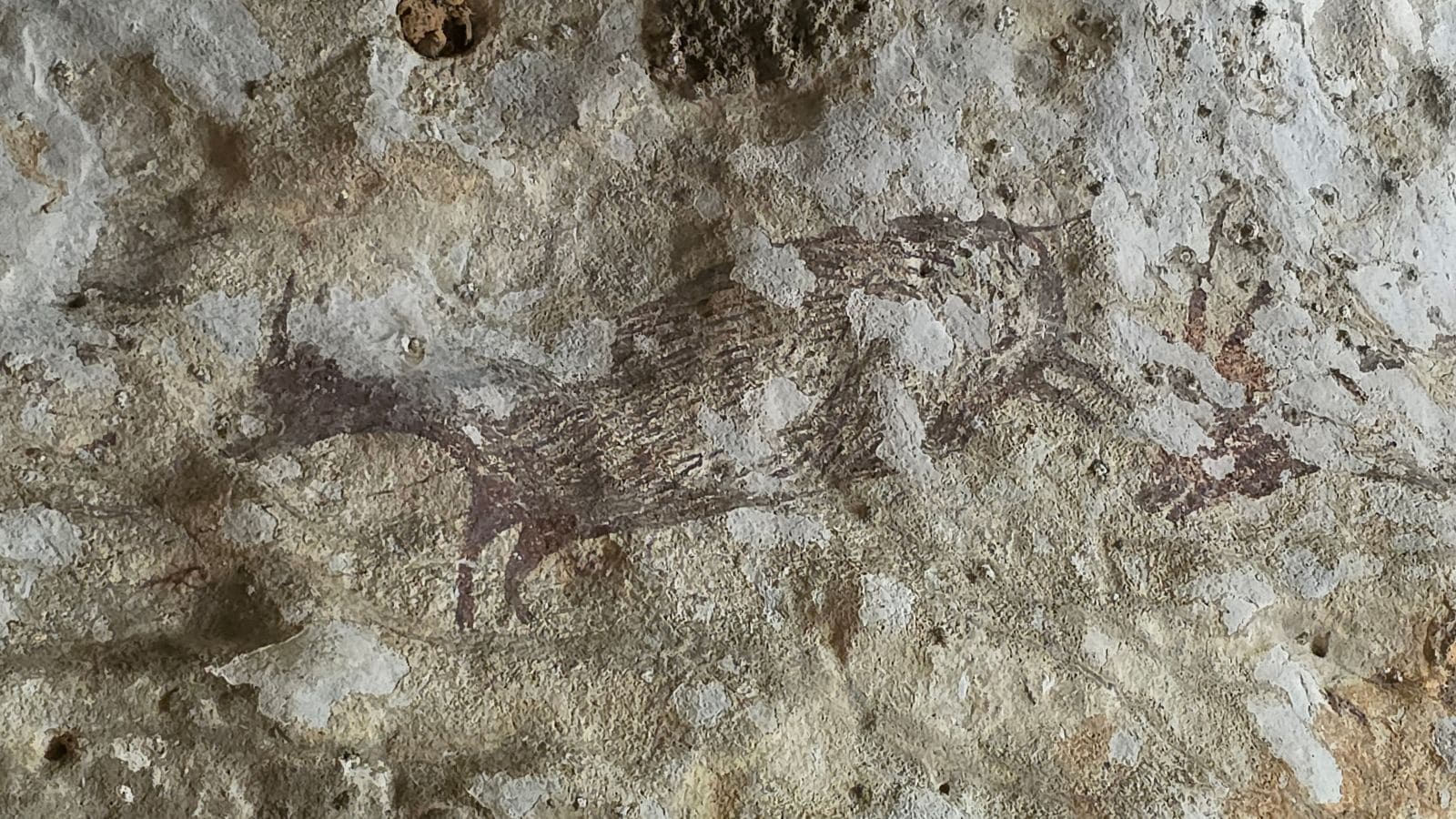
Prehistoric hand stencils and narrative hunting scenes that completely rewrite our understanding of early human creativity are currently sitting in the direct path of roaring flames. On the Indonesian island of Sulawesi, a worsening wave of wildfires has pushed perilously close to the Maros-Pangkep karst region, home to some of the oldest cave paintings on Earth. Researchers like Griffith University archaeologist Basran Burhan are sounding the alarm, noting that if tactical mitigation doesn't happen immediately, we risk losing irreplaceable fragments of human history forever.
For decades, European caves like Lascaux and Chauvet hogged the spotlight when discussing early human art. That narrative shattered when dating techniques revealed that Sulawesi's limestone caves hold rock art dating back at least 51,200 years, with some hand stencils on nearby Muna Island stretching past 67,800 years old. These works predate European counterparts by tens of thousands of years, proving that complex symbolic thought and storytelling thrived in maritime Southeast Asia long before Western art history supposedly began. For another look, consider: this related article.
Today, that priceless timeline is baking under extreme heat and choking smoke. Driven by severe drought conditions, dry weather has turned vast stretches of forest and peatland into a tinderbox. Between late September and mid-October alone, over 270 hectares within the national park burned. Flames have crept within 800 meters of major archaeological sites. Firefighters like Muhammad Ikfar have spent grueling days trying to control the blazes amid brutal heat, but the environment remains fragile and volatile.
Smoke poses a silent, insidious threat to these Paleolithic masterpieces. When thick wildfire smoke rolls through the limestone chambers, it coats the ancient pigments in dark soot. This soot smears and blurs the intricate details, making figures nearly impossible to identify or document. Beyond the smoke, the extreme thermal stress caused by intense fires makes the fragile rock flake and crack. Limestone karst formations are already vulnerable to flaking when exposed to rapid temperature swings. When a wildfire sweeps past a cave entrance, the sudden heat spike can literally cause chunks of ancient rock face to detach and crumble to dust. Further analysis regarding this has been provided by NBC News.
Climate shifts are fueling these intense dry seasons across Indonesia, turning seasonal brushfires into catastrophic ecological and cultural emergencies. Park officials like Bantimurung-Bulusaraung National Park Chief Abdul Rajab have watched burn zones expand rapidly day by day, endangering native biodiversity alongside fragile heritage sites.
If you care about archaeology or human history, this crisis demands urgent attention. Digital preservation efforts, such as high-resolution 3D laser scanning and photogrammetry, are racing against the clock to archive every square centimeter of these chambers before physical degradation wipes them out. Governments and international bodies must step up funding for targeted firebreaks and rapid-response mitigation around critical heritage hotspots. Without immediate boots on the ground and proactive preservation barriers, our earliest ancestors' voices will burn away into ash.