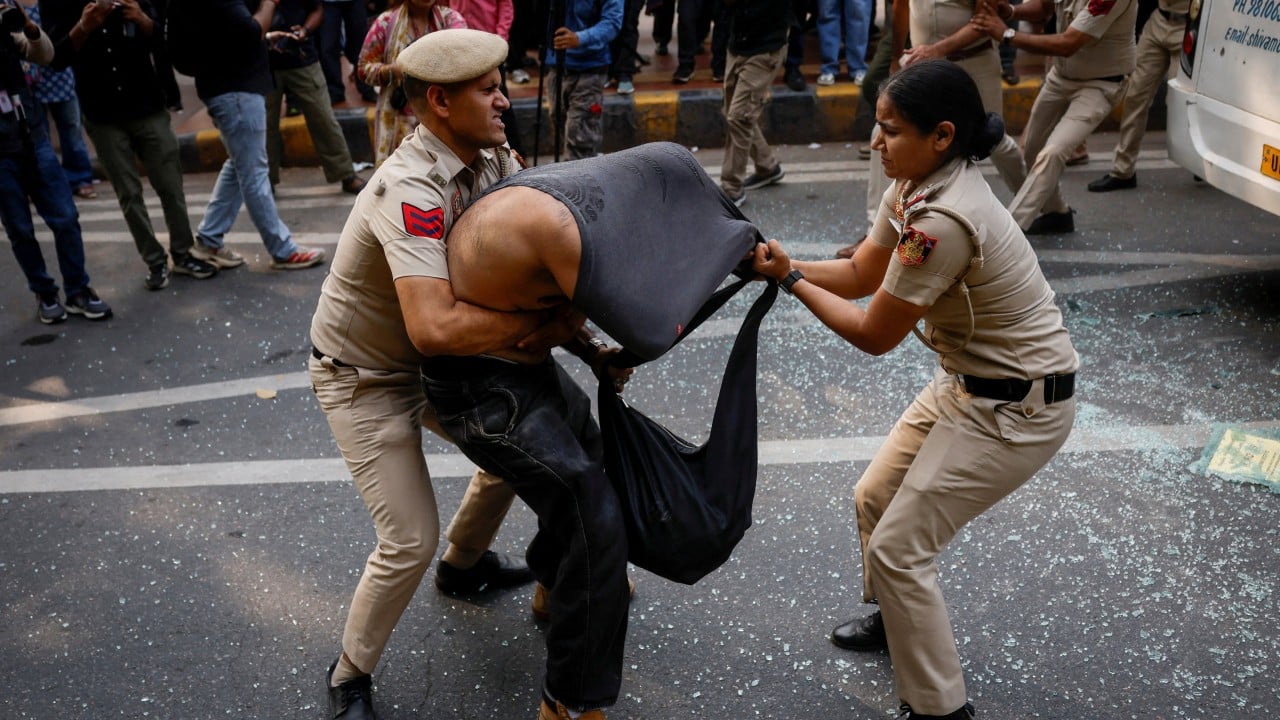
When a government locks down an entire capital city over a satirical insect moniker, you know the panic is real.
New Delhi turned into a fortress over the weekend. Authorities deployed over 35,000 security personnel, shut down dozens of metro stations, suspended mobile internet in strategic zones, and cancelled incoming train services for ten hours straight. The target of this massive state apparatus wasn’t an invading army. It was a group of young activists belonging to the Cockroach Janta Party. For a deeper dive into this area, we suggest: this related article.
The founders of the CJP—Abhijeet Dipke, Saurav Das, and Ashutosh Ranka—were swarmed by police inside an aircraft right after landing at Delhi airport. Thousands of other protesters, including opposition figures and students, were hauled away in a sweeping crackdown designed to choke off a massive anti-government demonstration before it could even draw breath.
Yet, by late Saturday, the detained leaders were abruptly freed. Their release didn't signal a change of heart by Prime Minister Narendra Modi’s administration. It exposed the sheer difficulty of trying to bury a movement that wears its insult like a badge of honor. For broader background on the matter, detailed reporting can also be found on NBC News.
How a Slur Became a Revolution
To understand why thousands of citizens are willing to face mass arrests, you have to look back at how this movement started. Earlier this year, a dismissive remark by India's chief justice compared unemployed youth to parasites. Instead of shrinking away in shame, young Indians flipped the narrative on its head. They embraced the cockroach as the ultimate symbol of survival and resilience. You can step on it, spray it, or try to lock it out, but it refuses to die.
What began as a viral online joke quickly morphed into a formidable political headache for the ruling Bharatiya Janata Party. Back in July, protests orchestrated by the movement forced the resignation of the education minister over exam paper leaks—a stunning vulnerability for an administration that prides itself on ironclad control.
Now, the battlegrounds have shifted from university examination boards to the ballot box.
The Voter List Controversy That Sparked the Siege
Saturday's aborted march on Jantar Mantar wasn’t random. It targeted the Election Commission of India and Chief Election Commissioner Gyanesh Kumar over the ongoing Special Intensive Revision of electoral rolls.
Opposition parties and youth activists claim the revision is a thinly veiled attempt to engineer election outcomes. More than 130 million names have been scrubbed from voter lists since the process began. Critics argue that these deletions disproportionately impact demographics likely to vote against the ruling party, while opposition leaders like Rahul Gandhi warn that democratic integrity is hanging by a thread.
On the flip side, the government and the Election Commission maintain that the massive purge is purely administrative housekeeping aimed at cleaning up duplicate and ineligible entries. But when you lock down schools, halt courtroom operations, shutter liquor stores, and drag prominent content creators like YouTuber Dhruv Rathee into preventive house arrest, you stop looking like a government defending a routine paperwork update. You look like a government bracing for impact.
What Happens When the Streets Push Back
Following their release on Saturday night, the freed CJP leaders didn't quiet down. Dipke took straight to social media, labeling Prime Minister Modi an embarrassment and a bully, while vowing that the fight for electoral accountability is far from over. Small, defiant groups of demonstrators popped up across the capital on Sunday morning, forcing police into yet another round of hasty dispersals and detentions.
South Asia has seen this script before. From Sri Lanka's economic uprisings to recent political upheavals in Bangladesh and Nepal, a common thread unites the region's youth: when economic frustration collides with institutional distrust, digital satire transforms into physical defiance.
The Modi administration has maintained power for over twelve years by neutralizing political opposition through institutional dominance and sheer electoral muscle. But movements born online and hardened on the tarmac operate differently. They don't have traditional headquarters to raid or predictable hierarchies to dismantle.
When you arrest leaders inside airplane cabins and clamp a digital chokehold on a city of millions, you stop hiding the fear. You broadcast it to the world. The cockroach movement isn't going back into the woodwork, and the questions it's raising about the future of Indian democracy are going to echo long after the barricades come down.

:max_bytes(150000):strip_icc():focal(986x183:988x185)/president-donald-trump-main-033125-5875db75918d4d92b8c319d1e26298bc.jpg)