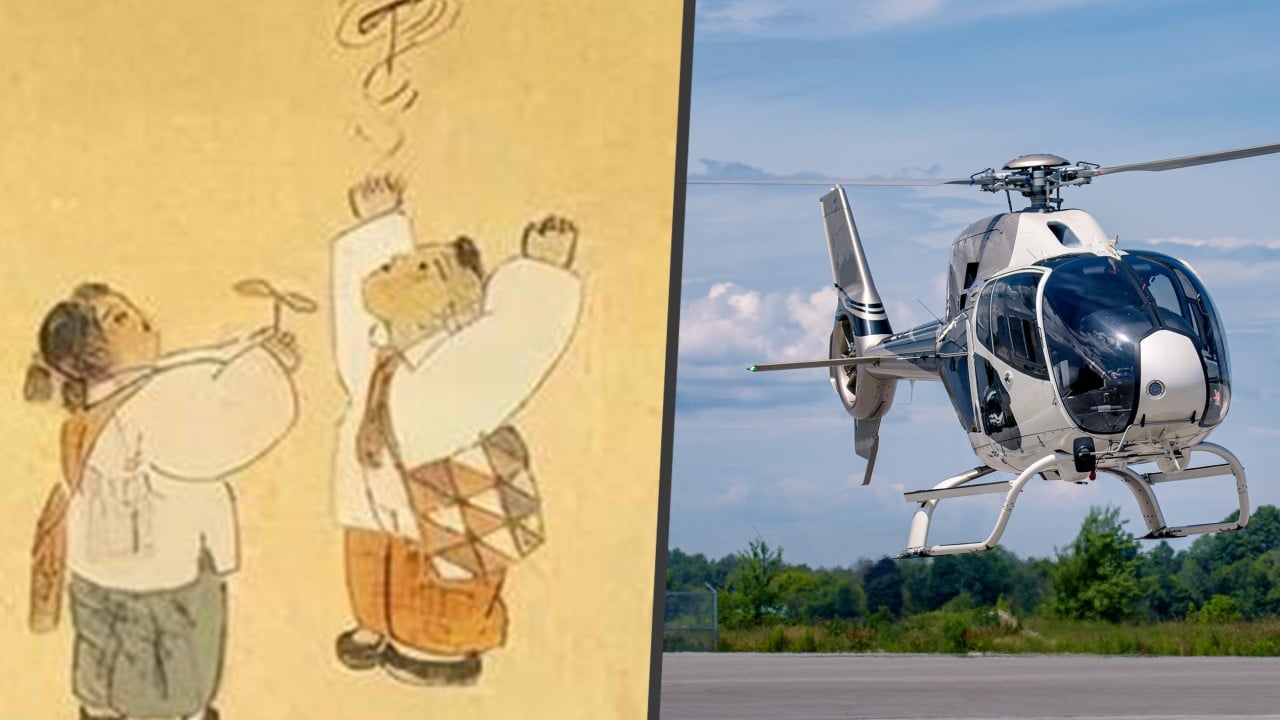
You roll a stick between your palms, let go, and watch a tiny wooden blade shoot into the sky. It looks like magic. But that simple toy, known globally as the bamboo-copter or bamboo dragonfly, actually laid down the aerodynamic DNA for every helicopter flying today.
Most people think vertical flight is a product of twentieth-century industrial engineering. They picture rugged aviation pioneers tinkering with heavy steel engines in muddy fields. The real roots stretch back more than two millennia. Long before Western scientists figured out how rotary wings could generate lift, children in ancient China were spinning bamboo blades into the air.
The Ancient Origins of the Bamboo Copter
Historical traces point back to around 400 or 500 BC. Early craftsmen carved a small T-shaped toy consisting of a thin bamboo blade with a central hole, fitted tightly with a wooden stick. Spin the stick fast enough between your hands and release it, and the rotational velocity pushes air downward, forcing the toy upward.
It sounds deceptively simple. Yet, getting a bamboo-copter to actually fly requires a strict physics threshold. The blade angle, weight distribution, and overall dimensions must find a precise equilibrium. If the balance is off by a fraction of a gram or a few degrees, the toy simply tumbles to the ground instead of climbing.
Written records caught up with the physical toy during the Jin dynasty. Around 320 AD, the Daoist philosopher Ge Hong penned the Baopuzi, which translates to The Master Who Embraces Simplicity. In an astonishing passage, he described "flying cars" built from jujube wood with ox-leather straps rigged to returning, rotating blades. Scholars still debate whether these larger vehicles were literal attempts at man-lifting aircraft or imaginative concepts of immortal travel. Either way, the mechanical principle of the spinning rotor was captured in ink centuries before Europe saw its first architectural sketch of a vertical flyer.
How the Toy Travelled West and Inspired Aviation
Trade routes and cultural exchange carried the spinning toy into Renaissance Europe. You can spot the helicopter-top in European artwork from the fifteenth and sixteenth centuries, appearing in paintings and stained glass windows.
While it remained a harmless pastime in Asia, European thinkers looked at the toy and saw raw engineering potential. British polymath George Cayley—widely celebrated as a pioneer of aeronautics—became obsessed with the device in the late eighteenth century. Cayley built his own versions using cork, feathers, and whalebone bow drills. He discovered that while a standard child's toy might top out at twenty feet, scaled-up and optimized versions could climb nearly a hundred feet into the air.
Those experiments transformed a child's plaything into the direct ancestor of the helicopter rotor and the aircraft propeller. Decades later, aviation icons like Igor Sikorsky drew heavily on these foundational aerodynamic insights when building aircraft capable of true vertical takeoff and mid-air hovering.
Cultural Resonance in the Modern Era
For millions of people today, the bamboo-copter isn't just an engineering milestone. It is a pop culture icon.
In 1970, the legendary Japanese manga and anime franchise Doraemon introduced the "take-copter" (taketonbo). In the series, a robotic cat from the twenty-second century pulls a tiny plastic propeller out of his fourth-dimensional pocket and places it on the head of Nobita, instantly granting him the power of flight. That fictional callback cemented the ancient toy in the minds of generations across Asia, bridging historical folklore with science fiction.
If you want to experience the physics firsthand, pick up a traditional bamboo version or a modern plastic variant online or at a specialty toy shop. Rub the shaft hard, release it into an open outdoor space, and watch how an idea from two thousand years ago still manages to defy gravity.