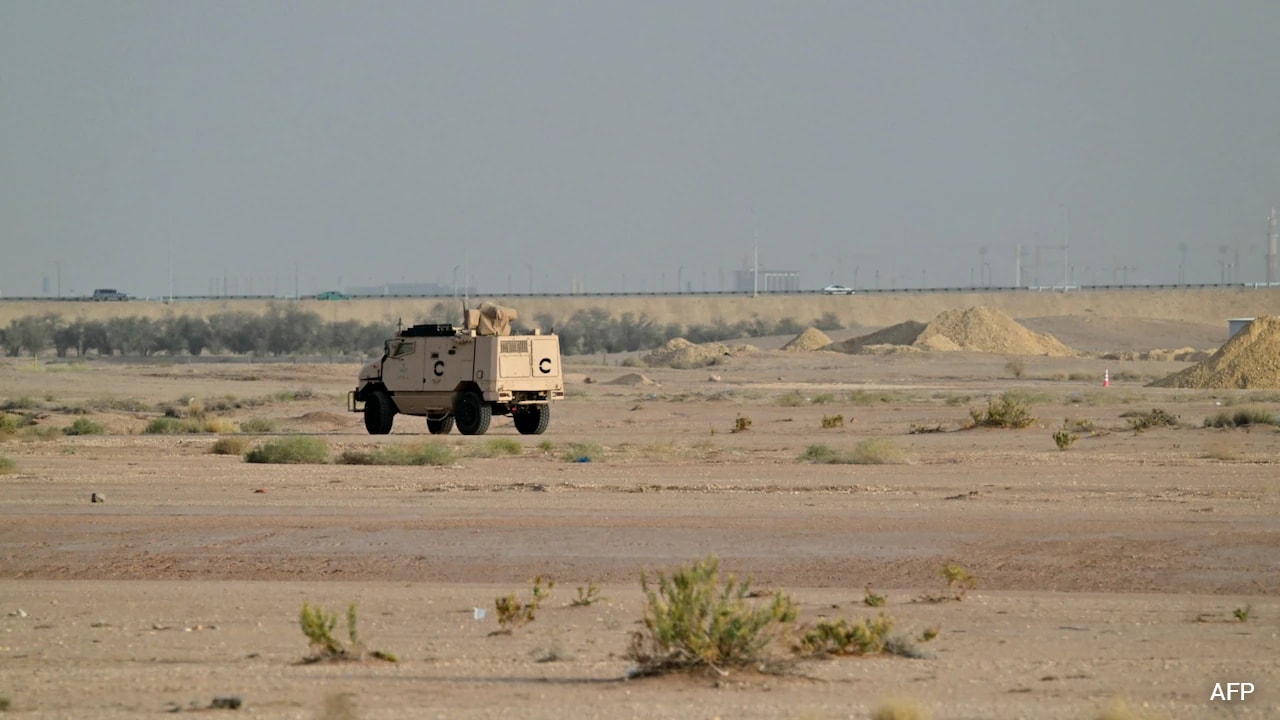
Geopolitical shocks rarely announce themselves politely. When ballistic missiles and explosive drones slice through Middle Eastern airspace to target major civilian and industrial hubs, the illusion of distant containment shatters instantly. You are looking at a dangerous escalation that reaches far beyond regional border skirmishes. When the Iran-backed Houthis announced strikes hitting the King Khalid International Airport in Riyadh and critical energy infrastructure like the Aramco refinery in Rabigh, they didn't just rattle stock markets. They laid bare the stark vulnerability of global energy supply lines.
Most people treat these cross-border attacks as isolated blips on the evening news. They aren't. They represent a fundamental shift in asymmetric warfare where non-state actors wield precision strike capabilities once reserved for superpowers. Let's break down why these specific escalations matter, what they mean for global petroleum markets, and how modern missile defense networks face unprecedented stress tests.
The Anatomy of a High Stakes Cross Border Strike
Distance used to be a buffer. Riyadh sits roughly one thousand kilometers north of Yemen's conflict zones. For decades, conventional military doctrine dictated that launching sustained, long-range aerial assaults over such vast expanses required sophisticated air forces, satellite telemetry, and massive state budgets.
The Houthi movement rewrote that rulebook. By relying on Iranian-supplied technology, they have weaponized low-cost loitering munitions and modified cruise missiles. Houthi military spokesman Yahya Saree detailed a multi-pronged assault utilizing drones alongside ballistic and cruise missiles. This wasn't a random mortar shell lobbed over a trench. It was a calculated, synchronized strike package designed to probe radar gaps, test Patriot missile battery reaction times, and create maximum psychological and economic shockwaves.
When key infrastructure like an Aramco facility or an international transit hub like Riyadh's airport becomes a direct target, the cost isn't just measured in physical debris. It is measured in investor confidence, insurance premiums for maritime and aviation shipping, and the constant, grinding anxiety of civilian populations living under the flight path of automated destruction.
Why Saudi Energy Infrastructure Remains a Prime Target
Energy is the beating heart of the global economy. Saudi Arabia sits at the apex of that market, acting as the swing producer that can theoretically stabilize or destabilize crude oil flows with the turn of a valve.
Hitting oil installations is not a military tactic aimed at defeating an opposing army on a battlefield. It is economic sabotage designed to bleed an adversary's primary revenue stream while telegraphing a message to the international community. When refineries face threats, global crude futures react immediately. Traders panic, refiners scramble for alternative feedstocks, and everyday consumers end up paying more at the pump thousands of miles away.
The Rabigh refinery and other southern installations targeted in these campaigns are chosen precisely because their disruption ripples globally. Protecting every square mile of sprawling industrial pipe networks, storage tanks, and distillation columns is logistically impossible. Defense planners call this the defender's dilemma. You must protect everything, everywhere, all the time. The attacker only needs to get lucky once.
The Regional Shadow War and Tehran's Fingerprints
Pretending that the Houthis operate in an independent vacuum is intellectually dishonest. Western intelligence agencies and regional analysts have documented the steady flow of advanced military components, guidance systems, and technical expertise from Iran across the Arabian Sea and through porous smuggling routes.
Tehran's strategy relies on plausible deniability wrapped in a network of regional proxies. From Lebanon to Yemen, these armed factions project Iranian influence without requiring direct confrontation between regular armies. Yet, as the frequency of sophisticated missile strikes increases, that thin veneer of deniability wears paper thin.
Saudi air defense batteries have intercepted a vast majority of these incoming projectiles over the years, thanks to billions of dollars invested in advanced anti-missile hardware. But a defensive success rate of ninety-nine percent still leaves room for catastrophe if the one percent that gets through happens to strike a critical transformer, a fuel depot, or a crowded terminal. That mathematical reality keeps defense strategists awake at night.
What Comes Next for Global Security and Markets
The immediate aftermath of these attacks brings familiar diplomatic hand-wringing, emergency security briefings, and swift condemnation from Western allies. But diplomatic statements won't shoot down a descending cruise missile.
As regional actors continue to refine their drone and missile capabilities, the threshold for a major miscalculation shrinks dangerously. A stray projectile hitting a foreign embassy, a commercial airliner caught in the crossfire, or a massive environmental disaster triggered by a direct hit on a coastal oil terminal could easily drag passive observers into an active conflict.
You need to watch the intersection of regional diplomacy, intelligence-sharing, and technological upgrades in counter-drone defense systems. The days of treating regional conflicts as local localized disputes are gone. In an interconnected world powered by complex energy grids and globalized supply chains, a missile fired over the Arabian desert sends shockwaves straight to your doorstep. Assess your exposure, pay attention to the shifting alliances, and stop assuming distant conflicts will stay distant.
/i.s3.glbimg.com/v1/AUTH_e7c91519bbbb4fadb4e509085746275d/internal_photos/bs/2023/y/T/1p3niVTgaRArTzh6nHnA/snapinsta.app-1080-326161460-2411880255644703-6884858907585465780-n.jpg)