Life is handed. Literally. If you look at your hands, they are mirror images of each other, but you can't stack them neatly on top of one another. Molecules do the exact same thing.
For decades, chemistry struggled with a massive headache: biological systems strictly prefer one specific mirror-image orientation over the other. When you build synthetic drugs, you usually get a messy 50-50 mix of both versions. One half cures your headache, while the other half might wreck your liver.
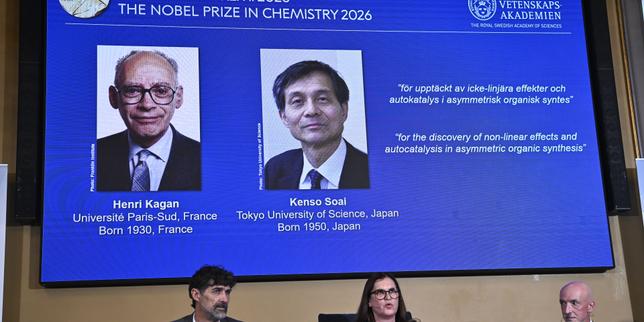
That fundamental puzzle just got solved. The Royal Swedish Academy of Sciences awarded the 2026 Nobel Prize in Chemistry to Frenchman Henri Kagan and Japanese chemist Kenso Soai. They unlocked the secrets of asymmetric organic synthesis, nonlinear effects, and autocatalysis.
The Long Road to Molecular Handedness
Back in the lab, forcing a chemical reaction to build only one specific mirror-image molecule—a property called homochirality—used to feel like trying to flip a coin and forcing it to land on heads every single time.
Henri Kagan, working at Paris-Saclay University, spent decades pioneering catalytic systems that changed how molecular geometry is handled. Long before this award, many chemists viewed him as the true godfather of asymmetric catalysis. When the Nobel committee handed out prizes in this general field back in 2001, Kagan's omission shocked the scientific community. Now, at 95 years old, he has received his overdue recognition alongside Kenso Soai of the Tokyo University of Science.
Soai brought an entirely different piece of the puzzle to the table. He discovered the phenomenon known as the Soai reaction, a striking example of asymmetric autocatalysis. In his reactions, a chiral molecule acts as its own catalyst, multiplying its own handedness with astonishing efficiency. It sounds like molecular science fiction, but it is real, reproducible, and revolutionary.
Why This Matters Outside the Lab
You don't need a PhD in organic chemistry to feel the impact of what Kagan and Soai achieved. Modern medicine relies entirely on clean, single-form molecules.
When pharmaceutical companies synthesize active ingredients for treatments—ranging from basic anti-inflammatories to complex cancer drugs—separating unwanted mirror-image molecules costs billions of dollars and creates toxic chemical waste. By enabling reactions that naturally lean toward a single orientation, these discoveries make manufacturing safer, cheaper, and vastly more efficient.
It is easy to look at a 12 million Swedish kronor prize and think it's just academic prestige. It's much more than that. It represents the foundation upon which safe, targeted therapeutics are built every single day.
Stop thinking of chemical synthesis as a random collision of atoms. Thanks to Kagan and Soai, it is now an art of absolute precision.