Traditional boatbuilding is painfully slow. You need expensive custom molds, endless hours of manual fiberglass layup, and a massive fixed factory that takes months to set up. If a hull gets damaged halfway across the ocean, you can't just whip up a replacement on the spot. You wait weeks for shipping.
Voltage Vessels, a startup based in Hawaii, decided that model is broken. Led by founder Sam Young, the company is building high-performance marine vessels using large-scale 3D printing, recycled plastic, and raw volcanic rock. It sounds like science fiction, but the military is already paying attention.
What Goes Into a Volcanic Boat
The secret sauce is a proprietary structural composite called Eclipse X9. Instead of relying on virgin resins and standard fiberglass, Voltage Vessels combines recycled PETG thermoplastic with chopped basalt fiber.
Basalt is literally volcanic rock. Melt it down and spin it into continuous or chopped strands, and you get a fibrous reinforcement material that offers incredible rigidity, high impact resistance, and unique physical traits. When paired with recycled plastic pellets or filament, the resulting compound feeds directly into large-format industrial 3D printers.
You skip the mold entirely. A digital file goes into the printer, and the machine builds the hull layer by layer.
Why the Military Cares About Volcanic Rock
The defense sector isn't funding this just to be eco-friendly. The real driver is supply chain agility and operational logistics.
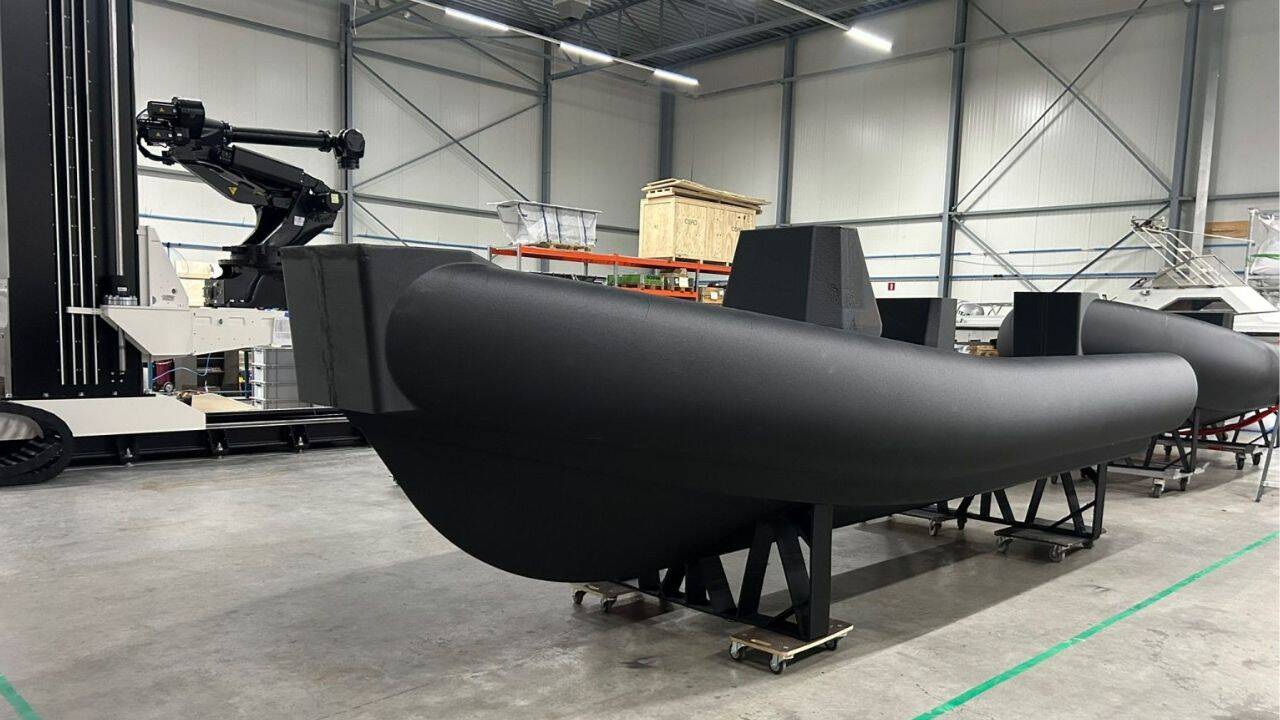
In contested maritime environments, waiting months for replacement parts or complete boats from a centralized shipyard is a massive vulnerability. Voltage Vessels has submitted a six-meter rigid-hull inflatable boat (RHIB) hull for U.S. maritime defense evaluation. These fast boats are essential for modern naval operations, and the ability to print them on demand changes everything.
Under the company's proposed model, Hawaii serves as the first node in a distributed manufacturing network. Instead of shipping finished watercraft thousands of miles across the Pacific, military logisticians could store digital blueprints and print structural hulls, buoys, or unmanned surface vessels right where they're needed.
Standing Up to the Ocean
Any new marine material has to prove it can survive saltwater. Plastics and novel composites often degrade, absorb water, or lose structural integrity after months at sea.
To validate Eclipse X9, independent testing was conducted by the Advanced Structures and Composites Center at the University of Maine. The numbers speak for themselves:
- Saltwater Immersion: After 24 to 26 months of continuous testing, the composite retained over 90% of its initial strength.
- Water Absorption: Stays well below 0.4%, preventing the moisture-induced rot and swelling that plagues lower-grade materials.
- Tensile & Bending Strength: Tested at roughly 108 megapascals of tensile strength and 112.98 megapascals of bending strength, outperforming many standard marine composites.
Beyond raw durability, basalt fiber has a distinct electronic advantage. It is non-conductive and transparent to radio frequencies. For unmanned surface vessels loaded with sensitive radar, GPS, and communication antennas, a hull that doesn't interfere with radio signals or reflect radar energy is a massive tactical upgrade.
What Comes Next for Additive Manufacturing
Right now, these volcanic-rock boats are sitting squarely in the defense pipeline. But scaling up is already in motion. The company's production framework is designed to handle up to 15,000 metric tons of material annually through U.S. compounding infrastructure, translating to millions of filament spools or regional pellets.
If distributed 3D printing can successfully replace traditional shipyards for military applications, commercial boatbuilding, coastal infrastructure, and ocean-monitoring equipment won't be far behind. We're looking at a complete restructuring of how heavy marine hardware gets built. Stop relying on outdated molds, and start printing on demand.