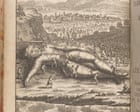
Most people think they know the story of Gulliver's Travels. You picture a guy tied down by tiny people on a beach, or maybe you remember a cartoon version where a giant visits a kingdom of bigger giants. It sounds like a children's fairy tale, right? That is the greatest literary con job in history.
When Jonathan Swift smuggled his manuscript out of Dublin under cover of night in 1726, he wasn't writing bedtime stories for kids. He was dropping a nuclear bomb of satire right into the lap of the British establishment, targeting everything from corrupt politicians to scientists who spent their time trying to extract sunbeams out of cucumbers.
Three hundred years later, fans, scholars, and institutions across Ireland are celebrating the tricentennial of Swift's masterpiece. Trinity College Dublin is putting rare 18th-century editions, pop-up books, and even a 1976 Marvel comic on display. St Patrick’s Cathedral is hosting musical premieres and readings. People are flocking to honor a book that most modern readers completely misunderstand.
If your only exposure to the book is the cute animated movie where a shipwrecked sailor wanders around Lilliput, you're missing the absolute best parts. Swift didn't write a whimsical adventure. He wrote a bitter, raging takedown of human stupidity that feels more relevant right now than it did in the Georgian era.
Take Laputa, the floating island governed by pretentious intellectuals. The citizens there are so obsessed with abstract theory and high-minded numbers that they literally cannot function in reality. They need servants called "flappers" to hit them with inflated bladders just to remind them when to speak or listen. Does that sound familiar? Look around modern tech culture, corporate boardrooms, and academic silos. We are living on Laputa right now. Swift saw our obsession with hollow optimization and automated thought engines coming three centuries early. He even mocked an "engine" built of wires and paper strips designed to pump out texts on philosophy and mathematics without human genius. It's an eerie, satirical ancestor of modern algorithmic content production.
Then there are the Struldbruggs in the kingdom of Luggnagg. Gulliver initially thinks eternal life sounds like paradise. Who wouldn't want to cheat death? But he quickly discovers the horrifying reality. The Struldbruggs don't stay young forever. They age endlessly, accumulating diseases, losing their memories, and becoming legally dead at age eighty while continuing to rot away in conscious misery. It's a brutal antidote to our current obsession with biohacking and tech-bro immortality projects. Swift understood that endless life without youth is just a slow-motion torture chamber.
We also need to talk about Mary, Gulliver's wife. In most adaptations, she's an afterthought, someone left at home while her husband goes off on wild romps. Contemporary writers have started flipping the script, imagining her side of the story while her husband is out gallivanting across fictional islands, returning home grumpy and alienated from normal human society. Gulliver doesn't come back a hero; he comes back a misanthropic recluse who prefers the company of horses to his own family.
Swift lived a complicated, angry life. He was a dean at St Patrick’s, a political pamphleteer, and a man who looked at the cruelty of the British empire in Ireland and chose violence with a pen. When he wrote A Modest Proposal—suggesting that impoverished Irish families sell their babies as food to the wealthy—he wasn't being literal. He was screaming at a ruling class so indifferent to human suffering that hyperbole was the only weapon left.
That same savage energy drives Gulliver's Travels. By the time Gulliver reaches the land of the Houyhnhnms—rational, noble horses who rule over crude, humanoid beasts called Yahoos—he realizes that humans are basically just aggressive, filthy Yahoos wearing clothes. He can't even stand the sight or smell of his own family when he returns to England.
You should pick up the unexpurgated version of the book this year. Skip the sanitized children's abridgements. Read the parts where Swift tears into religious wars fought over which end of a boiled egg to crack. Read the parts where giant kings look down at human civilization and label us the most pernicious race of little odious vermin to crawl the earth.
It hurts because it's true. Swift held up a mirror three hundred years ago, and we are still too vain to admit what we look like.