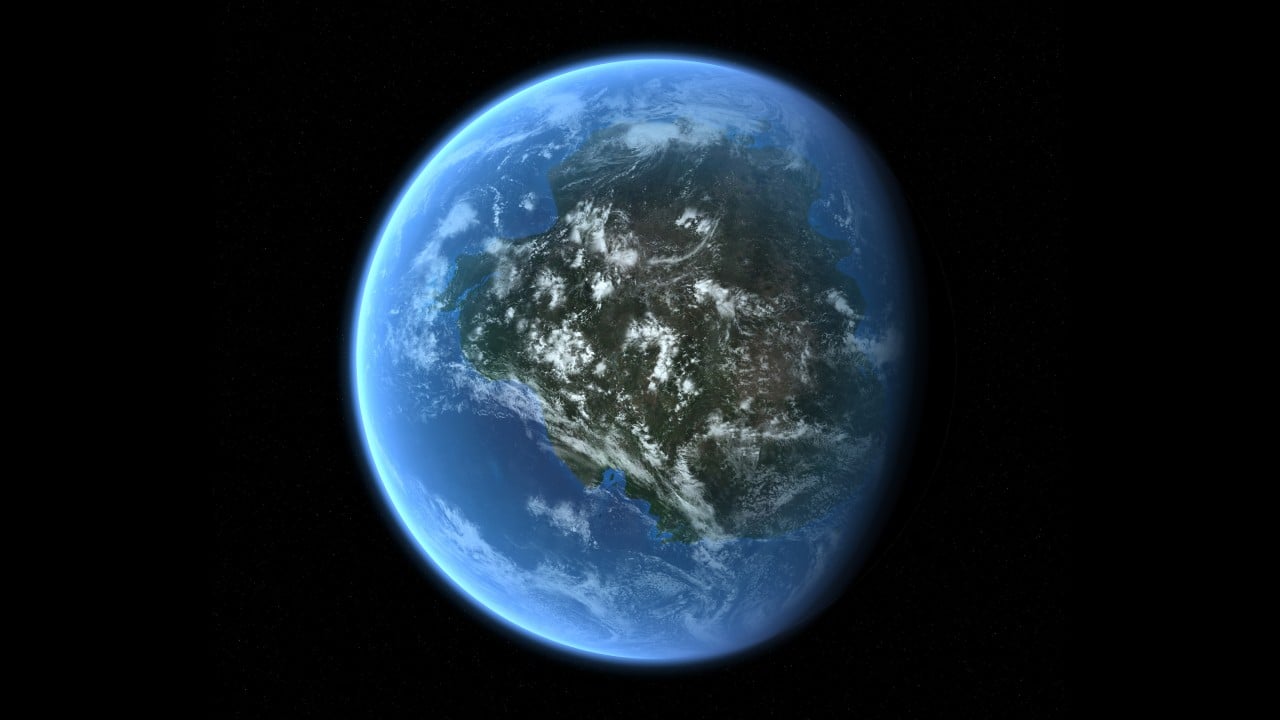
For decades, textbook maps of Earth's ancient past missed a massive piece of the puzzle. Geologists used to think Gondwana accounted for roughly 64 percent of the planet's continental crust. That figure always sat awkwardly below the 75 percent threshold required to qualify as a true supercontinent.
It turns out the maps were simply wrong.
An international team led by Chinese scientists, alongside researchers from Australia's Curtin University and Zhejiang Lab, published a study in Science Advances that completely rewrites the scale of Earth's deep history. By analyzing over 25,000 igneous rock samples and tracking neodymium isotope signatures, the research team discovered vast, overlooked fragments of ancient crust buried deep beneath modern mountains across Asia, Europe, and North America.
When you add those hidden pieces back into the equation, Greater Gondwana covered an astonishing 80 percent of Earth's continental crust around 500 million years ago.
How Scientists Found a Continent Hiding in Plain Sight
You can't just dig a trench down to the core to see what happened half a billion years ago. The surface of our planet constantly recycles itself through tectonic shifts, collisions, and volcanic activity. Mountain chains like the Himalayas or the Appalachians are geologic wreckages where ancient pieces got mashed together, warped, and buried under layers of younger sediment.
To see through the noise, the research team, led by Tao Wang and William J. Collins, compiled massive basement terrane maps. They relied on samarium and neodymium isotope measurements taken from granitoids and related rocks.
Why isotopes? Because chemical signatures act like an indelible barcode. When younger rocks form from older melted crust, they retain isotopic clues pointing back to when that original material was first extracted from Earth's mantle.
By tracking these chemical fingerprints across 25,346 samples, the team traced coherent zones of ancient crust running through the Tethyan mountain systems of Asia—stretching from Southeast Asia and China toward Tarim and Kazakhstan—and continuing westward into Iran, Turkey, and Europe, alongside fragments tucked away in the North American Appalachians.
These newly recognized pieces total roughly 20.5 million to 25.5 million square kilometers of extra continental material. Combined with traditional Gondwana, the total landmass footprint hits roughly 80 percent, instantly solving a long-running debate over whether the ancient behemoth was actually a true supercontinent.
The Volcanic Ring That Sparked the Cambrian Explosion
Finding out a landmass was bigger than expected is fascinating on its own, but the real breakthrough lies in what Greater Gondwana was doing to the rest of the planet.
By approximately 500 million years ago, an immense network of subduction zones and volcanic arcs surrounded the supercontinent. According to the study's reconstructions, this volcanic ring stretched roughly 31,700 kilometers—equivalent to about 79 percent of Earth's total circumference.
Think about that scale. It's comparable to a planetary ring of fire operating continuously for millions of years.
Peking University geologist Wang Chao, who wasn't involved in the study, pointed out that this massive belt of subduction and volcanism fundamentally altered global climate and marine environments. Continuous volcanic activity pumps massive amounts of carbon dioxide and water vapor into the atmosphere. That planetary greenhouse effect helped drag Earth out of extreme Neoproterozoic climatic conditions, warming up the globe and shifting shallow ocean chemistry.
The timing couldn't be more critical. The peak formation and breakup phases of Greater Gondwana line up directly with the Cambrian explosion, the epochal evolutionary event where animal diversity surged at an unprecedented rate. Deep planetary tectonics didn't just move rocks around; they basically set the stage for complex life to take over the planet.
What This Revision Means for Modern Earth Science
Geology textbooks love neat categories, but nature is messy. For years, scientists debated whether Gondwana was a "true" supercontinent or just a very large collection of wandering blocks because its estimated 64 percent crustal share fell short of the traditional 75 percent cutoff.
This study shatters that debate. Greater Gondwana clears the threshold by a wide margin, proving that much of what we assumed about continental drift's speed and scale needs an update.
More importantly, it shows how much of Earth's history is still buried right under our feet. Modern analytical techniques like large-scale isotopic mapping let us peer through thousands of meters of younger rock and mountain ranges to rebuild lost worlds.
If millions of square kilometers of continental crust were hiding beneath three modern continents this whole time, you have to wonder what else we are missing in the deep basement of our planet. Stop looking only at what is on the surface. The real history of Earth is locked away in the chemistry of the stones beneath us.