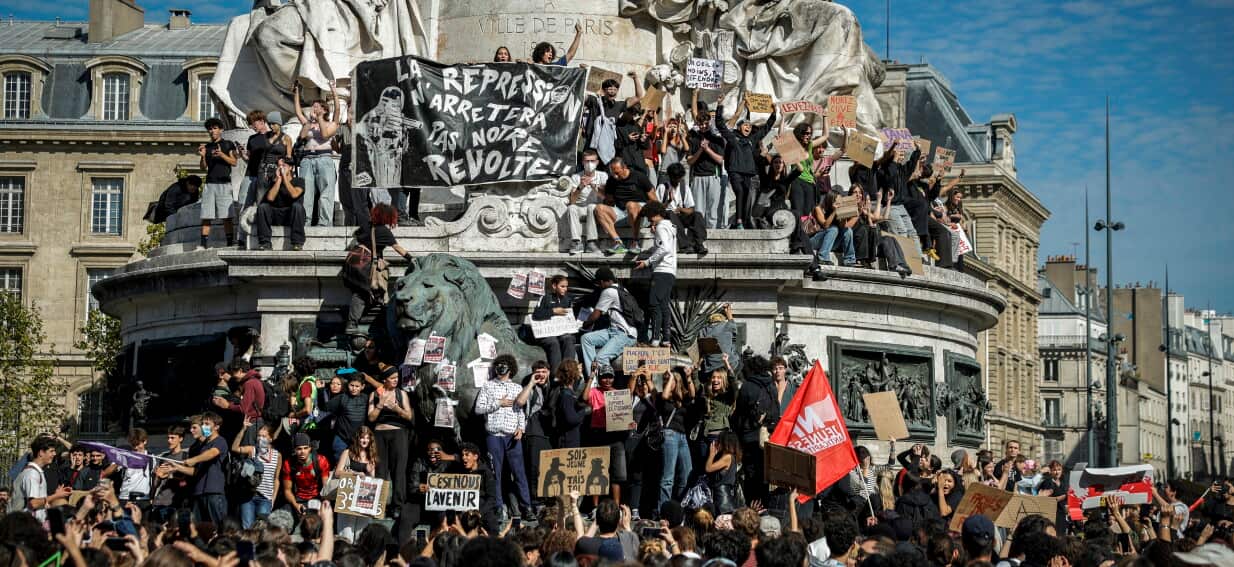
You cannot walk through Paris or Lyon right now without smelling tear gas and burnt plastic. Thousands of teenagers are taking over the streets, locking school gates with heavy chains, and screaming at riot police. This isn't just another casual student strike. It is a massive pressure cooker blowing its lid right in the middle of Emmanuel Macron’s second term.
Teenagers across France are furious. They are staring at crumbling ceilings, broken heating systems, missing classroom doors, and an chronic shortage of teachers that leaves them sitting in empty study halls for weeks on end. When you tell a generation they are the future while forcing them to study in freezing, decaying rooms with no toilet paper, you shouldn't be shocked when they lock the gates and demand answers.
The Reality Behind the Classroom Rage
The protests didn't materialize out of thin air. They started small in late September when students at several high schools blocked building entrances to protest against institutional neglect. Within days, the movement exploded nationwide.
The numbers tell a messy story. The French interior ministry puts the nationwide turnout around 256,000 protesters, while union organisers claim closer to 450,000. Parents and teachers have joined the kids on the asphalt, turning a student grievance into a full-scale national reckoning.
Listen to 17-year-old Thomas from the Paris suburb of Val-de-Marne. He told reporters that some of his classrooms lack enough desks and chairs, while the bathrooms don't even have doors. That is the daily reality of public education in one of the world's richest economies. Students aren't marching because they want a day off class. They are marching because they feel entirely abandoned by a political class that treats public infrastructure like an afterthought.
State Response and Rising Violence
As the weeks rolled on, peaceful blockades frequently devolved into chaotic clashes. Riot police answered stone-throwing crowds with batons, tear gas, and stun grenades.
The police tactics have drawn intense international and domestic condemnation. Amnesty International recently stepped in, demanding that French authorities put an immediate stop to what they called disproportionate police repression. The human cost has been brutal. A teenager lost a hand after a police stun grenade went off, and a 14-year-old student in northwest Paris was hit in the face with a tear gas canister at close range, losing several teeth.
The government finds itself trapped in a defensive crouch. Prime Minister Sebastien Lecornu condemned the destruction, noting that burning down a high school doesn't fix its roof. At the same time, the interior ministry confirmed that ten internal investigations have been launched into police misconduct. Over 6,500 people have been arrested since the movement began, the vast majority of them minors.
Political Fallout and Opportunistic Noise
With the 2027 presidential election looming on the horizon, this crisis is gasoline on an already raging political fire. Far-right figures like Marine Le Pen are watching closely, while hard-left politicians like Jean-Luc Melenchon openly back the protesters, drawing accusations from the ruling party of stoking the flames.
Even international figures have chimed in. US President Donald Trump used the French unrest to push his own narrative about migration, proving that everyone with a microphone wants to use French teenagers as props for their own political agendas.
Prime Minister Lecornu announced that high schools across the country will close for a half-day between Wednesday and Friday to permit internal democracy meetings. Critics call it a weak band-aid on a gushing wound. Students like 16-year-old Yanis point out the tragic irony of the situation, admitting that it feels like the government only listens when things get violent.
What Comes Next
Fixing a broken education system requires billions of euros and years of administrative overhaul, neither of which the French government seems willing or able to deploy right away. Teachers are burned out, budgets are squeezed, and trust between Gen Z and state authorities is at an all-time low.
If you want to understand where a country is heading, look at how it treats its schools. Right now, France is teaching its youth that peaceful dialogue gets ignored and change only arrives through confrontation. The school gates might reopen next week, but the anger isn't going away anytime soon. Expect more clashes, deeper political polarization, and a long, difficult reckoning as France faces up to the neglect of its own classrooms.