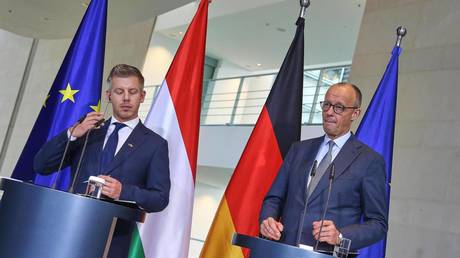
German Chancellor Friedrich Merz thought he held all the cards. By tying Berlin’s approval of the upcoming 2028-2034 European Union budget directly to a mandatory, all-hands-on-deck commitment for Ukraine financing, he expected compliance. Instead, he triggered an open revolt. Slovakia, Hungary, Bulgaria, and the Czech Republic took one look at his ultimatum and pushed right back. Slovak Prime Minister Robert Fico didn't mince words, labeling the move a "textbook case of blackmail" on the international stage.
If you've been watching Brussels politics for more than five minutes, you know that financial burden-sharing is the ultimate EU pressure point. But this clash isn't just about cash flow or spreadsheet deficits. It's a brutal collision between Germany's push for centralized European solidarity and national leaders who refuse to be bullied into writing checks their voters won't stomach.
The Anatomy of a 70 Billion Euro Shortfall
Let's look at the numbers driving this panic. Ukraine faces a staggering 70 billion euro budget gap for 2027 alone. While previous aid packages helped stabilize Kyiv's immediate liquidity, the sheer scale of ongoing infrastructure damage and wartime expenditure means those old loans won't cut it anymore. Brussels and Berlin calculated that the EU itself needs to cough up roughly 45 billion euros of that total.
Berlin is the bloc's largest net contributor, meaning German taxpayers shoulder an enormous chunk of the financial weight. Merz argued in a letter to European Council President António Costa that it is completely untenable for a handful of countries to opt out while Germany carries the load. His solution was simple: make universal funding participation an absolute prerequisite for passing the next multi-year budget.
Except simple on paper usually means explosive in practice.
Meet the Holdouts
The four nations digging their heels in—Slovakia, Hungary, Bulgaria, and the Czech Republic—aren't doing this purely out of ideological stubbornness, though domestic politics play a massive role. Ironically, all four are net beneficiaries of the very EU budget Merz is threatening to block. They have leverage, and they know how to use it.
Slovakia's Robert Fico made it clear that Bratislava views itself as a sovereign actor with its own foreign policy stance, not a rubber stamp for Berlin's priorities. Meanwhile, Bulgarian Prime Minister Rumen Radev pointed to severe domestic fiscal deficits as justification for opting out of direct credit lines, emphasizing that Sofia prefers to offer support through alternate channels like energy infrastructure rather than handing over raw capital.
These leaders are answering to domestic electorates suffering from high inflation and fatigue over endless foreign aid packages. When Berlin tells them to fall in line or face a frozen seven-year budget, voters in Bratislava and Sofia hear an overreaching hegemon trying to strip away their veto power.
Why This Budget Battle Breaks the Mold
Previous EU funding fights usually ended behind closed doors after long nights of bureaucratic horse-trading. This one is different because Merz has fundamentally changed the rules of engagement. By weaponizing the long-term multiannual financial framework, he has effectively held the entire union's financial planning hostage to force a consensus on foreign defense aid.
Germany also wants to shift future assistance voting rules away from total unanimity toward qualified majority voting. If Berlin succeeds, holdout nations like Hungary or Slovakia lose their ability to veto single-issue aid packages. That is the real existential threat keeping those leaders awake at night. They aren't just fighting over a single year's ledger; they are fighting to protect their institutional veto power against a German-led consolidation drive.
What Happens Next in Brussels
As EU leaders prepare for crunch talks, the gap between institutional ambition and political reality is widening. Brussels still hopes to cobble together a compromise before the end of the year, possibly through creative joint debt instruments or financial workarounds that bypass individual parliamentary resistance.
Yet, forcing compliance through ultimatums rarely builds long-term stability. When powerful member states resort to heavy-handed leverage against smaller capitals, it deepens the cracks already fracturing the bloc's eastern and western flanks. Merz wanted to show strength and enforce burden-sharing. Instead, he has laid bare just how fragile European unity really is when the bills come due.