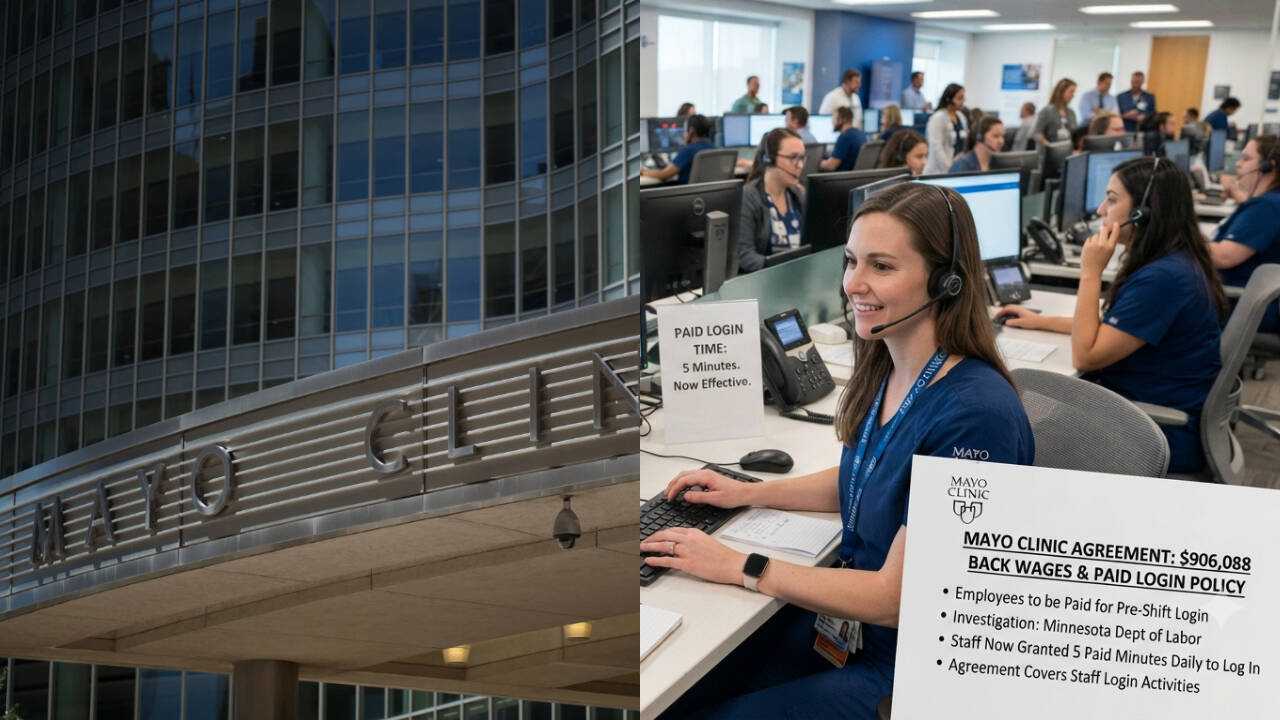
Five minutes doesn't sound like much. Skip a five-minute coffee break and nobody blinks. Miss five minutes of a show and you barely lose the plot.
Yet those tiny slivers of time just cost Mayo Clinic $906,088.88 in back wages after Minnesota Attorney General Keith Ellison's office investigated allegations of unpaid pre-shift work. That isn't a typo. Roughly nine hundred and six thousand dollars, paid out to 1,021 Patient Appointment Services Specialists and lead specialists across shifts worked between July 1, 2024, and May 19, 2026. For another view, check out: this related article.
If you've ever sat at a desk staring at a spinning wheel, waiting on Windows updates, VPN tokens, or scheduling software before your official clock-in time, this story hits close to home. Honestly, it exposes a massive blind spot in how modern workplaces treat "prep time." Employers love to call boot-up time or checking systems before a shift just part of getting ready. Wage laws often disagree.
How Unpaid Pre-Shift Work Adds Up Fast
Let's look at the math behind the Mayo Clinic settlement because it explains why small time gaps turn into big checks. Further reporting on this trend has been provided by MarketWatch.
Workers came forward to the Minnesota Attorney General's office with complaints about performing job duties outside paid hours. According to the state's findings, appointment staff were expected to boot up computers and log into required applications before shifts started, and some also reported wrapping up patient calls after shifts ended without extra pay. Timekeeping rounding practices were also flagged in the probe.
Under the agreement announced on November 23, 2026, back wages were calculated at 5.41 minutes per covered shift—broken down as 4.41 minutes tied to rounding discrepancies and 1 minute for other work time—multiplied by each employee's individual hourly rate. Multiply 5.41 minutes by thousands of shifts across more than a thousand workers, and suddenly "just five minutes" looks like a serious payroll liability.
I've seen HR teams treat five-minute pre-shift routines as harmless fluff for years. In practice, if a worker clocks in right at 8:00 a.m. to take live calls, but has to sit down at 7:53 a.m. to power on a terminal, load dual monitors, authenticate into health records, and open phone queues, they're already working. Calling that "free" time is a classic trap.
The Time Rounding Trap Most Workers Miss
Computer startup time got the biggest headlines, yet time rounding played a huge role in the numbers too.
Many employers use rounding rules—such as rounding clock-in and clock-out punches to the nearest quarter-hour or tenth of an hour—to simplify payroll math. On paper, rounding can cut both ways. In reality, when schedules or expectations push workers to start slightly early or stay slightly late, rounding often trims minutes off employee paychecks more often than it adds them.
In the Mayo Clinic case, the settlement requires ending time-rounding for affected appointment specialists and giving them five paid minutes at the start of each workday to boot up computers and log into systems, locking in policy shifts Mayo had already begun making around May 2026. There's also a $100,000 civil penalty hanging over the agreement if the clinic doesn't stick to its commitments.
One nuance worth keeping straight: settling an investigation isn't the same as a court finding of guilt. Mayo Clinic stated it disagreed with the attorney general's position on the timekeeping practices, explaining that it chose to resolve the matter so money went to staff rather than defense fees. Attorney General Ellison, meanwhile, praised the clinic for cooperating and changing policies while emphasizing that workers on site or performing job duties must be paid. Both sides have a point about practical incentives, even if they view the underlying rules differently.
Why Competitors Often Miss the Bigger Picture
Basic news recaps usually stop at the headline number and the five-minute login rule. That leaves out three practical realities that matter way more if you manage teams or work hourly shifts.
First, digital friction is real labor. Today's healthcare, call-center, and office roles run on slow boots, multi-factor prompts, virtual desktops, and clunky legacy apps. A five-minute login window sounds generous until a patch installs or a badge reader glitches—and then five minutes turns into twelve.
Second, end-of-shift creep is just as common as early arrivals. Finishing a patient call, typing up notes, or clearing a queue after your scheduled end time is unpaid labor if you're clocked out. Hourly workers often feel pressure to "finish what you started" rather than leave a caller hanging.
Third, compliance isn't just about avoiding fines. It's about trust. When scheduling specialists or front-line staff feel nickel-and-dimed over minutes while handling stressed callers all day, morale takes a hit. Paying cleanly for actual work time removes friction before regulators ever get involved.
What This Means Under Wage Laws
This settlement didn't invent a brand-new legal doctrine out of thin air. Under federal wage-and-hour principles—specifically the Fair Labor Standards Act—and state laws like Minnesota's, non-exempt employees generally must be paid for time spent performing principal activities or tasks integral to their job.
Courts and labor agencies look closely at control and necessity. If an employer requires you to be logged in and ready at a specific minute, the steps required to get logged in and ready usually aren't optional personal errands. Even small daily increments can trigger back-pay claims when multiplied across a large workforce over months or years.
At the same time, wage rules aren't black-and-white in every edge case. Commuting to work, walking from a parking lot in some circumstances, or arriving early purely by personal choice without doing job tasks can be treated differently from mandatory pre-shift work. That's why careful audits—and clear rules telling employees not to work off the clock—matter so much.
Practical Next Steps for Workers and Employers
If you're an hourly worker or scheduling specialist, start tracking your actual start and stop times in a personal log. Note dates, scheduled shift times, when you started booting up or taking calls, and when you actually finished. If you spot unpaid pre-shift or post-shift work—or time-rounding cuts—raise it with HR or payroll in writing, and keep in mind that state agencies like the Minnesota Attorney General's Office provide complaint channels for workers who believe they weren't paid properly.
If you run operations or manage hourly staff, stop guessing how long logins and wrap-up tasks take. Time your actual systems during peak morning hours, eliminate risky time-rounding practices where they shortchange workers, and make sure supervisors never nudge staff to start early or finish calls off the clock. Paying for every minute worked is a lot cheaper than paying back wages later.