Most people treat Halloween pumpkin carving like a rushed, messy chore. You grab a flimsy serrated plastic knife from a grocery store kit, hack a jagged hole into the top, scrape out stringy pulp, and saw out a couple of triangle eyes. Ten minutes later, you've got a crooked grin sitting on your front porch that will collapse into a moldy puddle by Thursday.
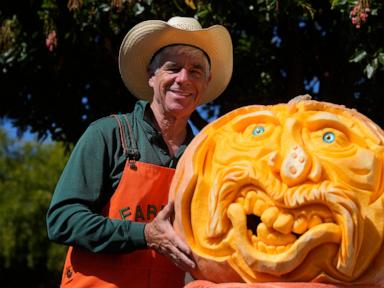
Mike Valladao looks at that exact same orange sphere and sees a blank canvas.
For four decades, Valladao has operated under the moniker "Farmer Mike," carving out a legacy that earned him the title of the Picasso of pumpkin carvers. By day, he works as a systems engineer at a cybersecurity firm. By October, he slips into his signature orange overalls and farmer hat to transform massive Atlantic pumpkins—weighing anywhere from 100 to 1,000 pounds—into living, breathing works of art.
Throwing Away the Plastic Kit
If you want to understand what separates true artistry from a seasonal hobby, you have to look at the tools. Valladao doesn't use those cheap orange plastic saws that snap the second you hit a tough fiber. He uses gouges, chisels, and carving blades meant for wood and stone.
Giant Atlantic pumpkins offer a massive advantage over standard patch gourds: thick skins. That thickness changes everything. Instead of cutting all the way through the flesh to let candlelight shine out of a gaping hole, Valladao sculpts on the surface. He shaves down layers, carves deep grooves, and lets the natural gradients of the orange rind create shadow and light.
It is basically high-relief sculpture made out of squash.
“It’s really about the illusion of depth,” Valladao explains. He can make a nose stick out three inches while the eyes sink back into the skull, all carved from the solid meat of a single giant gourd.
Finding Art in Ordinary Moments
What makes Valladao's work fascinating is that he never went to art school. He didn't study classical sculpture in Florence or take master classes in fine arts. His inspiration comes from paying attention to the world around him.
Walking down the street or visiting a museum, he watches how people look and move. He notices how someone's nostrils flare or how a specific jawline curves. Those tiny human details get translated straight onto a 250-pound pumpkin.
Over the last forty years, his portfolio has grown far beyond spooky ghouls and standard witches. He has sculpted Yoda, Charlie Brown, intricate dragons, seaside landscapes, and comical creatures that look more like cartoon animation cels than squash.
This dedication recently hit a major milestone. Valladao celebrated his 40th year of Halloween artistry at the famous Half Moon Bay Art & Pumpkin Festival in California. Instead of hiding in a workshop, he sits right out on stage. Thousands of festival-goers watch him chip away live, turning a giant orange blob into a detailed masterpiece over the course of a weekend.
Taking Pumpkin Art on the Road
When you spend four decades mastering an unusual craft, people notice. Valladao's carved masterpieces haven't stayed confined to a sleepy coastal festival in Northern California. His reputation has landed him high-profile gigs across the country.
He's traveled to carve live at the San Diego Zoo, the California Academy of Sciences, and even the State Fair of Texas. He has even made an appearance on The Tonight Show, bringing his oversized gourds to a national television audience.
Yet, despite the media attention and the crowds, the process remains intensely physical and demanding. Moving a 300-pound pumpkin requires heavy lifting, steady hands, and immense patience. One slip of a chisel can ruin hours of delicate detail work, leaving no room for error.
Why This Craft Still Matters
In a digital world dominated by screens, CGI, and automated holiday decorations, watching someone carve a physical object out of dirt, water, and sunlight feels refreshing. It reminds us of the value of tactile, messy, real-world creation.
Valladao doesn't treat his work as a temporary gimmick. To him, it's deeply personal. After forty years of stacking up sawdust and pumpkin guts, he doesn't have any plans to put his chisels away.
“It’s fun, it’s enjoyable and, quite frankly, it’s a piece of me,” he says.
If you want to try stepping up your own pumpkin game this year, ditch the standard stencil kit. Stop thinking of the pumpkin as a box to hollow out, and start thinking of it as clay waiting to be shaped. Grab a sharp wood-carving tool, sketch out your lines, and focus on depth instead of just cutting holes.
Your porch decorations will never be the same.