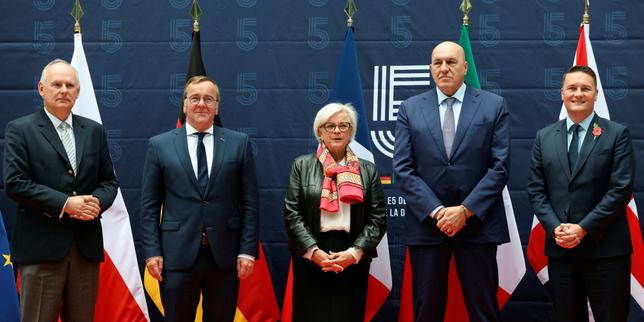
For decades, European capitals treated American security guarantees as a permanent subscription that never required a price hike. That era is over. When the defense ministers of Europe's five largest military powers—France, Germany, Italy, Poland, and the United Kingdom—issue a joint warning that the euro-atlantic space can no longer rely on external shields, it's time to listen. They aren't just drafting diplomatic memos for the archives. They're acknowledging a brutal geopolitical reality that has been ignored for far too long.
If you look closely at what's happening across the continent, the wakeup call isn't theoretical. Russia's ongoing war in Ukraine, combined with a relentless wave of hybrid attacks, cyber intrusions, infrastructure sabotage, and mysterious drone incursions, has exposed every single vulnerability in Europe's collective armor. You can't outsource your survival. When the threat is immediate and multi-dimensional, empty declarations of solidarity don't stop ballistic missiles or neutralize cyber sabotage units.
The Cost of Strategic Complacency
For years, politicians kicked the defense spending can down the road. Social budgets always won the political argument over artillery shells, air defense systems, and military mobility. But security isn't a luxury item you fund when there's spare cash in the treasury. It's the foundational bedrock that allows everything else to function.
Consider what these five defense ministers are actually demanding. They aren't asking for cosmetic budget increases that barely cover inflation. They are pushing for massive, sustained investments in domestic capabilities, sovereign industrial bases, and critical military resources. When defense budgets stall, industrial capacity shrivels. You can't spin up ammunition factories or electronic warfare production lines overnight when a crisis hits. Lead times take years, and manufacturing lines require steady, predictable orders to stay operational.
+-------------------------------------------------------+
|          The Shift in European Defense Strategy       |
+-------------------------------------------------------+
|  FROM: Outsourcing security & relying on external     |
|        guarantees                                     |
|                                                       |
|  TO:   Building domestic industrial capacity,         |
|        investing in sovereign capabilities, and       |
|        taking direct responsibility for regional      |
|        security                                       |
+-------------------------------------------------------+
Why Industrial Sovereignty Matters Now
Buying off-the-shelf military equipment from foreign allies might look efficient on paper, but it creates dangerous dependencies. If your supply chains, maintenance protocols, and spare parts originate outside your borders, your operational autonomy is an illusion.
European defense companies have spent years operating below capacity because domestic orders were sporadic. To maintain a credible deterrent against modern state aggression, nations need reliable, long-term procurement contracts. This means building integrated air defenses, securing maritime critical infrastructure, and hardening digital networks against state-sponsored hackers.
It also means addressing the elephant in the room: political will. Taxpayers hate paying for weapons they hope will never be used. Yet, insurance isn't a waste of money when your house is located in an active earthquake zone.
Facing the Hybrid Threat Matrix
Warfare isn't just about tanks rolling across borders anymore. The modern threat matrix includes gray-zone tactics designed to bleed adversaries without triggering a formal military response. Subsea cables are probed. Power grids face persistent cyber attacks. Disinformation campaigns systematically target democratic elections.
These tactics target the seams between European states. If one country lacks robust counter-drone capabilities or maritime surveillance, the entire perimeter is compromised. That's why regional cooperation among major defense powers is non-negotiable. Intelligence sharing, joint procurement programs, and standardized equipment interoperability are the only antidotes to fragmented defense postures.
What Needs to Happen Next
Talk is cheap, and communiqués don't deter hostile actors. Moving forward requires three concrete actions from European governments:
- Lock in Multi-Year Budget Increases: National parliaments must enshrine defense spending commitments into law, bypassing short-term political cycles.
- Prioritize Joint Procurement: Stop duplicating efforts with dozens of competing national weapon designs. Pool resources to build standardized, scalable military hardware.
- Secure Critical Infrastructure: Hardening energy grids, subsea cables, and logistics hubs against hybrid sabotage must become an immediate operational priority.
The warning from the E5 defense ministers is clear. Europe has the economic weight and technological prowess to defend itself, but it lacks the unified sense of urgency. Ignoring this warning won't make the threats go away. It will only make the eventual reckoning much more expensive.