Heavy machinery rules modern land management. Tractors rumble across fields, mowers roar, and efficiency trumps everything else. But machinery tears up delicate ecosystems, destroys ground-nesting insects, and compacts the soil.
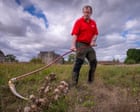
English Heritage is doing something radical. They are training a fresh wave of volunteers to pick up hand-held scythes. It sounds like a romantic throwback to Thomas Hardy novels, but it is actually a smart, ecological fix for modern conservation.
Why Heavy Mowers Are Failing Our Meadows
If you want to wreck a wildflower meadow, send a heavy tractor-mounted mower across it. These machines smash anthills, slaughter amphibians, and chop up bumblebees before they can escape. Modern mowers also shred vegetation uniformly, leaving no variation in sward height.
Wildflowers need a gentle touch. Traditional hand-scything cuts grass cleanly at an angle, mimicking the way grazing animals crop vegetation. It leaves the soil undisturbed and protects ground-dwelling creatures.
English Heritage realized they had a problem across their historic properties. They needed to manage grasslands without destroying the very wildlife living inside them. Enter the Exmoor National Park Authority, which stepped in to train the first cohort of volunteers in the proper mechanics of using and peening a scythe blade.
The Revival at Muchelney Abbey
The pilot project centers on Muchelney Abbey in Somerset, a historic monastery featuring a rare medieval two-storey latrine block. Today, the grounds are famous for something much smaller and rarer: the shrill carder bee.
This striking bumblebee with its distinct high-pitched buzz has suffered catastrophic population drops across Britain due to intensive farming and lost wildflower grasslands.
Volunteers are not just swinging blades here. They are working on a three-year partnership with the Bumblebee Conservation Trust. These recruits undergo specialized training to run rigorous wildlife surveys. They track floral bloom cycles, monitor bee foraging ranges, and measure how ecosystem recovery maps directly to hand-management techniques.
Muchelney is only the starting point. English Heritage pledged to build or enhance 100 meadows to mark the 2023 coronation of King Charles. This scything initiative serves as the testing ground for a wider rollout across national historical sites.
The Physical Reality of Hand Scything
Anyone romanticizing this work hasn't spent four hours swinging a blade through thick, damp grass. It is hard manual labor.
Ginny Slade, a community engagement manager for English Heritage who completed the rigorous training, points out that physical stamina is only half the battle. You need genuine enthusiasm.
"It's a repetitive movement," Slade notes. "You find your rhythm and zone into it. You can really connect with the meadow, the landscape."
There is also a sensory reward that diesel engines simply cannot match. The crisp hiss of steel slicing through stems, the sharp fragrance of crushed green foliage, and the rhythmic sweep of the body create an entirely different relationship with the outdoors.
Volunteers get paid in traditional currency, too—literal hunks of bread and cheese. Organizers wisely skipped West Country cider for lunch breaks due to workplace safety rules, but the rustic charm remains intact.
The Equipment Matters
You cannot grab a cheap garden center blade and expect good results. A proper Austrian or English scythe features a long, curved, razor-sharp blade attached to a snath (the handle) fitted with precise grips.
Proper maintenance is an art form. Blades require regular whetting in the field using a fine stone, and periodic peening—hammering the edge on a small anvil to draw out the steel and maintain a razor-thin profile.
As Slade points out, a good scythe treated with respect will outlive its owner. It is zero-emission, requires no fossil fuels, and makes zero noise pollution.
What This Means for Land Management
We rely too much on high-tech solutions for ecological problems. Sometimes the best tool for the job was invented centuries ago.
If you manage land, stop treating mowing as a brutal chore to be rushed through with heavy horsepower. Slow down. Look at what is living in the grass.
Pick up a blade, learn the rhythm, and start managing your patch of earth by hand.