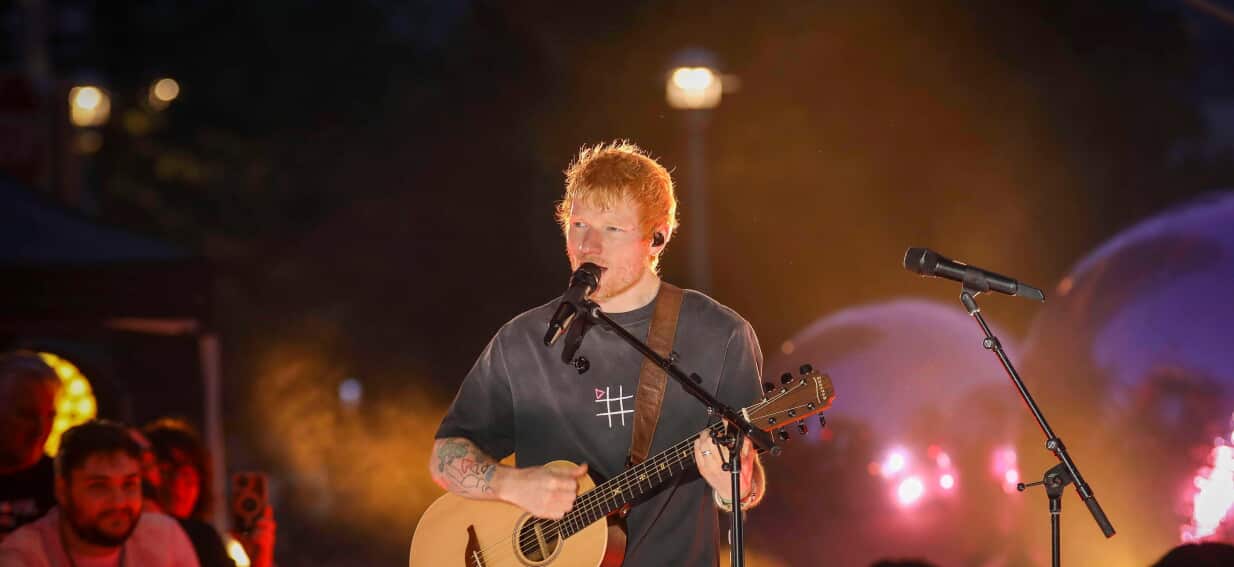
Concert stages are turning into high-stakes political battlegrounds. When US rapper Macklemore shouted "Free Palestine!" during his September set at New Jersey's MetLife Stadium while introducing his song "Hind's Hall," nobody expected the explosive chain reaction that would follow. Venue owners, corporate power players, and billionaire investors immediately stepped in. Within days, Macklemore was dropped from Ed Sheeran's tour. But the story didn't end there.
Instead of blowing over, the controversy triggered a massive walkout. Four more major acts quit Ed Sheeran's tour in solidarity, leaving the massive concert run scrambling for replacements and shining a harsh spotlight on the intersection of live music, corporate venue control, and political expression. Recently making waves lately: Why Chicago Is Finally Honoring Siskel And Ebert With Life-size Bronze.
The Domino Effect on the Road
Hours after Ed Sheeran posted on social media to clarify that Macklemore's removal was strictly a promoter and venue decision rather than his own call, the touring lineup started falling apart. Irish folk group Beoga—who also served as Sheeran's longtime backing band—announced they were walking away. Aaron Rowe, an Irish artist who had just been tapped to replace Macklemore on upcoming US dates, also pulled out. They were joined by Danish pop band Lukas Graham and Grammy-winning artist Finneas, Billie Eilish's brother and frequent collaborator, who was scheduled to open for Sheeran in South America later in the year.
The departing artists didn't mince words. They pointed directly to history, power dynamics, and the corporate chokehold over performance spaces. Additional details on this are detailed by Variety.
Beoga released a statement emphasizing their roots. "We are Irish people who understand colonialism," the band shared. "As founding members of the Irish Artists for Palestine movement, we are committed activists for justice."
Aaron Rowe echoed that sentiment while acknowledging his personal gratitude toward Sheeran, who had previously championed his career. Yet, principles won out over career milestones. Rowe stated that as Irish people, they know all too well about forced famine and violent occupation, refusing to stand by while wealthy stakeholders use their corporate leverage to silence artists.
Lukas Graham took a similar stance, noting that money shouldn't dictate who gets a voice in cultural spaces. Finneas added that artists must never be muzzled when speaking up for the oppressed.
Who Actually Made the Decision?
Ed Sheeran found himself caught in the middle of a massive public relations firestorm. He took to Instagram to distance himself from the axe swung at Macklemore, writing that the removal was solely up to the promoters and venue operators. He explained that he spent days trying to build a bridge with venues, but the final verdict remained unchanged.
The pressure came straight from the top. Macklemore revealed that major US venues threatened to bar him from performing entirely, galvanized by Robert Kraft, owner of the New England Patriots and the Kraft Group, which operates Gillette Stadium. Kraft issued a public statement defending the ban, citing Macklemore's recent comments alongside what he termed a broader pattern of rhetoric offensive to the Jewish community.
Macklemore defended his onstage speech, stating that his criticism of Israeli government policy and military actions in Gaza was not directed at Jewish people as a whole. Yet the corporate lines were already drawn. Venue owners held the ultimate trump card: control of the physical real estate. If the venues refuse to open their doors, the tour simply cannot happen.
The Impossible Position for Headliners
Ed Sheeran faces an unenviable dilemma familiar to massive arena headliners. He tried to thread the needle, stating that he respects Macklemore's conviction while explaining that his own shows are meant to bring diverse crowds together through music rather than serve as political forums. He also noted a practical obligation to his touring crew, musicians, and fans who bought tickets months in advance expecting a specific show experience.
When you employ hundreds of people whose livelihoods depend on stadiums staying open, walking away from a tour isn't a simple moral choice. It triggers massive financial fallout for roadies, sound engineers, lighting technicians, and local venue staff. Sheeran chose to keep the tour rolling, but the defection of his support acts proves that audiences and artists alike are watching closely.
What This Means for Live Music Going Forward
The fallout from the Ed Sheeran tour exposes a permanent shift in the live entertainment industry. Venues are no longer neutral landlords renting out floor space for a flat fee. They are active gatekeepers with strict political and corporate agendas.
When billionaires and venue conglomerates can unilaterally blacklist artists over geopolitical stances, the entire ecosystem changes. It forces every touring artist to weigh the cost of speaking their mind against the risk of sudden cancellation.
The music industry has always prided itself on rebellion, counterculture, and raw honesty. Right now, corporate risk management is fighting back hard. Whether fans will accept sanitized stages where political speech is scrubbed clean remains to be seen. But one thing is clear: artists are increasingly drawing their own lines in the sand, and concert lineups are becoming collateral damage in a much larger global fight.