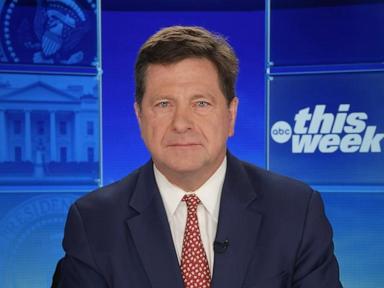
Director of National Intelligence Jay Clayton drew a sharp line on Sunday morning television: whatever diplomatic warmth President Donald Trump showed Vladimir Putin in China, Putin is not America's friend in Ukraine. Not even close.
If you've been watching the fallout from last week's APEC summit in Shenzhen, you probably saw the clips that set off a firestorm. Trump greeted the Russian leader by calling him his friend, then followed up on Truth Social with a handshake photo captioned "My friend" and compared the trilateral gathering with Chinese President Xi Jinping to historic superpower meetings. Critics saw a jarring contradiction between warm personal rhetoric and a brutal war still grinding through Ukraine. European allies bristled at the optics, and reporters spent the weekend pressing top administration officials to explain what "friend" actually means in cold geopolitical terms.
On ABC's This Week with Jonathan Karl, Clayton didn't pretend those tensions don't exist. He defended the president's framing inside the specific context of nuclear risk reduction among the world's three largest nuclear powers, then made clear where Ukraine sits. "He is not America's friend in Ukraine," Clayton said. "Not at all. Not at all."
Why DNI Clayton Drew That Line Right Now
Timing matters in intelligence and foreign policy, and the timing here couldn't be sharper. Clayton, a former Securities and Exchange Commission chair who took over as Director of National Intelligence in August 2026 after Senate confirmation, was defending a summit that took place on November 19 in Shenzhen on the sidelines of APEC.
For the first time, the sitting heads of state of the United States, China, and Russia held a trilateral meeting together without other leaders in the room. Analysts at groups like the Belfer Center and RFE/RL noted that while the three leaders issued a peace statement affirming that a nuclear war cannot be won and must never be fought, the declaration left out the wars in Ukraine and Iran and produced no binding arms-control breakthrough.
In Clayton's view, getting Washington, Beijing, and Moscow into the same room to talk about avoiding nuclear escalation was worth defending. That's a classic realpolitik argument: you don't have to like a leader's behavior on a battlefield to value a channel that keeps strategic arsenals from spiraling out of control.
Still, saying Putin is a "friend" in any sense sounds jarring when Russian missiles and drones are slamming into Ukrainian cities. According to reporting from the Kyiv Post and Reuters, hours after the Shenzhen summit got underway, Russian forces launched a massive 10-hour barrage of roughly 110 missiles and about 400 strike drones against Ukraine, killing at least nine civilians, injuring 28, and breaching neighboring Polish airspace. You can talk about nuclear guardrails in Shenzhen all you want, yet the reality on the ground tells a very different story.
The Tension Between Personal Diplomacy and Battlefield Reality
Here's what trips up a lot of casual observers when presidents use casual language with adversaries. In Washington, people often treat words like "friend" as a formal treaty commitment or a clean moral stamp of approval. Trump has repeatedly framed personal rapport with Putin and Xi as leverage and a stabilizer, arguing that having a direct line to leaders who command thousands of nuclear weapons makes the U.S. safer. When pressed on Friday about whether Putin is a friend to America as a whole, Trump sidestepped speaking for the entire country, saying he couldn't speak on behalf of America.
That distinction is messy. Honestly, it's one of the biggest friction points in U.S. foreign policy right now.
When a president posts a chummy photo with a caption calling Putin "my friend," allies in Europe don't hear nuance. They hear uncertainty. Polish Prime Minister Donald Tusk pushed back hard, declaring that Putin is not Europe's friend and never will be. German Chancellor Friedrich Merz dismissed the Shenzhen gathering as a photo op and warned against dividing Europe into spheres of influence. Meanwhile, Ukrainian President Volodymyr Zelenskyy reacted with visible frustration when asked about Trump's remarks, shrugging off the talk while Moscow continues to hold roughly a fifth of Ukrainian territory and shows no sign of dropping its demand that Kyiv cede the entire Donbas region for peace.
From an intelligence perspective, Clayton's job isn't to write poetic speeches. His job is to assess threats accurately. And on Ukraine, the intelligence picture hasn't turned Moscow into a cooperative partner for Washington. Russia is still fighting a war of aggression, launching huge aerial strikes, and resisting terms that satisfy Ukraine or its European backers.
What People Usually Get Wrong About This Split
Let's clear up a common misconception right away. When a DNI says Putin is not America's friend in Ukraine while defending a summit where the president called him a friend, people often assume the White House is fractured or contradicting itself on purpose.
Sometimes there is real friction behind closed doors. Other times, officials are simply separating two tracks that don't easily fit into a 10-second soundbite:
- Track one is superpower risk management. Talking directly with Moscow and Beijing about nuclear restraint, crisis communication, and avoiding escalation is a survival priority for any U.S. administration.
- Track two is regional conflict and sovereignty. Russia's war in Ukraine directly challenges European security, international borders, and U.S. alliances, even while Washington tries to broker talks to end the fighting.
That doesn't mean the messaging works cleanly. Far from it. If you tell the public a leader is your "friend" on Monday and your intelligence chief says he's "not America's friend in Ukraine" on Sunday, voters and allies alike are going to ask which version drives policy. And fair enough—they should.
Another mistake people make is thinking a summit without a major treaty means nothing happened at all. In diplomacy, a meeting can fail to solve a war and still matter as a signal. Shenzhen put the three biggest nuclear powers on camera together and reiterated a baseline pledge against nuclear war, even though it left out Ukraine and Iran and drew sharp pushback from European leaders. Knowing where the limits are is part of reading the moment clearly.
How to Read Intelligence Signals Without Getting Played
If you follow national security news closely, you've probably noticed how quickly headlines can distort a single exchange on a Sunday show. A clip gets shared without the three questions before it, and suddenly everyone is arguing over a phrase stripped of its context.
Here's what I look for when an intelligence official speaks on television—especially right after a high-stakes summit:
- Watch the narrow qualifiers. Notice how Clayton narrowed his answer specifically to Ukraine. That wasn't an accident. It allowed him to back the president's nuclear-de-escalation framing in Shenzhen while refusing to hand Moscow a free pass on its war in Ukraine.
- Separate rhetoric from leverage. Warm words from a president don't automatically mean a policy concession, and tough words from an intel chief don't automatically mean a policy shift. Look at actions—sanctions, weapons deliveries, diplomatic proposals, and troop or drone movements—not just adjectives.
- Cross-check with allies and frontline facts. Don't rely on a single cable clip or social media post. Check how European partners react, what Ukrainian officials say, and what independent tracking—such as assessments from the Institute for the Study of War—shows happening on the ground.
- Keep an eye on the broader threat board. Clayton isn't only looking at Eastern Europe. Around this same stretch in mid-November, he was also testifying before lawmakers on Capitol Hill about rising threats from Iran and rapid AI-driven cyber risks, reminding everyone that Washington is juggling multiple crises at once.
Whether the White House can turn high-level summits into a durable settlement in Ukraine remains an open question. What Clayton made unmistakable on Sunday is that friendship in a summit photo doesn't erase hostility on the Ukrainian front.
If you want to stay ahead of the story over the coming weeks, watch three concrete things: whether Moscow budges at all on its territorial demands in eastern Ukraine, how European leaders coordinate their response ahead of future diplomatic meetings, and whether the Shenzhen nuclear-communication pledge leads to any actual working-level talks or stays strictly on paper.