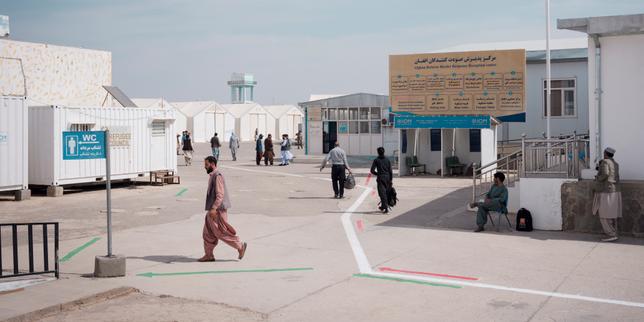
Going back to a country you barely know, with no savings, no roof, and an empty stomach, isn't a homecoming. It's a second displacement.
Across the western border of Afghanistan, hundreds of thousands of Afghans pushed out of Iran are discovering that crossing back into their homeland doesn't mean safety or stability. Some nights, families go to sleep hungry. Casual work is scarce, winter is closing in, and the aid system meant to catch people at the gate is stretched thin.
You see the headlines about border counts and regional tensions, yet the real story happens weeks after the crossing. When the transit meal is finished and the dust settles in provinces like Herat or Kabul, people are left staring at impossible math. Not enough money for rent, not enough food on the table, and very few ways to earn a steady living.
Why Afghan Deportations From Iran Keep Climbing
If you've watched the migration numbers over the past couple of years, the sheer volume is hard to wrap your head around. According to joint reporting from the UNHCR and IOM, more than 1.9 million Afghans returned or were deported from Iran in 2025 alone, with deportations making up roughly two-thirds of that flow. And the pressure didn't let up in 2026. By late October 2026, over 564,800 Afghans had already been deported from Iran this year, accounting for about 85% of all returns from that border.
Iran has hosted one of the largest Afghan refugee and migrant populations in the world for decades, with UN figures estimating around 4.4 million Afghans in the country, including 1.4 million undocumented people. When economic strain, tightening enforcement, and regional conflict collided in 2026—including the outbreak of hostilities involving the U.S. and Iran earlier in the year—the squeeze on Afghans in Iran got much worse. Protection space shrank, livelihoods grew harder to hold onto, and expulsions accelerated.
Here's what trips up a lot of outside observers. People tend to assume "return" means going home to an established family network and a familiar neighborhood. In reality, many of those sent across at crossings like Islam Qala in Herat and Zaranj in Nimroz have lived in Iran for years, or were born there. UNHCR data shows that children make up 27% of total returns from Iran since January 2025. For a kid who has only ever known schools, streets, and friends in Iran, being pushed across the border feels less like coming home and more like being dropped into foreign territory.
Going to Bed Hungry After Crossing the Border
Going to bed on an empty stomach isn't a dramatic metaphor for families trying to rebuild after expulsion. It's a daily reality for households that arrived with almost nothing and burned through whatever small cash they had on transport and immediate survival.
According to the World Food Programme (WFP), roughly 19.2 million people in Afghanistan—about 38% of the population—are projected to face crisis-level hunger or worse between November 2026 and April 2027, including around 5 million in emergency hunger. Recent IOM assessment data cited in humanitarian reporting also shows that 54% of surveyed returnees were unable to meet basic needs heading into winter, while an earlier UNDP finding noted that 92% of recent returnees couldn't cover basic needs right after coming back.
When you combine mass returns with a funding crunch, the gap gets ugly fast. The WFP has warned that funding shortages forced it to scale back monthly reach and halt specialized malnutrition prevention distributions in May 2025, leaving clinics and families with far less cushion. Meanwhile, UNICEF screening data from August 2026 found 22,617 returnee children screened for wasting across border points, transit centers, and return areas, with 781 admitted for treatment. One-third of the country's nutrition centers have also faced shutdowns due to funding shortfalls, according to UN reporting.
Honestly, that's the part that gets lost in policy debates. A border meal at Islam Qala—where UNHCR reported over 205,600 people received hot meals in 2026—helps on day one. It doesn't feed a family of six in February when casual labor dries up and flour prices bite.
The Hidden Traps Waiting Inside Afghanistan
Getting past the border gate is only the first hurdle. Once returnees head toward Herat, Kabul, Farah, Kunduz, or smaller rural districts, they run into a wall of practical obstacles that turn short-term hardship into a long-term trap.
First, there's shelter and debt. IOM's Returnee Resilience monitoring (Round 3, September 2026) showed shelter needs among assessed returnees climbing from 42% in Round 1 to 67% in Round 3. Many families arrive without housing or cash for rent, lean on relatives who are already stretched thin, or take on debt just to get through the month. Debt isn't just a spreadsheet problem here—humanitarian monitoring shows it pushes families toward risky coping choices and makes people think about crossing borders all over again.
Second, jobs and water are tight. Unemployment and scarce casual work hit returnees hard, especially in districts already dealing with drought and competition over water for drinking and farming, such as Qala-e-Kah in Farah or Aqcha in Jawzjan. IOM's Round 3 findings also pointed out a striking pattern: individual returnees were four times more likely than returnee families to plan leaving Afghanistan again when work and income weren't there.
Third, missing paperwork and restricted rights complicate everything. Nearly half of returnee households in response assessments have reported documentation gaps that make accessing services and aid harder. On top of that, Taliban restrictions—especially limits on women and girls in education, work, and public life—shrink household income options and add severe protection pressures for women-headed households and single returnees.
Let's be real: humanitarian aid alone can't fix an economy where millions of people are competing for a shrinking pool of work. Agencies like UNHCR and IOM do vital frontline work—offering cash assistance, transit support, registration, and emergency relief—yet their appeals frequently face steep underfunding. Even when aid reaches people, it's a bridge, not a permanent paycheck.
What You Can Do If You Want to Help
If you're reading this from abroad and wondering how to do something useful rather than just scrolling past another grim statistic, a few concrete steps actually matter.
- Support frontline agencies funding the returnee response. Look directly at organizations operating on the ground and tracking returnee needs, such as the UNHCR Afghanistan Emergency Response, the International Organization for Migration (IOM), and the World Food Programme (WFP). Winter food, cash assistance, and shelter support are immediate priorities, not abstract long-term projects.
- Prioritize flexible or cash-based relief where possible. Returnees often need different things in their first few weeks—food one week, rent or medicine the next—and unrestricted or multi-purpose cash helps households decide what's most urgent.
- Follow border and reintegration reporting, not just one-off headlines. Pay attention to post-arrival tracking from IOM and UNHCR rather than treating border crossings as the end of the story. Reintegration takes months or years, and sustained attention keeps pressure on donors and policymakers.
- Check charity transparency before giving. Verify administrative overhead, field presence in western and northern provinces, and clear reporting on how funds reach displaced and returning families.