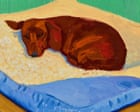
When a beloved pet becomes a multi-million-pound masterpiece, the art world stops to watch. Christie's is putting Dog Painting 17 on the block during London's Frieze Week. It features David Hockney's favorite dachshund, Stanley, curled up on a cushion. The estimate sits firmly between £1.5 million and £2.5 million. It sounds wild until you look at the backstory. This isn't just a portrait of a sleeping dog. It marks the very first time one of Hockney's famous canine canvases hits the open auction market.
Collectors are scrambling. Why? Because the vast majority of these intimate 1994-1995 series pieces remain locked away in the David Hockney Foundation or tightly held private collections. Only six works from this celebrated series are currently in private hands. When rarity meets raw emotional resonance, prices soar.
The Untold Story Behind Hockney's Canine Obsession
You can't understand these paintings without knowing why Hockney picked up his brush to paint Stanley and Boodgie in the first place. The artist was grieving. He had lost several close friends to the AIDS crisis and suffered the devastating loss of his lifelong confidant Henry Geldzahler to pancreatic cancer. He needed comfort. He wanted to create something purely loving.
Stanley, named after the comedian Stan Laurel, entered Hockney's life in 1987 as a small puppy. Boodgie arrived later. They became constant companions in his Hollywood Hills home on Montcalm Avenue. Friends were initially shocked that the peripatetic artist wanted pets. They quickly realized he was completely besotted.
The dachshunds ran absolute riot. They ignored house training entirely. Biographer Christopher Simon Sykes documented how visitors often found out the hard way. One friend, Jonathon Brown, famously recalled stepping into shoes left on the floor only to find a messy surprise inside.
Then there is the legendary Dennis Hopper incident. Hockney and his unruly dogs attended a dinner party at Hopper's striking Frank Gehry-designed home in Venice, Los Angeles. Boodgie decided to leave a fresh "gift" right in the middle of the pristine floorboards. Hockney lightly wagged his finger, scolded the dog with a soft "no, NO!", and then looked at a visibly furious Hopper.
Hockney delivered a classic punchline. He told the actor it would dry by morning and someone could just pick it up. Hopper reportedly stared with the intensity of a chain-gang murderer. He chose silence, barely holding his temper. That was the magic of Hockney's world. His dogs weren't disciplined pets. They were muses, companions, and chaotic family members rolled into one.
Breaking Down Dog Painting 17
Art market analysts often miss the technical brilliance of these canvases because they get distracted by the cute subject matter. Tessa Lord, Christie's head of postwar and contemporary art, points out the incredible spontaneity in the brushstrokes.
Look closely at the canvas. You'll spot a rich, textured mottling underneath the cushion where Stanley rests. Notice the slight flick of the ear that brings the sleeping animal to life. It feels effortless, yet it reflects decades of mastery from one of the twentieth and twenty-first century's greatest visual chroniclers.
When Hockney first showed these dog paintings at the LA Louver gallery, the reception was staggering. He proudly claimed the exhibition drew 7,000 visitors in just four days. Many attendees brought their own dogs along to share the experience. It wasn't just an art show. It was a community celebration of unconditional affection.
What This Auction Means for Art Collectors Today
If you're watching the secondary art market right now, you know blue-chip pieces by legendary names face strange market fluctuations. But works with genuine emotional storytelling defy downward trends. Buyers want intimacy. They want a connection to the artist's personal life rather than cold abstraction.
Dog Painting 17 offers exactly that narrative depth. It captures a moment of domestic peace during a tumultuous, heartbreaking era in Los Angeles. It bridges high modernism with universal tenderness.
The piece goes on free public display at Christie's in London starting October 8, ahead of its official sale on October 14. If you happen to be in town, go look at it. Skip the digital catalog images. Stand in front of the canvas and check out the physical texture of that cushion. You'll quickly see why people are willing to pay millions for a sleeping dachshund.